 Freeport vs. Baldwin, NY: What Homebuyers Should Compare Before Choosing
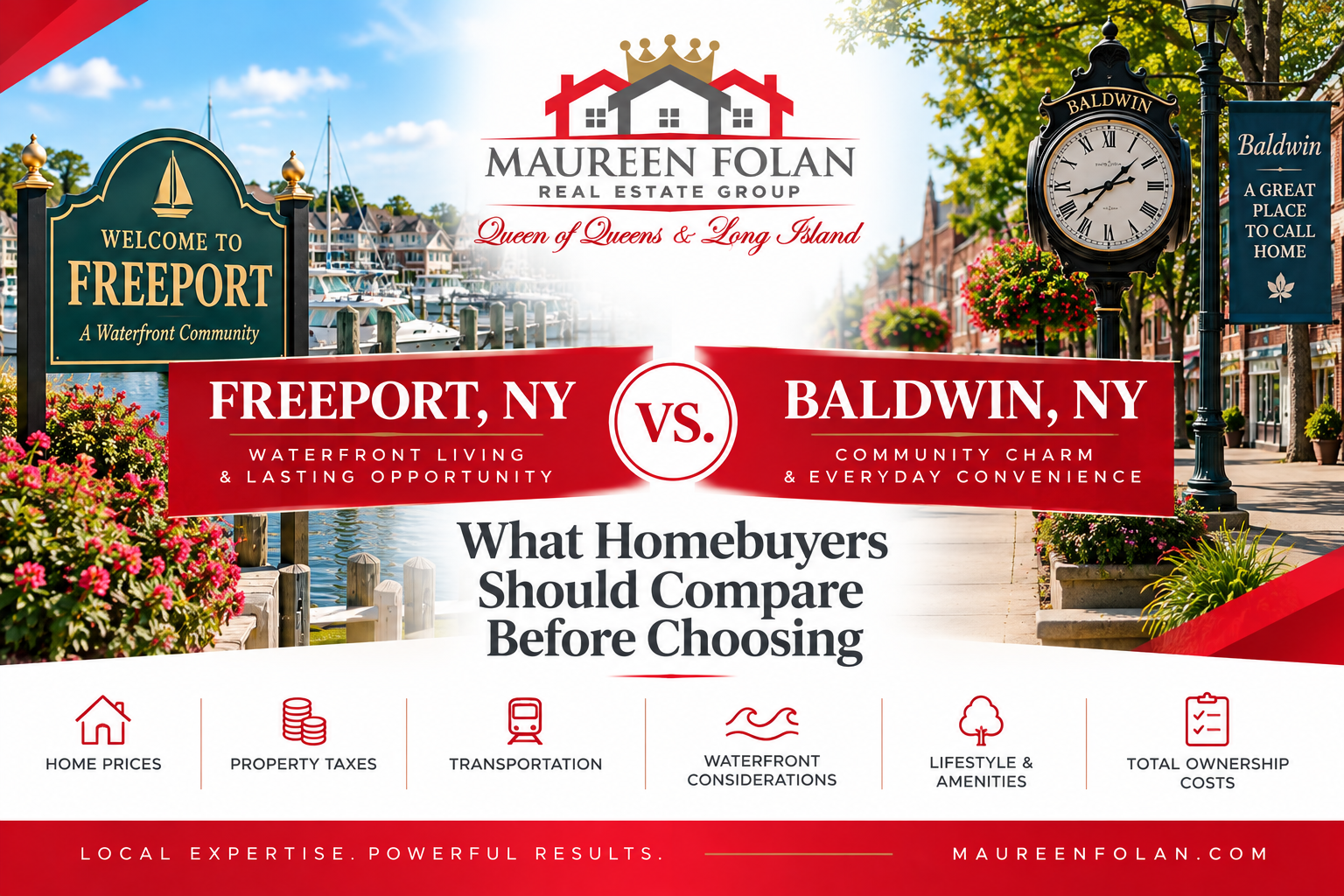
Freeport vs. Baldwin, NY: what should you compare before deciding where to buy your next home?
Freeport and Baldwin are neighboring Nassau County communities with Long Island Rail Road service, but the individual homes available in each can offer very different ownership experiences. Before choosing, compare property prices, taxes, condition, layout, transportation, flood-zone considerations, insurance, outdoor space, and total ownership costs rather than assuming one community is automatically the better choice.
Freeport vs. Baldwin, NY: Start With Your Homebuying Priorities
If you're comparing Freeport vs. Baldwin, NY, you may be wondering which community makes more sense for your next move.
Both locations can appear in the same Long Island home search.
You might find properties with similar asking prices, bedroom counts, or interior space.
But those similarities don't necessarily mean the homes offer the same value.
Before comparing communities, ask yourself:
What is my comfortable purchase budget?
How much interior space do I need?
Which layouts work for my everyday routine?
How much outdoor property do I want?
How important is transportation?
Am I willing to renovate?
What total ownership costs can I comfortably manage?
Your answers should guide the comparison.
Understanding the Difference Between Freeport and Baldwin
Freeport and Baldwin are neighboring communities in Nassau County within the Town of Hempstead.
One important distinction is their municipal structure.
Freeport is an incorporated village, with its own village government and certain municipal services.
Baldwin is an unincorporated community within the Town of Hempstead.
That distinction can affect which local authorities administer particular services, regulations, and property-related requirements.
For official information, consult the Village of Freeport and the Town of Hempstead.
When comparing homes, verify the jurisdiction and circumstances of each individual property.
Compare What Your Budget Actually Buys
Imagine you're considering two homes.
A renovated Freeport property with a functional layout.
And a Baldwin home with more interior space but some updating needs.
Both are within your budget.
Which represents stronger value?
You need to look beyond the listing price.
Compare:
- Condition
- Layout
- Usable interior space
- Lot characteristics
- Property-specific taxes
- Insurance
- Transportation
- Renovation requirements
- Maintenance responsibilities
The community name alone can't determine which property is the better purchase.
Property Taxes Can Change the Ownership Calculation
Property taxes are an important part of buying a home in Nassau County.
Don't assume that two properties with similar asking prices have similar taxes.
Official assessment resources are available through the Nassau County Department of Assessment.
For Freeport properties, investigate applicable village-related tax components and services.
For Baldwin properties, verify the applicable taxing jurisdictions and property-specific obligations.
Current tax amounts may reflect exemptions or circumstances associated with the existing owner.
Your attorney and other appropriate professionals can help clarify transaction-specific information.
Compare actual property records rather than relying on generalized tax estimates for either community.
Compare Total Ownership Costs
The asking price is only one part of the financial picture.
For each serious property, calculate:
Purchase price + financing costs + property-specific taxes + insurance + utilities + landscaping + maintenance + expected repairs and improvements.
A lower-priced home may require significant renovations.
A larger property may involve more maintenance.
Insurance expenses may differ.
One home may have older components requiring attention sooner.
Your goal isn't simply to purchase the less expensive house.
It's to choose the property whose complete ownership costs make sense for your budget.
Waterfront Considerations May Influence Your Freeport Search
Freeport includes residential properties near canals and other waterways.
Some homes may offer waterfront views, docks, bulkheads, or other marine-related features.
Those characteristics may appeal to buyers seeking a particular ownership experience.
However, they can also introduce additional responsibilities.
Depending on the property, investigate:
Waterfront structures.
Maintenance obligations.
Permits and approvals.
Flood-zone designations.
Insurance expenses.
Property boundaries and access rights.
Not every Freeport property is waterfront or water-adjacent.
Evaluate these considerations at the individual address.
Baldwin Properties Also Require Location-Specific Research
Don't assume that waterfront or flood-related considerations apply only to Freeport.
Some properties in Baldwin, particularly in southern portions of the community, may also warrant additional flood-zone or coastal research.
Before purchasing either property, review the actual address through the FEMA Flood Map Service Center.
Where relevant, investigate available flood history, insurance requirements, elevation information, and other property-specific factors.
Your attorney and appropriate insurance professionals can help clarify questions before closing.
Both Communities Have LIRR Service
Freeport and Baldwin each have Long Island Rail Road stations.
For buyers traveling toward Queens or Manhattan, rail transportation may be an important consideration.
Current schedules and station information are available through the Long Island Rail Road.
But don't assume that having a station in each community creates identical transportation experiences.
Your actual commute begins at the individual property.
Compare Transportation Door to Door
For the Freeport home, ask:
How would I reach the station?
How long would that take?
Which train would I realistically use?
Now repeat the exercise for the Baldwin property.
Then compare your destination, transfers if applicable, return trip, and how frequently you'll make the journey.
If you'll primarily drive, evaluate that route too.
The right transportation choice depends on your actual routine.
Evaluate Home Condition Before Cosmetic Finishes
Two properties can look very different in listing photographs.
One may have a newly renovated kitchen.
Another may feature older finishes but have been carefully maintained.
Separate:
Appearance: How the home looks.
Age: How old its features and components are.
Condition: How those components function and have been maintained.
Appropriate professional inspections and due diligence can help you better understand the physical condition of a property.
Don't allow attractive finishes to distract you from more important ownership considerations.
Decide How Much Renovation You're Willing to Undertake
Before making an offer, determine whether you're primarily a:
Move-in-ready buyer: You prefer relatively little immediate work.
Cosmetic-update buyer: You're comfortable changing finishes gradually.
Renovation buyer: You're willing to undertake substantial improvements to obtain the underlying property you want.
All three approaches can work.
But if the home only meets your needs after significant construction, investigate realistic costs and timelines before committing.
Layout Can Matter More Than Square Footage
Suppose the Baldwin home offers more reported square footage than the Freeport property.
Does that automatically make it more useful?
Not necessarily.
Walk through both homes as though you've already moved in.
Where do you enter?
How does the kitchen connect with the living areas?
Where would you work?
How much storage exists?
Which rooms would you actually use?
How do you access the outdoor areas?
A functional layout may provide more practical value than additional space you won't regularly use.
Compare the Lots Carefully
Outdoor property is another important consideration.
Don't compare lots based only on size.
Evaluate:
Usability.
Topography.
Landscaping.
Trees.
Driveway.
Outdoor entertaining areas.
Privacy features.
Maintenance.
Relationship between the house and yard.
A larger lot isn't automatically more useful.
Choose outdoor space that supports how you actually want to use the property.
Understand Maintenance Responsibilities
Depending on the home, outdoor ownership may involve lawn care, landscaping, tree maintenance, driveways, walkways, patios, decks, fences, and seasonal cleanup.
Waterfront properties may introduce additional responsibilities.
These expenses may be worthwhile.
But they should be included in your ownership expectations and budget.
Explore Freeport's Nautical Mile
One of Freeport's recognizable destinations is the Nautical Mile along Woodcleft Avenue.
The area includes waterfront businesses, restaurants, and marine-related activities.
If these destinations interest you, consider how frequently you'd realistically use them.
How would you get there from the property?
Would the location make those activities more convenient?
An amenity has practical value when it fits your routine.
Explore Baldwin Based on Your Actual Needs
When considering Baldwin, evaluate the destinations and services that matter to you.
These might include transportation, shopping, restaurants, public parks, and other everyday amenities.
Rather than relying on generalized community descriptions, spend time exploring routes from the actual properties you're considering.
Your goal is to understand how each address supports your daily activities.
Spend Time in Both Communities Before Choosing
Not every visit should involve a real estate showing.
Spend ordinary time in Freeport.
Do the same in Baldwin.
Run errands.
Test transportation.
Explore public destinations relevant to your interests.
Drive routes you expect to use regularly.
Return at another time.
You're not trying to decide which community is universally better.
You're determining which individual property and location work best for you.
If You're Moving From Queens, Start With Your Current Home
If you already own in Queens, your current property may provide much of the financial foundation for your Long Island purchase.
Before establishing your budget, understand what your Queens home may realistically sell for.
Estimate likely net proceeds after accounting for your remaining mortgage and transaction-related expenses.
Then determine how much equity you want to use.
You may prefer to preserve funds for moving, repairs, renovations, insurance, future maintenance, and cash reserves.
The objective isn't simply to maximize your next purchase price.
It's to remain financially comfortable after closing.
Coordinate Your Queens Sale With Your Next Purchase
If your Queens sale proceeds are needed for your Freeport or Baldwin purchase, establish your preferred transaction sequence early.
Ask:
Do I need to sell before buying?
Could I purchase first?
Can I comfortably own both properties temporarily?
How much equity will I use?
How much liquidity do I want afterward?
What happens if my Queens property sells before I find the right home?
Planning these scenarios before negotiations can provide more flexibility.
Related article: Moving From Queens to Freeport, NY: What Homeowners Should Know Before Relocating.
Build a Freeport vs. Baldwin Comparison Sheet
Once you've identified serious properties, compare them directly.
| Factor | Freeport Home | Baldwin Home |
|---|---|---|
| Purchase price | Compare | Compare |
| Property-specific taxes | Verify | Verify |
| Municipal jurisdiction | Verify | Verify |
| Condition | Compare | Compare |
| Documented improvements | Review | Review |
| Layout | Compare | Compare |
| Usable space | Compare | Compare |
| Lot | Compare | Compare |
| Storage | Compare | Compare |
| Flood-zone information | Verify | Verify |
| Insurance costs | Compare | Compare |
| Transportation | Compare | Compare |
| Renovation needs | Compare | Compare |
| Maintenance | Compare | Compare |
| Total ownership costs | Compare | Compare |
Not every category should carry equal weight.
Identify which factors matter most to your decision.
Know Your Non-Negotiables Before Competition Begins
Before submitting an offer, establish your boundaries.
Comfortable purchase ceiling.
Total ownership-cost limit.
Transportation requirements.
Renovation tolerance.
Lot preferences.
Condition requirements.
Insurance expectations.
Desired financial reserves.
Then identify which preferences are flexible.
Maybe cosmetic finishes can change.
Maybe your transportation routine cannot.
Knowing the difference can help you make decisions without abandoning your strategy.
Don't Choose Based on Community Stereotypes
A Freeport vs. Baldwin, NY decision should focus on objective property and location characteristics relevant to your needs.
Avoid generalized assumptions about who lives in either community or who should move there.
Instead, evaluate property features, condition, price, taxes, transportation, maintenance, amenities you personally use, and long-term ownership costs.
The strongest decision is based on your priorities and verified property information.
Seven Questions That Can Clarify Freeport vs. Baldwin
Before choosing, ask:
- Which property better accomplishes the reasons I'm moving?
- Which complete ownership cost is more comfortable?
- Which transportation routine works better for my schedule?
- Which layout and usable space better support my daily activities?
- Which lot provides the outdoor space I actually want?
- What insurance, renovation, and maintenance responsibilities apply?
- If both properties disappeared tomorrow, which features would I search for again?
That final question can help reveal what you genuinely value.
Final Takeaway: Freeport vs. Baldwin, NY
If you're comparing Freeport vs. Baldwin, NY, don't try to declare a universal winner.
Compare actual properties.
Evaluate purchase prices, property-specific taxes, municipal jurisdiction, condition, documented improvements, layout, usable space, lots, flood-zone considerations where applicable, insurance, transportation, renovation needs, maintenance, and total ownership costs.
Both communities have Long Island Rail Road service, but your transportation decision should begin at the individual property.
Spend time in both locations.
Test your commute.
If you're moving from Queens, compare each option with your current home and determine which purchase better accomplishes your goals.
As Maureen Folan, Queens & Long Island Real Estate Expert, I help buyers evaluate these decisions property by property rather than relying on broad assumptions.
Because the strongest answer to Freeport vs. Baldwin isn't one community name.
It's the home, costs, transportation, responsibilities, and ownership experience that make the most sense for your next move. 
Schedule a Buyer Consultation
Comparing Freeport and Baldwin—or exploring Merrick and other nearby Long Island communities?
Schedule a Buyer Consultation with Maureen Folan Real Estate Group.
We'll compare properties based on your budget, condition preferences, documented improvements, lot requirements, transportation, renovation tolerance, insurance considerations, maintenance expectations, and total ownership costs.
If you're moving from Queens, we can also coordinate your current-home sale with your Long Island purchase through one Queens-to-Long-Island strategy.
You can also request the Property Tax Guide to help organize important ownership-cost questions before making your decision.
Maureen Folan
Queens & Long Island Real Estate Expert
Maureen Folan Real Estate Group
MaureenFolan.com