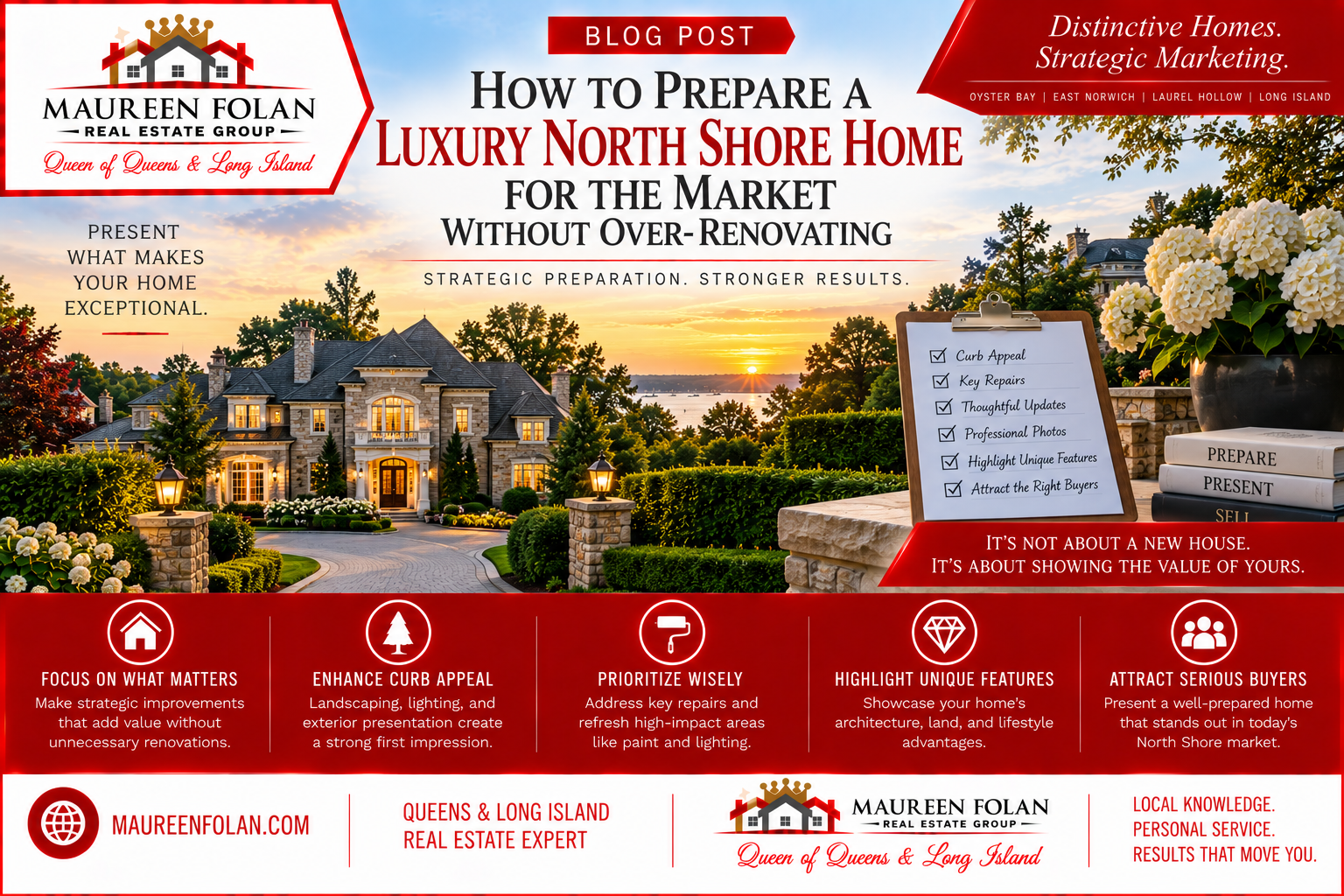
 How to Prepare a Luxury North Shore Home for the Market Without Over-Renovating
How should you prepare a luxury North Shore home for sale without spending unnecessarily on renovations?
Start with the home's current market position before choosing projects. For many luxury sellers, the strongest strategy is to repair visible issues, improve presentation, refine landscaping, emphasize distinctive architecture and property features, and renovate only when the expected competitive benefit justifies the cost, time, and disruption.
Preparing a Luxury Home for Sale on Long Island Doesn't Mean Making Everything New
If you're preparing a luxury home for sale on Long Island, it can be tempting to assume buyers expect perfection.
You look at the kitchen and think it should be replaced.
Then the bathrooms.
Maybe the floors.
Light fixtures.
Paint.
Landscaping.
Before long, you're contemplating a major renovation for a house you're planning to leave.
Some improvements may absolutely make sense.
Others may not.
The objective isn't to make your property brand-new.
It's to determine what will help the home compete most effectively with the alternatives available to your likely buyer.
Establish the Home's Current Value Before Spending Money
This should happen first.
Before calling contractors, understand where your property may fit in its current condition.
Review relevant recent sales.
Look at active competition.
Consider the home's architecture, land, privacy, renovations, amenities, condition, and location.
Then ask three questions:
What might the property command in its current condition?
What could strategic preparation potentially change?
What might a substantial renovation change?
You can't guarantee a future sale price.
But you can make much better spending decisions when you have a baseline.
Luxury Sellers Need to Understand Their True Competition
Your comparable market may extend beyond the nearest homes.
A buyer considering an Oyster Bay Cove estate might also examine Laurel Hollow or Cold Spring Harbor.
A Huntington Bay buyer might consider another waterfront North Shore community.
At higher price points, buyers may have greater geographic flexibility.
So before renovating, ask:
What other homes can my likely buyer purchase for similar money?
Then compare yours.
If competing properties are extensively renovated, condition may deserve more attention.
If your home offers superior land, architecture, privacy, or another scarce feature, you may have more flexibility.
Divide Your Projects Into Three Categories
One of the easiest ways to control pre-listing spending is to classify potential work.
Repair
These are things that are damaged, malfunctioning, or visibly need attention.
A broken fixture.
Damaged trim.
Exterior deterioration.
A door that doesn't operate properly.
Visible unfinished work.
Repairs can matter because buyers may interpret multiple small problems as evidence of broader deferred maintenance.
Refresh
These are improvements designed primarily to strengthen presentation.
Examples might include:
- Selective painting
- Deep cleaning
- Lighting improvements
- Decluttering
- Furniture editing
- Professional window cleaning
- Landscaping cleanup
- Refinishing certain surfaces where appropriate
- Updating selected hardware or fixtures
Refreshes can sometimes create a substantial visual improvement without changing the home's fundamental architecture.
Renovate
These are major projects involving significant cost, construction, design decisions, and time.
Kitchen replacements.
Major bathroom remodels.
Substantial layout changes.
Large-scale construction.
The farther you move toward renovation, the stronger the financial justification should become.
Fix Deferred Maintenance Before Chasing Design Trends
A luxury buyer may forgive a kitchen that isn't the latest style.
Visible neglect can be harder to reconcile with premium positioning.
Before spending heavily on aesthetics, address the basics.
Does everything function?
Are exterior areas maintained?
Are there obvious leaks or damaged finishes?
Are lighting fixtures working?
Are railings, doors, hardware, and other frequently touched elements in reasonable condition?
Does the property feel cared for?
A maintained home and a newly decorated home aren't necessarily the same thing.
Maintenance usually deserves priority.
Don't Renovate Away Architectural Character
This is particularly important for distinctive North Shore properties.
An older home may have architectural elements that would be difficult or expensive to reproduce today.
Millwork.
Fireplaces.
Doors.
Windows.
Stonework.
Room proportions.
Staircases.
Other period details.
Before replacing something simply because it isn't new, ask whether it's actually outdated—or whether it's part of what makes the property distinctive.
Luxury buyers don't all want the same aesthetic.
A home with genuine character can be more compelling than one remodeled into something generic.
Kitchens Need Strategy, Not Panic
The kitchen is often where sellers consider spending the most money.
Before undertaking a full remodel, evaluate what buyers are actually seeing.
Is the kitchen functional?
Are cabinets in reasonable condition?
Does the layout work?
Is the lighting adequate?
Are surfaces clean and maintained?
Would smaller cosmetic improvements materially strengthen presentation?
Then look at your competition.
If similarly priced properties consistently offer extensively renovated kitchens, your current condition may affect buyer perception.
But that doesn't automatically mean a complete remodel produces the best return.
Pricing may be another solution.
Remember: Renovation Cost Isn't Added Value
Suppose you spend $150,000 renovating a kitchen.
The home doesn't automatically become worth $150,000 more.
Buyers determine market value through what they're willing to pay relative to their alternatives.
They don't reimburse you based on receipts.
The project could create significant value.
It could create less than it costs.
Or it could make the home more marketable without producing an equivalent dollar-for-dollar increase.
That's why renovation decisions should begin with competitive analysis, not contractor estimates.
Bathrooms Often Benefit From a More Targeted Approach
Bathrooms can create a strong impression without always requiring complete reconstruction.
Look at:
Grout.
Caulk.
Lighting.
Fixtures.
Paint.
Mirrors.
Hardware.
Cleanliness.
Visible maintenance.
A dated but immaculate bathroom can feel very different from a neglected one.
Before demolition, determine whether the real issue is the bathroom's age or its presentation.
Paint Can Have Outsized Visual Impact
Paint is often one of the more manageable ways to improve consistency.
But don't automatically repaint every room.
Focus on areas where:
The finish is visibly worn.
Strongly personalized choices distract from the property.
Rooms feel inconsistent.
Existing colors interfere with photography or natural light.
The objective isn't to make every luxury home beige.
It's to create a cohesive presentation where buyers notice the architecture and space before the wall color.
Lighting Deserves More Attention Than It Gets
Lighting can influence how expensive a home feels without requiring structural renovation.
Start with the obvious.
Make sure bulbs work.
Use consistent light temperatures where appropriate.
Clean fixtures.
Consider whether selected outdated fixtures distract from otherwise strong rooms.
Then look at natural light.
Are window treatments unnecessarily blocking it?
Does furniture interfere with windows?
Are the windows clean?
You want buyers to experience the property's existing light as effectively as possible.
Decluttering Luxury Homes Requires Restraint
A larger property can contain a lot of furniture and personal belongings without feeling obviously cluttered to the owner.
Photography can reveal otherwise.
Your objective isn't to empty the home.
It's to clarify:
Room proportions.
Architectural features.
Sightlines.
Traffic flow.
Views.
Storage.
Remove enough that buyers can understand the house.
Leave enough that rooms still feel intentional.
Storage Areas Need Preparation Too
Buyers may look inside closets, garages, pantries, basements, and other storage areas.
If everything is packed completely full, the home may appear to lack storage even when it doesn't.
Start moving early.
Remove items you don't need during the listing period.
Organize what's left.
This improves presentation and reduces the amount of work you'll face later.
Landscaping Can Be More Important Than Another Interior Upgrade
For many North Shore luxury homes, the land is a significant part of the property's value.
Acreage.
Mature landscaping.
Privacy.
Gardens.
Outdoor entertaining.
Pools.
Views.
These characteristics may be difficult to reproduce.
Before spending heavily inside, look outside.
Does the landscaping support the architecture?
Are important views blocked?
Are pathways clear?
Do hedges and plantings enhance privacy?
Does the property feel maintained?
A thoughtful exterior refresh can sometimes strengthen the complete property more than another interior design change.
Mature Landscaping Should Be Treated Carefully
Don't aggressively remove mature vegetation simply because you want the property to feel more open.
Those plantings may be providing privacy or contributing significantly to the setting.
Instead, evaluate strategically.
What should be trimmed?
What should remain?
Which landscaping frames the house?
Which hides it?
Which contributes to privacy?
Which requires attention?
Mature landscaping can take decades to reproduce.
Treat it like an asset when appropriate.
Pools and Outdoor Amenities Should Look Ready to Use
If your property has a pool, terrace, outdoor kitchen, garden, or other significant amenity, make sure it supports the marketing.
Clean it.
Address visible maintenance.
Simplify furniture.
Make the intended use easy to understand.
The buyer should see an amenity—not another project.
That doesn't mean everything must be new.
It means presentation should be consistent with the property's positioning.
Prepare the Arrival Experience
For an estate property, the showing begins before buyers reach the house.
Look at:
The entrance.
Gates where applicable.
Driveway.
Landscaping.
Exterior lighting.
Front elevation.
Parking.
Walkway.
Front door.
These elements create the first physical impression.
If the arrival is one of your property's strengths, make sure photography and video capture it.
Professional Photography Should Drive Some Preparation Decisions
Before completing your preparation plan, think about how the property will photograph.
A room can feel perfectly comfortable in person but appear crowded in a photograph.
A beautiful view can disappear behind window treatments.
An outdoor area can look confusing without appropriate furniture placement.
A strong photographer can help communicate the property.
But photography can't fix every presentation problem.
Prepare the house for both the camera and the buyer who arrives afterward.
Video Can Help Larger Properties Make Sense
Luxury homes with substantial square footage, acreage, or multiple outdoor spaces can be difficult to understand from photographs alone.
Video may help communicate:
Flow.
Scale.
Arrival.
Architecture.
Indoor-outdoor relationships.
Grounds.
Views.
Amenities.
The purpose isn't cinematic spectacle.
It's helping a serious buyer understand the property before or after an in-person visit.
Aerial Imagery Can Explain Land and Setting
Where appropriate and legally permitted, aerial imagery can be especially useful for properties with:
Acreage.
Privacy.
Waterfront.
Large outdoor environments.
Pools.
Distinctive lot configurations.
It can help buyers understand how the pieces fit together.
But aerial imagery should never imply unverified property boundaries or access.
Accuracy remains essential.
Organize Property Documentation Before Listing
A well-prepared luxury property is more than visually ready.
Its information should be organized too.
Depending on the home, useful records may involve:
Major renovations.
Roof work.
Mechanical systems.
Generators.
Pools.
Irrigation.
Surveys.
Permits and certificates where applicable.
Warranties.
Waterfront improvements where relevant.
Other substantial property features.
Your attorney and other appropriate professionals should advise you on legal or transaction-specific documentation.
The practical goal is to avoid scrambling after a serious buyer starts asking questions.
Don't Make Improvements You Can't Finish Properly
A half-completed renovation can be worse than leaving a functional older space alone.
If you're considering a project, be realistic about the timeline.
Can materials arrive?
Can the work be completed professionally?
Will inspections or permits be needed?
Could the project delay your preferred listing date?
What happens if the scope expands?
Selling shortly after construction creates a different risk calculation than renovating a home you plan to enjoy for years.
Time Has a Cost Too
Imagine a renovation takes four months.
Even if the project improves the home, you need to consider what that delay means.
Does it interfere with your next purchase?
Relocation?
Preferred selling season?
Carrying costs?
Personal schedule?
Could the competitive market change?
Project cost isn't simply the contractor invoice.
Time is part of the investment.
Don't Design for One Hypothetical Buyer
Another danger is renovating according to what you imagine a luxury buyer wants.
There is no single luxury buyer.
One may prefer contemporary design.
Another wants traditional architecture.
One values a dramatic kitchen.
Another cares more about land and privacy.
If you're renovating specifically for resale, highly personalized choices can create risk.
Broad marketability and architectural consistency are generally more useful objectives than chasing one design trend.
Pricing Can Solve Problems Renovation Can't
Sometimes the best strategy is to sell the home in its existing condition at a price that acknowledges the work.
That can be especially relevant when the property has difficult-to-reproduce strengths such as:
Land.
Architecture.
Privacy.
Waterfront.
Views.
Location.
Mature landscaping.
A buyer may happily accept cosmetic projects to obtain those characteristics.
Don't assume every condition objection must be solved physically.
Some are solved through positioning.
Know Which Buyer You're Trying to Attract
Your preparation strategy should reflect the likely buyer pool.
Is the property most compelling to someone seeking turnkey condition?
A buyer wanting an estate they can personalize?
Someone prioritizing acreage?
A waterfront buyer?
A buyer relocating from Queens?
The answer can influence how much preparation makes sense.
You don't need to appeal equally to everyone.
You need to communicate the home's value clearly to the buyers most likely to appreciate it.
What Should You Spend Money On First?
A practical priority order is:
- Necessary repairs and visible maintenance
- Deep cleaning
- Decluttering and furniture editing
- Lighting and window presentation
- Landscaping and exterior cleanup
- Strategic paint and cosmetic refreshes
- Preparation of pools and outdoor amenities
- Professional photography and visual marketing
- Major renovation only when justified by market analysis
This order helps keep your budget focused on presentation before construction.
Final Takeaway: Preparing a Luxury Home for Sale on Long Island
When preparing a luxury home for sale on Long Island, more renovation isn't automatically better preparation.
Start with market position.
Understand what the home might command in its current condition.
Identify what buyers would compare it with.
Then prioritize maintenance, presentation, landscaping, architectural character, outdoor amenities, photography, and clear property positioning.
Only undertake major renovations when the likely competitive benefit justifies the financial cost, delay, and execution risk.
For North Shore properties in Oyster Bay Cove, Laurel Hollow, Cold Spring Harbor, Huntington Bay, Centerport, and surrounding markets, the most valuable characteristics may be the ones you can't easily renovate into existence:
Land. Privacy. Architecture. Views. Waterfront. Setting. Mature landscaping.
As Maureen Folan, Queens & Long Island Real Estate Expert, I help homeowners determine which preparation decisions may strengthen a sale—and which expensive projects may deserve a second look before you commit.
Because the goal isn't to make your home completely new.
It's to make the value of what you already own unmistakably clear. 
Get a Personalized Home Value Estimate
Thinking about selling a luxury North Shore home but unsure how much work to do first?
Get a Personalized Home Value Estimate from Maureen Folan Real Estate Group before beginning major renovations.
We'll evaluate your property's current condition, architecture, land, improvements, amenities, relevant recent sales, and competition to help you build a more strategic preparation plan.
You can also request the Home Seller Preparation Checklist to organize repairs, refreshes, landscaping, presentation, and larger projects before spending begins.
Maureen Folan
Queens & Long Island Real Estate Expert
Maureen Folan Real Estate Group
MaureenFolan.com
:format(webp):quality(80)/u.realgeeks.media/maureenfolan/001.jpg)
:format(webp):quality(80)/u.realgeeks.media/maureenfolan/HVREPORT.png)