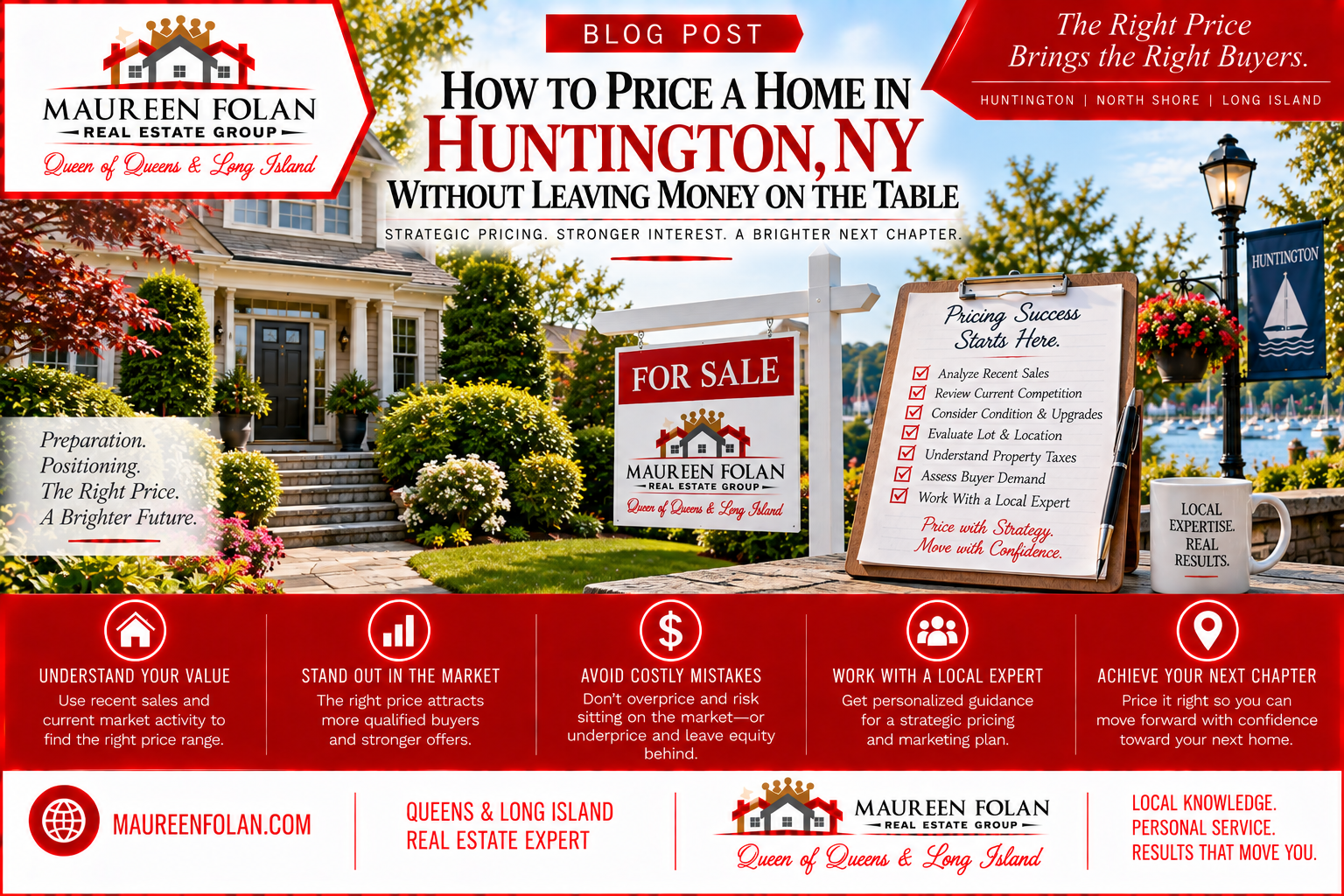
 How to Price a Home in Huntington, NY Without Leaving Money on the Table
How should you price a home in Huntington, NY to attract serious buyers without unnecessarily leaving money on the table?
The strongest pricing strategy considers relevant recent sales, current competing listings, your home's condition, lot, location, renovations, property-specific features, and current buyer response within your price range. The goal isn't automatically to choose the highest asking price. It's to position your Huntington home where buyers can recognize its value and competition has an opportunity to work in your favor.
Learning How to Price a Home in Huntington, NY Starts With One Important Distinction
There's a difference between:
The price you ask.
and
The price a buyer is ultimately willing to pay.
If you're trying to determine how to price a home in Huntington, NY, it's easy to assume that starting higher protects you from leaving money on the table.
Sometimes sellers think:
“If we start high, we can always negotiate.”
Or:
“We can reduce the price later.”
Technically, both are true.
But those strategies overlook how buyers actually experience a new listing.
Your asking price establishes the competitive category in which buyers evaluate your property.
And that can influence everything that happens next.
Your Asking Price Determines Your Competition
Imagine your Huntington home is potentially compelling within one price range.
Now increase the asking price significantly.
The property itself hasn't changed.
But the buyer's comparison has.
At the higher price, your home may suddenly compete with properties offering:
More square footage.
More extensive renovations.
A larger or more useful lot.
Different architecture.
Additional amenities.
A location the buyer prefers.
The same home can look like strong value in one competitive category and weaker value in another.
That's why pricing isn't simply about selecting a number.
Pricing is positioning.
Start With Relevant Recent Sales
Closed sales remain an important part of determining a property's likely market position.
But not every nearby sale is equally useful.
Ask:
How similar was the property?
How did the condition compare?
What about lot size and usability?
Was it extensively renovated?
How did the layout compare?
What was its location?
Did it have features your home doesn't?
Does your property offer something it didn't?
The objective isn't to find one sale with the highest price and use it as your benchmark.
It's to understand what buyers actually paid for the best available comparable properties.
The Highest Sale Isn't Automatically Your Comparable
This is one of the easiest pricing mistakes to make.
Suppose a nearby Huntington property sold for substantially more than other recent homes.
Naturally, that sale gets your attention.
But why did the buyer pay that price?
Maybe the home had:
A larger lot.
A complete renovation.
More usable space.
Superior outdoor amenities.
A particularly desirable property characteristic.
Or several advantages working together.
Before using an exceptional sale to support your price, understand what made that sale exceptional.
Active Listings Matter Just as Much
Recent sales tell you what buyers paid.
Active listings tell you what your buyer can purchase right now.
That's critical.
Suppose historical sales suggest one pricing range, but two attractive competing properties have just entered the market.
Your buyer sees them too.
Ask:
What else can someone purchase for approximately the same money?
How does its condition compare?
Which home has the better lot?
Which requires less work?
Which is presented more effectively?
Where does your home have the advantage?
Your pricing strategy needs to account for today's choices—not simply yesterday's transactions.
Pending Sales Can Provide Useful Context
A property going under contract can also tell you something.
It suggests buyers responded sufficiently to create an accepted offer.
You may not know the final sale price until closing, and transaction details can vary.
But pending activity can still help you understand where buyers are showing interest.
Watch the market as your listing date approaches.
The competitive landscape can change quickly.
Condition Has to Be Part of Pricing
Buyers don't evaluate asking price and condition independently.
They combine them.
A renovated Huntington home can reasonably compete differently from a similar property requiring substantial updates.
That doesn't mean an older or less updated home can't achieve a strong result.
It means the price needs to make the overall proposition compelling.
A buyer may happily purchase a dated home because they value:
The lot.
Location.
Architecture.
Layout.
Outdoor space.
Or the opportunity to renovate according to their preferences.
But they will still consider the cost and inconvenience of the work.
Don't Assume Renovation Cost Equals Added Value
Suppose you've invested $100,000 in improvements.
That doesn't automatically mean the home's market value increased by $100,000.
The market determines how buyers value the result.
They may value it more.
Less.
Or differently than you expected.
A renovation's market contribution depends on factors including quality, relevance, design, condition, and how it compares with alternatives.
Keep your receipts.
Just don't use them as a mathematical formula for pricing.
The Lot Can Affect Value Significantly
Buyers aren't purchasing only the structure.
They're purchasing the property.
Consider:
Lot size.
Usability.
Privacy.
Topography.
Landscaping.
Outdoor entertaining.
Driveway and parking.
Relationship between house and yard.
A larger lot isn't automatically superior.
A smaller but highly functional property may appeal more strongly to certain buyers.
Your pricing analysis should account for what the land actually provides.
Location Within Huntington Matters
“Huntington” is too broad to function as a complete pricing adjustment.
One property may offer convenient access to Huntington Village.
Another may create a different transportation routine.
Another may provide a quieter residential setting farther from the downtown environment.
The broader Town of Huntington also contains numerous villages and hamlets, making precise geographic comparison especially important. Town of Huntington
When comparing sales, location should be evaluated property by property.
Huntington Village Proximity May Matter to Some Buyers
Huntington Village's restaurants, shops, services, entertainment, and cultural destinations can make proximity meaningful to buyers who expect to use them regularly.
But don't assume every buyer assigns the same value to that proximity.
One buyer may prioritize downtown access.
Another may prefer additional property farther away.
A third may prioritize transportation above both.
The correct pricing strategy recognizes the location's strengths without pretending every buyer values them identically.
Property Taxes Can Affect Buyer Perception of Price
Your asking price isn't the only number buyers consider.
They may also be evaluating property-specific taxes, financing, insurance, maintenance, and expected improvements.
That means two similarly priced homes can create different affordability calculations.
As a seller, you don't control every ownership expense.
But you should understand that buyers may compare your property based on total cost, not simply list price.
This becomes particularly relevant when competing homes have noticeably different ownership profiles.
Architecture Can Differentiate a Property
Not every valuable feature appears in a spreadsheet.
A Huntington home may have architecture, natural light, proportions, craftsmanship, or other characteristics that distinguish it from more standardized properties.
These qualities can matter to buyers.
But they still need to be communicated effectively.
If architectural character is one of your home's strongest features, the preparation, photography, and description should help buyers recognize it.
Pricing and marketing work together.
Pricing Can't Compensate for Weak Presentation Forever
Imagine a correctly priced home with dark photographs, cluttered rooms, neglected landscaping, and poor showing access.
Will buyers recognize the value as easily?
Probably not.
Pricing is critical.
It isn't magic.
Your property still needs to be prepared and marketed so buyers can understand why the price makes sense.
Strong positioning combines:
Price + condition + presentation + photography + marketing + access.
Presentation Can't Rescue Any Price Either
The opposite is also true.
Beautiful photographs don't make an unrealistic price sustainable.
Professional staging doesn't change the comparable sales.
Marketing can create attention.
It can't permanently replace value.
The strongest listing strategy aligns the property's presentation with a price buyers can justify relative to their alternatives.
Beware of Pricing Based on What You “Need”
Maybe you need a certain amount from the sale to purchase your next home.
Perhaps you want to reach a specific net-proceeds target.
Those financial goals are important to your planning.
They don't determine market value.
Buyers don't know what you need.
They compare your property with other options.
Start with the market.
Then determine whether the likely outcome supports your next move.
If it doesn't, you may need to reconsider timing, preparation, or the next purchase—not simply add the difference to your asking price.
Don't Price Based on an Automated Estimate Alone
Automated home valuations can provide useful context.
They shouldn't replace property-specific analysis.
An algorithm may process:
Recorded sales.
Square footage.
Bedrooms.
Lot size.
Public records.
It may have more difficulty evaluating:
Actual condition.
Renovation quality.
Usable outdoor space.
Architectural character.
Privacy.
Layout.
Current competing inventory.
The way your home presents relative to another.
Use automated estimates as a reference point—not as your entire strategy.
Don't Price Based on a Neighbor's Opinion
Your neighbor may know what a nearby home sold for.
They may even know what the owner hoped to receive.
That doesn't make the information useless.
It also doesn't make it a valuation.
Real estate transactions contain details that aren't always obvious from the outside.
Condition.
Terms.
Timing.
Improvements.
Buyer competition.
Property differences.
Use verified market evidence whenever possible.
Starting Too High Can Cost You Early Attention
The first period after your listing goes live can be important.
Buyers already searching in your price range may notice the property quickly.
If the asking price feels disconnected from the competition, they may skip it.
Some sellers assume they'll return after a price reduction.
Some will.
Others may already have purchased something else.
A later adjustment can improve your position.
It can't recreate the first time the active buyer pool saw the listing.
But Pricing Too Low Without a Strategy Isn't the Goal Either
Strategic pricing doesn't mean automatically choosing an artificially low number.
The objective is not to “give the house away” in hopes of creating activity.
Your price should be supported by market evidence and aligned with your selling strategy.
Different properties and market conditions may justify different approaches.
The important thing is that the strategy is deliberate.
Not arbitrary.
Understand the Difference Between Asking Price and Market Response
Once the listing launches, buyers begin giving you information.
Showing requests.
Second visits.
Questions.
Offers.
Feedback.
Or silence.
Those are market signals.
If your home receives substantial activity, that tells you something.
If buyers repeatedly see it but don't make offers, that tells you something too.
If showing activity is unusually low relative to comparable listings, investigate.
Your original pricing decision isn't sacred.
It's a hypothesis the market begins testing immediately.
One Buyer's Feedback Isn't the Market
Don't overreact.
A buyer may dislike your kitchen.
Another may love it.
Someone may think the yard is too large.
Another buyer specifically wants that space.
Individual opinions are personal.
Patterns matter more.
If multiple buyers independently identify the same issue, pay attention.
Combine feedback with objective activity and competitive changes before adjusting strategy.
Days on Market Need Context
Sellers often become anxious about days on market.
But the number alone doesn't explain what happened.
A property may remain available because of price.
Condition.
A narrow buyer pool.
Showing restrictions.
A changing competitive environment.
Or another property-specific factor.
Instead of focusing only on the number of days, ask:
What has the market been telling us during those days?
That's more actionable.
A Price Reduction Should Be Strategic
If a price adjustment becomes necessary, don't choose the amount randomly.
Look at where the home will be positioned afterward.
Which buyers will now see it?
Which properties will it compete against?
Does the new price materially improve the value proposition?
A tiny adjustment that leaves the property in essentially the same competitive position may accomplish very little.
Pricing decisions should continue to be about positioning.
Multiple Offers Don't Automatically Mean You Underpriced
This is a common seller concern.
If several buyers compete for your home, you might wonder:
“Did we price it too low?”
Not necessarily.
Competition can be evidence that the property was positioned effectively enough to attract multiple serious buyers.
The ultimate result depends on the offers and terms produced.
A price that encourages strong market engagement can sometimes produce a better outcome than an aspirational price that suppresses interest.
The strategy should be evaluated by the result—not simply by whether the initial asking price was below the final sale price.
Evaluate Offers Beyond Price
Once offers arrive, don't stop analyzing.
A higher number isn't automatically the strongest complete offer.
Depending on your circumstances, you may also need to consider:
Financing.
Contingencies.
Timing.
Transaction certainty.
Other terms.
Your attorney and other appropriate professionals can help you understand the implications of contract terms relevant to your transaction.
The objective is the strongest overall outcome, not simply the largest headline number.
Your Next Move Should Influence Offer Strategy
Suppose you're selling your Huntington home and buying elsewhere.
Closing timing may matter considerably.
Perhaps you're relocating.
Maybe you need the sale proceeds for your next purchase.
That can make certainty or timing especially important.
Know these priorities before the offers arrive.
Your pricing strategy gets buyers to the table.
Your negotiation strategy determines which complete offer best supports your next move.
If You're Selling Huntington and Moving Toward Queens
Maureen Folan Real Estate Group's Queens and Long Island focus can be particularly useful when your move crosses those markets.
You need to understand what your Huntington sale may realistically produce.
Then connect that with your purchasing strategy.
The same applies if you're moving elsewhere on Long Island.
One sale.
One purchase.
One larger plan.
What Should a Huntington Pricing Analysis Include?
Before choosing an asking price, evaluate:
- Relevant recent closed sales
- Current active competition
- Pending activity where useful
- Property condition
- Renovation quality
- Lot size and usability
- Architecture and layout
- Outdoor amenities
- Location
- Property-specific differentiators
- Buyer activity in the relevant price range
- Your selling timeline and next move
No single item determines the answer.
The interaction among them does.
Pair Pricing With Preparation
Pricing shouldn't happen in isolation.
If you're preparing to sell, first determine which repairs and refreshes may improve buyer perception.
Internal link: What Huntington Homeowners Should Fix Before Selling—and What They Can Skip
Then consider how the completed preparation affects your competitive position.
A home that photographs and shows exceptionally well may create a stronger response than one with similar specifications but weaker presentation.
Pair Pricing With Strong Marketing
Your marketing needs to explain why the property deserves its position.
Professional photography.
Clear listing copy.
Accurate property details.
Thoughtful presentation of outdoor areas.
Useful location context.
Easy showing access.
Together, these help buyers understand the home.
Internal link: Selling a Home in Huntington, NY: How to Stand Out in Today's Market
Final Takeaway: How to Price a Home in Huntington, NY
If you're determining how to price a home in Huntington, NY, don't begin with the highest number you hope someone might pay.
Begin with the buyer's alternatives.
Review relevant recent sales.
Study current competition.
Evaluate your home's condition, lot, architecture, renovations, location, taxes, presentation, and difficult-to-reproduce characteristics.
Then choose a price that places the property in a competitive position where buyers can understand its value.
Because pricing too high can reduce early attention.
Pricing strategically can create engagement.
And strong engagement can give you more options when serious buyers begin making offers.
As Maureen Folan, Queens & Long Island Real Estate Expert, I help Huntington homeowners connect pricing with preparation, competition, marketing, and the next move—rather than treating the asking price as an isolated number.
Because the goal isn't simply to list at the highest price.
It's to create the strongest possible market position for the home you actually own. 
Get a Personalized Home Value Estimate
Thinking about selling your Huntington home and wondering where it fits in today's market?
Get a Personalized Home Value Estimate from Maureen Folan Real Estate Group.
We'll evaluate your home's condition, lot, layout, improvements, location, relevant recent sales, and current competition to develop a property-specific pricing strategy.
You can also request the Home Seller Preparation Checklist before deciding which improvements are worth completing prior to launch.
Maureen Folan
Queens & Long Island Real Estate Expert
Maureen Folan Real Estate Group
MaureenFolan.com

