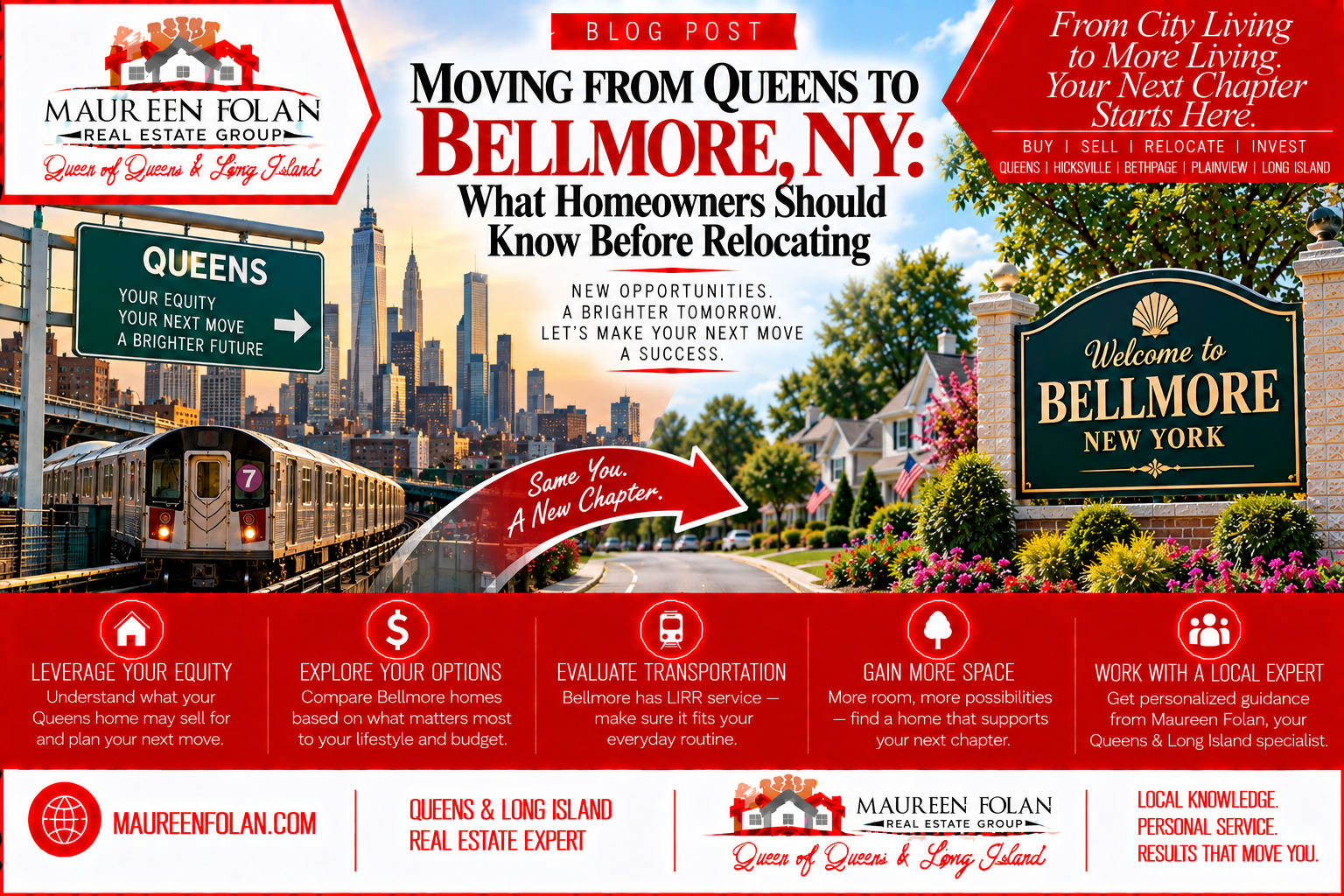
 Moving From Queens to Bellmore, NY: What Homeowners Should Know Before Relocating
What should you know before moving from Queens to Bellmore, NY?
Moving from Queens to Bellmore can change your housing costs, available space, transportation routine, outdoor responsibilities, and overall ownership experience. If you already own in Queens, start by understanding your current home's potential value, then coordinate its sale with your Bellmore purchase while comparing property-specific taxes, condition, layout, lot, transportation, renovation needs, maintenance, and total ownership costs.
Moving From Queens to Bellmore, NY Starts With Your Current Home
If you're considering moving from Queens to Bellmore, NY, it's natural to begin searching Bellmore listings.
But if you already own in Queens, your relocation strategy should begin with the property you have today.
Your current home can influence:
Your Bellmore purchase budget.
Down payment.
Available cash reserves.
Financing strategy.
Timing.
Ability to act when the right property appears.
Instead of treating your Queens sale and Bellmore purchase as separate transactions, approach them as two connected parts of one move.
Understand What Your Queens Home May Realistically Sell For
Before establishing your Bellmore budget, develop a realistic picture of your current home's market position.
A property-specific evaluation should consider:
- Relevant recent closed sales
- Current competing listings
- Property type
- Condition
- Renovations and improvements
- Layout
- Lot where applicable
- Property-specific location
- Current buyer activity
An automated estimate can provide context.
But if your Bellmore purchase depends on your sale proceeds, a property-specific analysis gives you a stronger foundation for planning.
Sale Price Isn't the Same as Net Proceeds
Suppose your Queens home sells for an attractive price.
That entire amount doesn't automatically become your Bellmore down payment.
Your remaining mortgage balance and transaction-related expenses affect your likely net proceeds.
Then you need to answer another question:
How much of that equity do you actually want to use?
Available equity and your preferred investment in the next home aren't necessarily the same number.
Don't Automatically Use Every Dollar of Equity
Your Queens equity can provide meaningful purchasing flexibility.
That doesn't mean you need to maximize your Bellmore purchase price.
You may want to preserve funds for:
Moving.
Furniture.
Repairs.
Renovations.
Landscaping.
Future maintenance.
Cash reserves.
A strong relocation should leave you financially comfortable after closing.
Define Why You're Leaving Queens
Before serious Bellmore showings begin, identify what you're trying to accomplish.
Do you need more interior space?
Better storage?
Outdoor property?
A dedicated workspace?
A different layout?
Another type of home?
Is transportation an important part of the decision?
Write down those priorities.
Your Bellmore purchase should actually solve the reasons you're moving.
Don't Move Simply to Get More House
Additional square footage can be valuable.
It can also mean more space to:
Furnish.
Clean.
Heat.
Cool.
Maintain.
Eventually repair.
Ask what you'll actually do with the additional space.
If another bedroom, workspace, or storage area solves a real need, that's meaningful.
If not, a smaller property with a stronger layout may provide a better ownership experience.
Understand Bellmore's Geographic Context
Bellmore is a Nassau County community within the Town of Hempstead.
Official municipal information and services are available through the Town of Hempstead, while Nassau County provides property-assessment resources through its Department of Assessment.
Those resources provide useful background.
But your ownership experience ultimately depends on the individual property you purchase.
Property Taxes Need to Enter the Plan Early
Don't wait until you're preparing an offer to investigate property-specific taxes.
Research them as part of your initial comparison.
Current figures may reflect exemptions or circumstances associated with the existing owner.
Your attorney and other appropriate professionals can help you understand transaction-specific information.
Budget from the actual Bellmore property rather than relying on a generalized estimate.
Build a Queens-to-Bellmore Ownership Comparison
Create a before-and-after worksheet.
For your Queens home, estimate:
Current housing payment.
Property taxes.
Insurance.
Utilities.
Maintenance.
Exterior responsibilities.
Then calculate the same categories for the Bellmore property.
Include:
Purchase price + financing + property-specific taxes + insurance + utilities + landscaping + maintenance + expected repairs and improvements.
Now you're comparing the actual financial transition.
A Different Property Can Change More Than Your Mortgage
Suppose the Bellmore home gives you more interior space.
Utilities may change.
A larger lot can increase landscaping responsibilities.
An older property may require future improvements.
A renovated property may require less immediate work while carrying a different purchase price.
Your mortgage payment is only one part of the transition.
Understand the Property as It Exists Today
Individual homes can change significantly over time.
If the Bellmore property has additions, conversions, renovations, or other substantial modifications, understand what was completed.
Ask what documentation is available where relevant.
Your attorney and other appropriate professionals can assist with transaction-specific questions involving permits, certificates, surveys, title, and related records.
The objective isn't to assume modifications are problematic.
It's to understand what you're buying.
Don't Let One Renovated Room Define the Property
A beautifully updated kitchen can make a powerful first impression.
So can a renovated bathroom.
Still evaluate:
Overall condition.
Layout.
Storage.
Natural light.
Lot.
Exterior.
Major components where appropriate.
Transportation.
Taxes.
Maintenance.
Ask what was updated—and what wasn't.
Decide Your Renovation Tolerance Before Relocating
Moving itself requires substantial coordination.
Do you also want construction?
Some buyers do.
They're willing to purchase a less updated property because its location, lot, layout, or another underlying characteristic is difficult to reproduce.
Others want to unpack and settle in.
Know whether you're primarily a:
Move-in-ready buyer
Cosmetic-update buyer
or
Renovation buyer
before a particular property makes that decision for you.
Don't Underestimate “We'll Fix It Later”
Renovation can sound simple during a showing.
Kitchen.
Bathrooms.
Flooring.
Lighting.
Paint.
Exterior work.
Maybe layout changes.
Then the project grows.
If the property only works after substantial improvements, investigate realistic costs and timing before making an offer.
Potential needs a budget.
Don't Reject a Strong Home Because It's Dated
The opposite mistake can eliminate good opportunities.
An older kitchen isn't automatically defective.
Paint can change.
Fixtures can change.
Some flooring can change.
Separate:
Needs attention
from
Would like to change.
Then evaluate the underlying property.
Focus on What Is Difficult to Change
Give appropriate weight to:
Location.
Lot.
Natural light.
Orientation.
Fundamental architecture.
Certain aspects of layout.
Cosmetic finishes are generally more flexible.
A permanent property characteristic you dislike may be considerably harder to solve.
Layout May Matter More Than Square Footage
Walk through each Bellmore property as though you've already moved in.
Where do you enter?
Where do groceries go?
How does the kitchen connect with the living areas?
Where would you work?
How much storage exists?
Which rooms would you actually use?
How do you reach the yard?
More square footage doesn't automatically mean better functionality.
Make Sure Storage Actually Improves
If lack of storage is one reason you're leaving Queens, investigate it carefully.
Look at:
Closets.
Pantry.
Garage.
Basement or other storage areas where applicable.
Utility spaces.
Imagine your belongings there.
Your next home should solve the problems motivating your move.
Decide How Much Outdoor Property You Want
Additional outdoor space may be one reason you're considering Bellmore.
Define what you want from it.
Privacy?
Gardening?
Outdoor entertaining?
Recreation?
More separation?
Then evaluate the actual lot.
More land isn't automatically more useful.
More Outdoor Property Means More Responsibility
Depending on the home, exterior ownership may involve:
- Lawn care
- Landscaping
- Trees
- Irrigation
- Driveways and walkways
- Patios or decks
- Fences
- Seasonal cleanup
Those responsibilities may be completely worthwhile.
Just make sure they're included in your expectations and budget.
Bellmore's LIRR Service May Be Important to Your Move
Bellmore has Long Island Rail Road service.
If you expect to continue traveling regularly toward Queens or Manhattan, transportation may become an important part of your relocation analysis.
Current station information, schedules, and service should be verified directly through the Long Island Rail Road.
Don't stop at the fact that Bellmore has a station.
Test the complete trip.
Calculate Your Door-to-Door Commute
For each serious Bellmore property, ask:
How long does it take to reach the station?
How would I get there?
Which train would I realistically use?
What happens at my destination?
How does the return trip work?
If you'll primarily drive, test that route too.
Your transportation routine starts at the property—not at the platform.
Compare the New Commute With Your Queens Routine
Use your current commute as the baseline.
How much does the trip change?
How frequently will you make it?
What are you gaining from the Bellmore property in exchange?
More interior space?
Outdoor property?
Storage?
A layout you prefer?
Another type of ownership experience?
That's the real relocation tradeoff.
Test Transportation Under Realistic Conditions
A weekend trip may not represent your normal weekday.
If transportation matters significantly, experience your likely route under realistic conditions when practical.
That can reveal differences that generic estimates don't fully communicate.
Spend Time in Bellmore Without Looking at Houses
Not every visit should involve a showing.
Return without a real estate appointment.
Run an ordinary errand.
Test transportation.
Drive from areas you're considering to destinations you expect to use.
Come back at another time.
You're not trying to determine whether Bellmore is universally “better” than Queens.
You're determining whether your everyday routine works from the individual property you're considering.
Compare Bellmore With Wantagh Using Actual Homes
Wantagh may naturally appear in the same search.
Both communities have LIRR service.
But don't reduce the comparison to train stations.
Compare actual properties based on:
Price.
Property-specific taxes.
Condition.
Layout.
Lot.
Storage.
Transportation.
Renovation requirements.
Maintenance.
Total ownership costs.
The stronger property may resolve the geography question.
Internal link: Wantagh vs. Bellmore, NY: What Homebuyers Should Compare Before Choosing
Merrick and Other Nearby Markets May Enter the Search
Depending on your budget and priorities, Merrick, Wantagh, Seaford, East Meadow, or other nearby communities may also become relevant.
That's useful.
One property may offer stronger condition.
Another may provide more outdoor space.
A different location could create a transportation routine you prefer.
Keep enough flexibility for the right home to emerge.
Don't Choose Based on Rankings or Demographic Assumptions
Your relocation decision should focus on objective property and location characteristics relevant to your individual needs.
Compare:
Property.
Price.
Property-specific taxes.
Condition.
Layout.
Lot.
Transportation.
Maintenance.
Amenities you personally use.
Total ownership costs.
Long-term plans.
Avoid generalized assumptions about who lives in a community or who should move there.
Your Queens Sale and Bellmore Purchase Need One Strategy
If your Queens sale proceeds are needed for the Bellmore purchase, establish your preferred sequence early.
Ask:
- Do I need to sell before I buy?
- Could I purchase first?
- Can I comfortably own both properties temporarily?
- How much equity do I expect to use?
- How much liquidity do I want afterward?
- What happens if my Queens property sells first?
- What happens if the right Bellmore property appears first?
Planning these scenarios before negotiations can give you more control.
Prepare Your Queens Home Before You Need to Sell Quickly
You don't necessarily need to list immediately.
But preparation can begin.
Understand its potential market value.
Identify visible repairs.
Begin decluttering.
Organize relevant property information.
Consider what photography and marketing preparation may require.
If the right Bellmore property appears, you'll already understand what needs to happen on the Queens side.
Your Queens Pricing Strategy Should Support the Move
If the transactions are financially connected, your current-home pricing strategy matters.
An unrealistic asking price can interfere with your Bellmore purchase timeline.
Your Queens sale strategy should consider:
Relevant recent sales.
Current competition.
Condition.
Preparation.
Buyer activity.
Preferred timing.
The objective isn't simply to ask for the highest possible number.
It's to create a sale strategy that supports the complete move.
Evaluate Queens Offers in Context
When offers arrive, price matters.
Depending on your circumstances, financing, contingencies, timing, and transaction certainty may also affect how effectively an offer supports your Bellmore purchase.
Your attorney and other appropriate professionals can help you evaluate transaction-specific terms.
Think about both transactions together.
Keep Financial Reserves After Closing
A different property may introduce expenses you didn't previously have.
Moving costs money.
Maintenance continues.
You may discover improvements you want to make after living in the home.
Preserving appropriate reserves can provide flexibility.
The question isn't simply:
“Can I buy this Bellmore home?”
It's:
“Can I comfortably own it afterward?”
Know Your Walk-Away Point Before Competition Begins
Before making an offer, establish your boundaries.
Comfortable purchase ceiling.
Total ownership-cost limit.
Renovation budget.
Transportation requirements.
Lot preferences.
Condition tolerance.
Desired cash reserves.
Then identify which difficult-to-reproduce property characteristics might justify paying more.
Preparation makes negotiation easier.
Ten Questions to Answer Before Moving From Queens to Bellmore
Before committing to the move, ask:
- Why am I leaving my Queens property?
- What might my current home realistically sell for?
- What might my net proceeds be?
- How much equity do I want to use?
- What total Bellmore ownership cost is comfortable?
- What improvements or modifications have been made to the property I'm considering?
- How much house and outdoor property do I want to maintain?
- Does transportation work from this exact property?
- How much renovation am I genuinely willing to undertake?
- How should the Queens sale and Bellmore purchase be sequenced?
Those answers give your relocation plan structure.
Final Takeaway: Moving From Queens to Bellmore, NY
If you're considering moving from Queens to Bellmore, NY, begin with the property you already own.
Understand its potential market value.
Estimate likely net proceeds.
Decide how much equity you want to use.
Then evaluate Bellmore properties based on purchase price, property-specific taxes, condition, layout, documented improvements, lot, transportation, renovation needs, maintenance, and total ownership costs.
Test your commute.
Spend time in Bellmore outside of showings.
Determine how much house and outdoor property you actually want.
Preserve appropriate financial reserves.
And coordinate your Queens sale with the Bellmore purchase before either transaction creates unnecessary pressure.
As Maureen Folan, Queens & Long Island Real Estate Expert, I help homeowners connect both sides of that transition through one strategy.
Because moving from Queens to Bellmore isn't simply about changing addresses.
It's about making sure your equity, next property, transportation, ownership costs, timing, and everyday routine all support the move you're trying to make. 
Talk With a Queens & Long Island Real Estate Expert
Thinking about selling your Queens home and moving to Bellmore?
Talk With a Queens & Long Island Real Estate Expert at Maureen Folan Real Estate Group.
We can begin by evaluating your current Queens property, estimating how the sale may influence your purchasing strategy, and comparing Bellmore and nearby Long Island properties based on your priorities.
You can also request the Property Tax Guide to help organize the ownership-cost questions worth investigating before purchasing.
Maureen Folan
Queens & Long Island Real Estate Expert
Maureen Folan Real Estate Group
MaureenFolan.com

