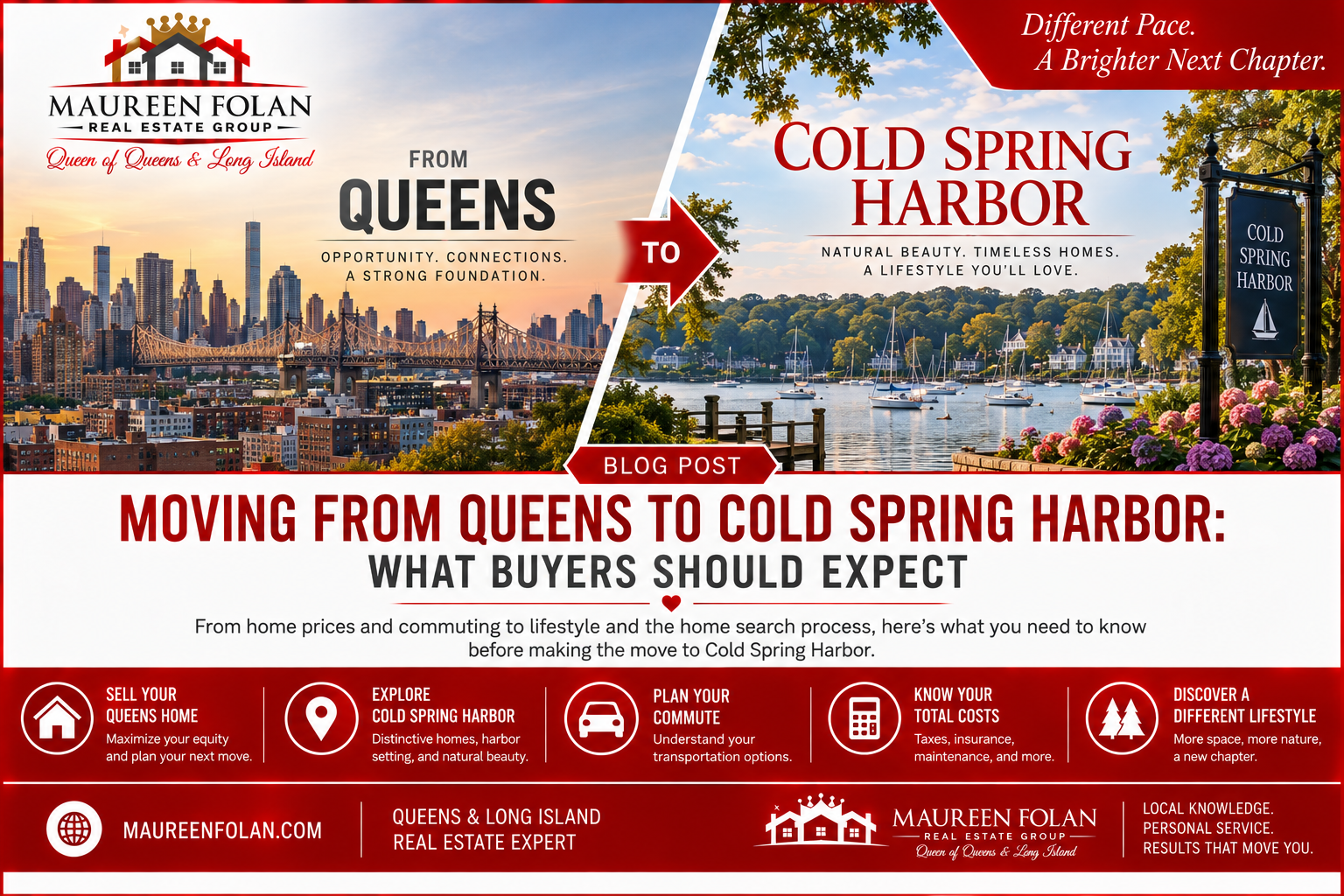
 Moving From Queens to Cold Spring Harbor: What Buyers Should Expect
What should you expect when moving from Queens to Cold Spring Harbor, NY?
Moving from Queens to Cold Spring Harbor can involve a significant change in the type of property you own, your housing costs, maintenance responsibilities, transportation routine, and everyday relationship with Long Island's North Shore. If you already own in Queens, the strongest strategy is to coordinate your current-home sale with your Cold Spring Harbor purchase while evaluating equity, total ownership costs, property condition, land, transportation, and the lifestyle you actually want from the move.
Moving From Queens to Cold Spring Harbor Is More Than Buying a Different House
If you're considering moving from Queens to Cold Spring Harbor, there's a good chance the properties attracting your attention look very different from your current home.
You may be considering more land.
A larger house.
Distinctive architecture.
A more private setting.
Proximity to the harbor.
Or simply a different relationship with outdoor space.
But changing the property is only one part of the move.
Your transportation may change.
Your maintenance responsibilities may increase.
Your property-specific taxes and insurance could look different.
And if you own your Queens home, you may be coordinating two substantial transactions at once.
That's why the move should begin with a plan—not a listing you happened to fall in love with.
Start With Your Queens Home
Before deciding how much you should spend in Cold Spring Harbor, understand what your current Queens property may realistically contribute to the transaction.
A property-specific valuation should consider relevant recent sales, current competition, condition, improvements, property type, location, and current buyer activity.
Don't automatically treat an online estimate as your expected sale price.
And don't build your next-home budget from the highest nearby sale without understanding how that property differs from yours.
You want a realistic estimate of your potential net proceeds, not simply an exciting gross sale number.
That gives your Cold Spring Harbor search a much stronger financial foundation.
Decide How Much Queens Equity You Actually Want to Use
Available equity and desired down payment aren't necessarily the same thing.
Suppose your Queens sale leaves you with substantial proceeds.
You could apply a large portion toward your next purchase.
But should you?
Your Cold Spring Harbor ownership plan may also require financial flexibility for:
- Closing and moving expenses
- Immediate improvements
- Furnishings
- Landscaping
- Routine maintenance
- Future capital projects
- Insurance
- Cash reserves
The goal isn't necessarily to put every available dollar into the purchase price.
It's to structure the move so you're financially comfortable after closing.
Expect a High-Value Housing Market
Cold Spring Harbor represents a substantial real estate investment.
For the three months ending July 2026, Redfin reported a median Cold Spring Harbor sale price of approximately $2.1 million, with homes averaging 27 days on the market. Redfin classified the market as very competitive. Current Cold Spring Harbor housing-market data
That doesn't mean your Cold Spring Harbor purchase will cost $2.1 million.
The community has relatively limited transaction volume, and the types of homes sold during a particular period can move the median significantly.
Instead of asking what the “average Cold Spring Harbor home” costs, determine what the type of property you want currently costs.
That's the relevant market.
Your Home Search May Become More Property-Specific
In a denser Queens market, you may be accustomed to comparing properties using relatively standardized characteristics.
Cold Spring Harbor can require a different approach.
Two homes at similar prices may differ substantially in:
Architecture.
Land.
Condition.
Renovation level.
Privacy.
Outdoor amenities.
Topography.
Setting.
Views.
Maintenance.
That can make simple price-per-square-foot comparisons less useful.
You aren't only buying interior space.
You're buying the complete property.
Decide Why You're Moving Before You Shop Seriously
Why Cold Spring Harbor?
This question matters.
Maybe you're looking for a different amount of land.
Perhaps you want a North Shore harbor setting.
You may be drawn to distinctive architecture.
Maybe your housing needs have changed.
Perhaps you want a property that offers a different relationship between indoor and outdoor space.
Write down the reasons.
Then evaluate every property against them.
If a home doesn't accomplish what motivated you to leave Queens, its impressive features may not make it the right purchase.
Cold Spring Harbor's Landscape Can Be Part of the Appeal
The area's harbor and outdoor environment can be one reason buyers consider the move.
Cold Spring Harbor State Park encompasses approximately 40 acres of hilly terrain overlooking the harbor and serves as the northern trailhead of the Nassau-Suffolk Greenbelt Trail. Cold Spring Harbor State Park
The Town of Huntington also maintains Cold Spring Harbor Park and other recreational resources in the broader area.
These features can provide meaningful context for your move.
But don't purchase a property based solely on the idea of living “near the harbor.”
Determine what access to those places looks like from the actual home.
Spend Time There Without Looking at Houses
One of the most useful relocation exercises is to stop touring properties temporarily.
Spend time around Cold Spring Harbor.
Drive the routes you'd realistically use.
Visit the village corridor.
Explore public recreational areas relevant to you.
Run an ordinary errand.
Try the drive at a different time of day.
The goal isn't to have an enjoyable afternoon.
It's to understand what your ordinary routine could look like.
A community can feel very different when you're evaluating Monday morning instead of Sunday afternoon.
Your Commute Needs a Real-World Test
If you'll continue traveling regularly to Queens or Manhattan, transportation should be investigated before you buy.
Cold Spring Harbor has Long Island Rail Road service, but your complete commute depends on the property, station access, current schedules, and your destination.
Verify current rail information directly through the Long Island Rail Road.
Then map the entire trip.
How long does it take from the house to the station?
How will you get there?
Which train would you realistically use?
What happens at the other end?
What does your return trip look like?
If you're driving, test that route too.
The commute that matters isn't “Cold Spring Harbor to Manhattan.”
It's your driveway to wherever you're actually going.
Property Taxes Should Enter the Conversation Early
When moving from Queens to a higher-value Long Island property, property-specific taxes can materially affect your ownership budget.
Don't wait until you've fallen in love with a house to investigate them.
And don't rely on a generalized number for “Cold Spring Harbor taxes.”
Verify the taxes associated with each serious property.
Then compare them alongside the purchase price and your other costs.
Two homes with similar asking prices can create very different annual ownership expenses.
Calculate the Complete Cost of Ownership
For each serious property, consider:
Purchase price + financing + property-specific taxes + insurance + utilities + landscaping + maintenance + expected improvements.
If you're considering a larger home, operating costs may increase.
If you're considering more land, landscaping and exterior maintenance may become more significant.
If the home is older, future capital projects may deserve attention.
If it's waterfront or water-adjacent, additional property-specific considerations may apply.
Your budget should reflect the house you're going to own, not merely the transaction you're trying to complete.
More Land Means More Responsibility
Additional outdoor space can be one of the most exciting differences when moving from Queens.
But land needs maintenance.
Lawns.
Trees.
Landscaping.
Driveways.
Patios.
Drainage.
Exterior lighting.
Fences or gates where applicable.
Possibly pools or other amenities.
None of that makes a larger property undesirable.
It simply means you should decide how much land you genuinely want to manage.
More acreage isn't automatically more valuable to you.
Older and Distinctive Homes Need Thoughtful Evaluation
Cold Spring Harbor can offer properties with architectural character.
If that's part of what attracts you, separate three concepts:
Age. Condition. Appearance.
An older home can be beautifully maintained.
A dated-looking property can have sound underlying systems.
A newly renovated interior can still contain older major components.
If you become serious about a property, appropriate professional inspections and due diligence can help you better understand what you're purchasing.
Don't reject character because it isn't new.
And don't overlook maintenance because the architecture is beautiful.
Renovation Potential Can Be an Opportunity—or a Burden
Perhaps the right Cold Spring Harbor property needs work.
That doesn't automatically make it a poor purchase.
A less updated home may allow you to obtain land, architecture, or location that would be harder to afford in completely renovated condition.
But renovation needs to be approached realistically.
Before making the purchase dependent on a major transformation, consider:
Project cost.
Timing.
Professional estimates.
Permitting where applicable.
Disruption.
Your tolerance for managing the work.
Your available reserves after closing.
Potential only creates value when you're realistically able and willing to execute the plan.
Waterfront and Water Views Require Different Thinking
If part of your Cold Spring Harbor search involves water, define exactly what you want.
A water view and waterfront ownership are not the same.
A property near the harbor and a property directly on it create different ownership experiences.
If you're seriously considering waterfront or water-adjacent property, appropriate due diligence may involve property boundaries, flood information, insurance, shoreline conditions, permits, access rights, drainage, and other property-specific considerations.
The relevant professionals should advise you based on the particular property.
Don't let the view replace the investigation.
Privacy Should Be Tested, Not Assumed
Luxury listings frequently describe properties as private.
Stand on the property and evaluate that for yourself.
How does the house relate to neighboring homes?
What can you see from the primary living spaces?
What creates the privacy—distance, landscaping, topography, or another feature?
Would maintaining that privacy require significant landscaping?
A property may offer exactly the separation you want.
Or the listing language may be doing more work than the lot itself.
Don't Buy More House Than You Want to Operate
Moving from Queens can make additional interior space feel appealing.
But larger homes come with operating costs.
More rooms to heat and cool.
More surfaces to maintain.
More roof.
More windows.
More furniture.
More systems.
Ask what you want the extra space to do.
Work-from-home space?
Guests?
Entertaining?
Storage?
Hobbies?
If you can't identify a purpose, don't assume more square footage automatically improves your life.
Compare Cold Spring Harbor With Other North Shore Options
Cold Spring Harbor doesn't have to be your only search.
Depending on your priorities, you may also consider Huntington Bay, Centerport, Oyster Bay Cove, Laurel Hollow, or other North Shore communities.
Compare actual properties.
One community may offer a stronger waterfront option.
Another may give you more land.
Another may offer architecture you prefer.
The right house can sometimes matter more than your original town preference.
Cold Spring Harbor vs. Huntington Bay: Which North Shore Community Fits Your Lifestyle?
Selling and Buying at the Same Time Requires a Sequence
If you need your Queens sale proceeds for the Cold Spring Harbor purchase, establish your preferred sequence before either transaction becomes urgent.
Ask:
- Do I need to sell before I buy?
- How much equity do I expect to deploy?
- Can I carry both properties temporarily?
- What happens if my Queens home sells first?
- What happens if the Cold Spring Harbor home appears first?
- How much financial reserve do I want after closing?
- Which transaction terms matter most to my overall timeline?
These questions aren't as exciting as touring a waterfront property.
They're what make the move workable.
Your Queens Offer Strategy May Need to Support Your Purchase
When selling your Queens property, don't evaluate offers solely by the headline price if the sale is tied to your next purchase.
Financing.
Contingencies.
Closing timing.
Certainty.
Other terms.
All can affect how well an offer supports your larger plan.
A slightly different combination of terms may sometimes align more effectively with your Cold Spring Harbor purchase.
Your current-home sale should serve your next move, not exist independently from it.
Prepare Financially Before a Rare Property Appears
Luxury markets can have limited inventory, especially when you combine several specific requirements.
Perhaps you want:
A certain amount of land.
A particular architectural style.
Move-in-ready condition.
Harbor views.
Privacy.
A specific price range.
The more characteristics you combine, the less frequently the right property may appear.
That makes preparation important.
Know your budget, financing strategy, reserves, timing, and walk-away point before the home arrives.
Preparation helps you act efficiently without abandoning discipline.
Don't Let Scarcity Push You Into the Wrong Purchase
A rare property can create urgency.
That doesn't mean you should ignore concerns.
Ask whether the home genuinely accomplishes the goals behind your move.
Understand the condition.
Review the total ownership cost.
Complete appropriate due diligence.
Know what compromises you're making.
Scarcity is relevant.
It's not a substitute for judgment.
Final Takeaway: Moving From Queens to Cold Spring Harbor
If you're considering moving from Queens to Cold Spring Harbor, plan the transition as one connected real estate decision.
Start with your Queens home.
Understand its potential value and estimated net proceeds.
Decide how much equity you want to use.
Then evaluate Cold Spring Harbor properties based on price, taxes, condition, architecture, land, privacy, maintenance, transportation, and total ownership costs.
Spend time in the area outside of showings.
Test your commute.
Understand how much property you want to maintain.
And if you're considering waterfront or water-adjacent homes, make sure the practical ownership questions receive as much attention as the view.
Cold Spring Harbor offers a distinctive North Shore setting, including the harbor landscape and the 40-acre Cold Spring Harbor State Park overlooking the water. Cold Spring Harbor State Park
But the right move is ultimately about the individual property.
As Maureen Folan, Queens & Long Island Real Estate Expert, I help homeowners connect the sale of their Queens property with the purchase of their next Long Island home so both sides support the same financial and lifestyle plan.
Because moving from Queens to Cold Spring Harbor isn't simply about upgrading your address.
It's about making sure your next property delivers the ownership experience you're making the move to achieve. 
Talk With a Queens & Long Island Real Estate Expert
Thinking about selling your Queens home and moving to Cold Spring Harbor?
Talk With a Queens & Long Island Real Estate Expert at Maureen Folan Real Estate Group.
We can begin by evaluating your current Queens property, estimating how your sale may affect your North Shore purchasing strategy, and comparing Cold Spring Harbor homes based on your property, location, and ownership priorities.
You can also request the Property Tax Guide to help organize one of the important financial considerations when comparing higher-value Long Island properties.
Maureen Folan
Queens & Long Island Real Estate Expert
Maureen Folan Real Estate Group
MaureenFolan.com
:format(webp):quality(80)/u.realgeeks.media/maureenfolan/001.jpg)
:format(webp):quality(80)/u.realgeeks.media/maureenfolan/HVREPORT.png)