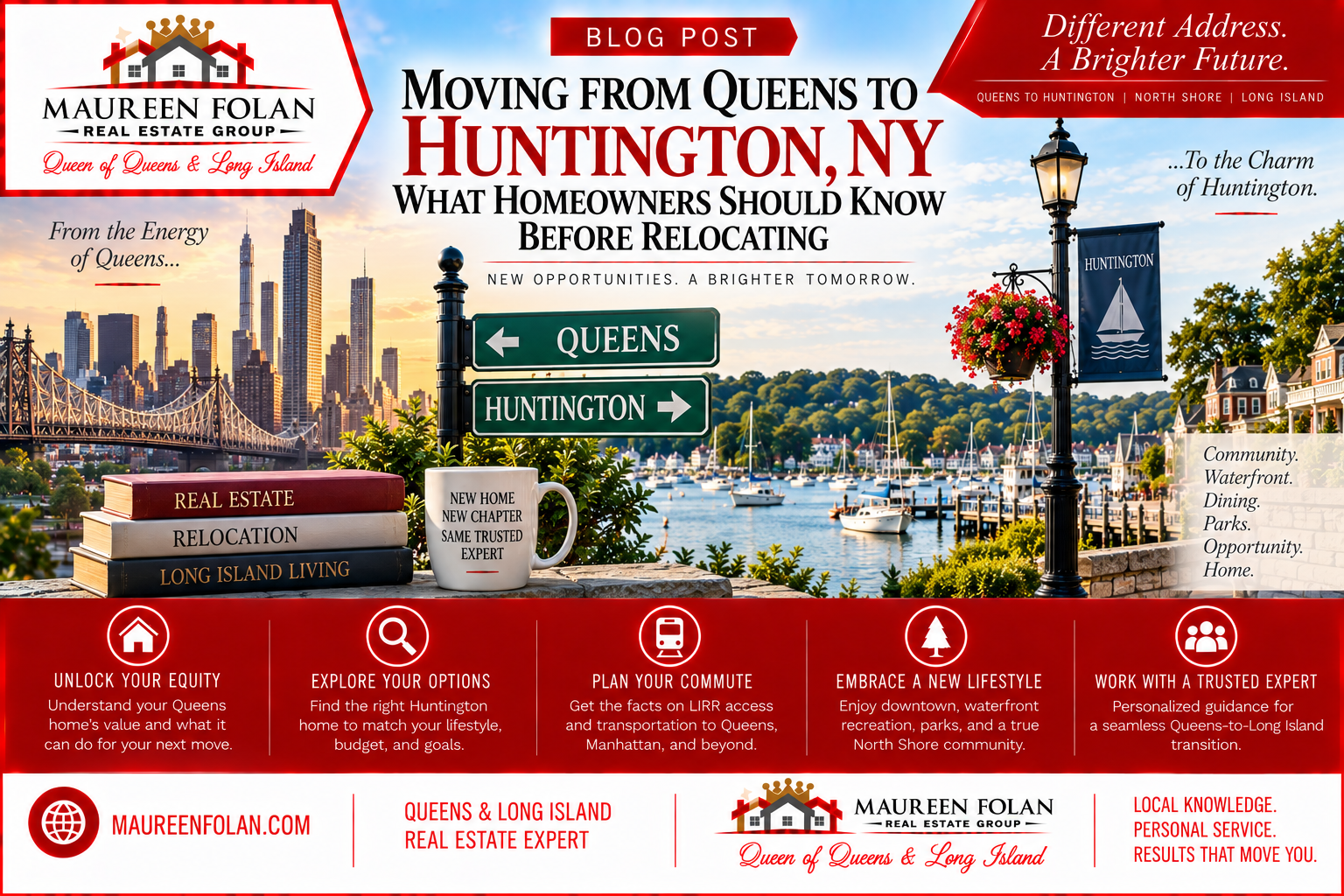
 Moving From Queens to Huntington, NY: What Homeowners Should Know Before Relocating
What should you know before moving from Queens to Huntington, NY?
Moving from Queens to Huntington can change your housing costs, property responsibilities, transportation routine, and the type of home you own. If you already own in Queens, start by understanding your current home's potential value, then coordinate your sale and Huntington purchase while comparing total ownership costs, property-specific taxes, condition, lot, transportation, and the everyday routine you want your move to create.
Moving From Queens to Huntington, NY Is Really Two Real Estate Decisions
If you're considering moving from Queens to Huntington, NY, browsing Huntington listings may feel like the obvious first step.
But if you already own a Queens property, your strongest strategy may begin with the home you're leaving.
You aren't simply buying in Huntington.
You're potentially:
Selling in Queens + buying in Huntington + coordinating the financial and logistical transition between them.
The value and timing of your Queens sale can affect your down payment, purchase range, reserves, closing strategy, and how quickly you can act when the right Huntington property appears.
Treating the transactions as one move rather than two unrelated events can make the entire process much clearer.
Start by Understanding Your Queens Home's Potential Value
Before deciding what you want to spend in Huntington, determine what your current Queens property may realistically contribute to the move.
A property-specific analysis should consider:
- Relevant recent sales
- Current competing listings
- Property type
- Condition
- Renovations and improvements
- Lot and layout
- Location
- Current buyer activity
Avoid automatically building your Huntington budget around an online estimate or the highest recent sale nearby.
You want a realistic range.
Then you can begin estimating what your sale may actually make available for the next purchase.
Sale Price Isn't the Same as Net Proceeds
Suppose your Queens home sells for a substantial amount.
The entire sale price doesn't become your down payment.
Your remaining mortgage balance and transaction-related expenses need to be considered when estimating potential net proceeds.
Then comes another decision:
How much of that equity do you actually want to use?
You may want to preserve funds for moving expenses, reserves, furnishings, repairs, landscaping, or improvements to your Huntington home.
The goal isn't necessarily to transfer every available dollar into the next property.
It's to create a purchase you can comfortably own afterward.
Decide What You're Trying to Change
Before you tour Huntington homes seriously, identify why you're considering leaving Queens.
Maybe you want more interior space.
Perhaps you want more outdoor property.
You may want a different housing style.
Maybe Huntington Village appeals to you.
Perhaps access to North Shore parks and waterfront recreation is part of the attraction.
Or your work and transportation requirements may have changed.
Write down your reasons.
Your next property should actually accomplish them.
Otherwise, you can go through an expensive and complicated move without solving the problem that motivated it.
Huntington Offers More Than One Type of Location
When people say “Huntington,” they can mean different things geographically.
The Town of Huntington covers a broad portion of Suffolk County's North Shore and includes numerous villages and hamlets. Huntington itself is also a specific hamlet and census-designated place.
The Town provides official information about its communities and municipal resources. Town of Huntington
For your home search, don't rely solely on the word Huntington in an address or listing.
Determine where the actual property is and how that location affects the places you'll use.
Huntington Village May Be Part of the Attraction
Huntington Village provides a recognizable downtown environment with restaurants, shops, services, and entertainment.
If that atmosphere is one reason you're considering the move, ask how much proximity matters.
Do you want to be particularly close to the Village?
Would you rather have more land and drive there when you want it?
How often would you realistically use downtown?
There's no universal answer.
But this tradeoff can materially affect which properties belong in your search.
Internal link: Why Buyers Are Drawn to Living in Huntington, NY
Don't Buy the Idea of a Lifestyle Without Testing It
A Saturday afternoon in Huntington can be enjoyable.
That's useful information.
It's not enough.
Try a Monday morning.
Drive the routes you'd actually use.
Run an ordinary errand.
Visit Huntington Village when you're not looking at houses.
See how long it takes to reach places relevant to you.
If you're considering several neighborhoods or nearby communities, experience each one.
You're trying to understand ordinary life, not simply whether the area makes a strong first impression.
Your Commute May Be One of the Biggest Changes
If you're continuing to work in Queens or Manhattan, transportation deserves careful investigation.
Huntington has Long Island Rail Road service, but current schedules and station information should always be verified directly through the Long Island Rail Road.
Don't stop at the train schedule.
Map the complete trip from the specific house.
How long does it take to reach the station?
How will you get there?
Which train would you realistically use?
What happens when you reach the other end?
What does your return trip look like?
Your commute isn't “Huntington to Manhattan.”
It's front door to final destination.
Test the Commute Before Making an Offer
If you'll make the trip frequently, experience it under realistic conditions.
A route that seems easy during a Sunday showing may feel different during a weekday commute.
Compare it with your current Queens routine.
How much additional time does the move create?
Is that tradeoff worthwhile for what you're gaining in the property?
You may decide it absolutely is.
Or transportation may become more important than you expected.
Either conclusion is useful before you buy.
Your Property Responsibilities May Increase
Depending on what you currently own in Queens, a Huntington home may involve a different maintenance profile.
You could take on:
More landscaping.
More trees.
A longer driveway.
Larger exterior surfaces.
A deck or patio.
More square footage.
A larger roof.
Additional storage.
A pool or other outdoor amenity.
More property can be exactly what you want.
But don't confuse more property with more benefit until you've considered what ownership requires.
Decide How Much Land You Actually Want
Buyers moving from denser areas can become particularly excited by larger lots.
Ask what you'll do with the space.
Do you want room for outdoor entertaining?
Gardening?
Recreation?
Privacy?
Or simply more separation?
If you value those things, additional land can be worthwhile.
If you don't particularly want to maintain a large property, a more manageable lot may give you a better ownership experience.
Buy the amount of land you want to use, not simply the most your budget allows.
More Interior Space Has a Cost Too
The same principle applies to the house.
Perhaps you're leaving Queens because you want more room.
Be specific.
Do you need another bedroom?
A home office?
Guest space?
Storage?
A larger kitchen?
More entertaining space?
If you can't identify how you'll use the additional square footage, don't automatically assume a larger house is the stronger purchase.
More home means more to heat, cool, furnish, clean, repair, and maintain.
Useful space matters more than maximum space.
Property Taxes Need to Enter the Search Early
Property-specific taxes should be part of your Huntington analysis from the beginning.
Don't rely on a generic estimate for “Huntington taxes.”
Verify the information for the individual home.
Then incorporate it into your ownership budget.
Two similarly priced properties can produce different ongoing housing expenses.
Your real comparison should look like:
Purchase price + financing + property-specific taxes + insurance + utilities + maintenance + expected improvements.
That's a much more useful affordability calculation.
Compare Your Current Queens Costs With the Next Home
Create a simple before-and-after comparison.
What do you currently spend on:
Mortgage or housing cost?
Taxes?
Insurance?
Utilities?
Maintenance?
Exterior responsibilities?
Then estimate the same categories for the Huntington property.
This helps you understand what the move changes financially.
A higher purchase price may not be the only meaningful difference.
And a home you can technically purchase may not create the ongoing expense profile you want.
Don't Forget Financial Reserves
If your Queens home has meaningful equity, you may have considerable purchasing power.
That doesn't mean every dollar belongs in the next down payment.
Homeownership continues after closing.
Repairs happen.
Landscaping needs attention.
You may want to change something after living in the home.
Keeping appropriate reserves can give you flexibility.
The objective isn't to purchase the maximum home your equity permits.
It's to build a comfortable ownership position.
Move-In-Ready or Renovation?
Huntington may give you options at different levels of condition.
Before you shop seriously, decide whether you're primarily a:
Move-in-ready buyer
Cosmetic-update buyer
or
Renovation buyer
If you've just sold a Queens home, you may value the simplicity of moving into something requiring little immediate work.
Another buyer may prefer obtaining a stronger lot or location and renovating over time.
Neither strategy is universally superior.
Your finances and tolerance for construction should determine the answer.
Don't Underestimate Renovation After a Move
“We can update it later” sounds simple during a showing.
Later arrives quickly.
A renovation requires money, planning, contractors, decisions, and disruption.
If a property's appeal depends heavily on a future renovation, investigate realistic costs before you stretch your purchase budget.
You want enough financial flexibility to complete the improvements you're counting on.
Potential can be valuable.
But it isn't free.
Older Huntington Homes Can Still Be Strong Purchases
Age alone doesn't determine condition.
An older home can be beautifully maintained.
A renovated interior can still contain older major components.
A dated-looking property may have excellent underlying characteristics.
If you decide to pursue a home, appropriate professional inspections and due diligence can help you understand its condition.
Focus on what you're actually buying rather than assuming newer is automatically better.
North Shore Recreation Can Be Part of the Move
The broader Town of Huntington contains parks, beaches, harbors, and waterfront recreational resources. Town of Huntington parks and recreation
If outdoor access is part of your relocation goal, determine which resources you personally expect to use.
Then map them from the property.
A feature that exists somewhere within the Town isn't necessarily convenient from every Huntington address.
Lifestyle claims become useful only when translated into your actual routine.
Waterfront Lifestyle Doesn't Require Waterfront Ownership
Perhaps the North Shore environment is one reason you're moving.
That doesn't necessarily mean you need direct waterfront.
A waterfront property may come with a significant premium and additional property-specific ownership considerations.
If your real goal is access to parks, harbors, or coastal recreation, a non-waterfront property might give you much of the experience you want.
Define the objective first.
Then decide which property feature delivers it most efficiently.
Huntington Isn't Your Only Option
If Huntington is on your shortlist, you may also encounter compelling homes in Northport, East Northport, Centerport, Cold Spring Harbor, or other nearby markets.
Keep enough geographic flexibility to compare actual properties.
Maybe Huntington provides the downtown environment you prefer.
Perhaps Northport gives you another Village setting.
East Northport might create a different transportation equation.
Centerport may offer a water-oriented property.
The correct comparison isn't based on reputation.
It's based on what your budget actually buys.
Compare Your Best Options Side by Side
When you've narrowed the search, create a simple comparison.
| Factor | Huntington Home | Alternative |
|---|---|---|
| Purchase price | Compare | Compare |
| Property-specific taxes | Compare | Compare |
| Condition | Compare | Compare |
| Layout | Compare | Compare |
| Lot | Compare | Compare |
| Renovation needs | Compare | Compare |
| Transportation | Compare | Compare |
| Maintenance | Compare | Compare |
| Location | Compare | Compare |
| Total ownership cost | Compare | Compare |
Then decide which factors matter most.
Not every row deserves equal weight.
Selling Your Queens Home and Buying in Huntington Requires a Sequence
This is where relocation becomes more complicated.
If you need your Queens sale proceeds to complete your Huntington purchase, establish your preferred transaction sequence early.
Ask:
- Do I need to sell before I buy?
- How much equity do I expect to use?
- Can I comfortably own both properties temporarily?
- What happens if my Queens home sells first?
- What happens if the Huntington home appears first?
- How much cash do I want to retain after closing?
- Which closing timeline would work best?
You don't want to answer these questions for the first time while negotiating an offer.
Your Queens Listing Strategy Should Support the Move
If the sale is directly connected to your Huntington purchase, your Queens pricing and marketing strategy should reflect the broader objective.
You need to understand:
Your likely sale range.
Expected timing.
How quickly you need to move.
Which offer terms matter.
What level of certainty you require.
This is why relocation strategy is different from simply selling one home and later buying another.
The transactions influence each other.
The Highest Queens Offer Isn't Automatically the Best Complete Offer
Price matters.
So can financing, contingencies, timing, and transaction certainty.
If one offer aligns much more effectively with your Huntington purchase, that may have practical value.
Evaluate offers in the context of the complete move rather than treating the sale as an isolated event.
Your goal is to get from one home to the other successfully.
Know Your Huntington Walk-Away Point Before Competition Starts
When you find the right property, emotions can move quickly.
Prepare beforehand.
Know your comfortable purchase ceiling.
Understand the taxes.
Estimate the maintenance.
Know how much renovation you're willing to undertake.
Calculate your reserves.
Decide which features justify paying more.
Then establish the point at which another home becomes the smarter choice.
Losing a property can be disappointing.
Buying one that exceeds your comfortable limits can be much more consequential.
Don't Choose Huntington Based on Rankings or Stereotypes
Your relocation decision should be based on objective property and lifestyle factors—not assumptions about who lives in a particular community or where someone “belongs.”
Focus on:
Property.
Price.
Condition.
Taxes.
Lot.
Transportation.
Maintenance.
Amenities you personally use.
Your preferred routine.
Long-term ownership goals.
Those factors give you a useful framework without relying on steering-oriented descriptions.
Seven Questions to Answer Before Leaving Queens
Before committing to the move, ask:
- Why am I leaving my current home?
- What might my Queens property realistically contribute financially?
- What total Huntington ownership cost am I comfortable with?
- How much property do I actually want to maintain?
- Does my transportation routine work from the specific home?
- How much renovation am I genuinely willing to undertake?
- How should my Queens sale and Huntington purchase be sequenced?
If you can answer those clearly, your home search becomes much more strategic.
Final Takeaway: Moving From Queens to Huntington, NY
If you're considering moving from Queens to Huntington, NY, don't treat the move as simply finding a bigger or different house.
Start with your Queens property.
Understand its potential value and estimated net proceeds.
Then determine what you actually want the Huntington move to accomplish.
Compare homes based on price, property-specific taxes, condition, lot, maintenance, transportation, renovation requirements, and total ownership cost.
Spend time in Huntington outside of showings.
Test your commute.
Decide how much house and land you want to maintain.
Keep appropriate financial reserves.
And coordinate your Queens sale with your Huntington purchase before either transaction creates unnecessary pressure.
As Maureen Folan, Queens & Long Island Real Estate Expert, I help homeowners connect both sides of that move through one strategy.
Because moving from Queens to Huntington isn't simply about leaving one property and buying another.
It's about making sure your equity, timing, next home, and everyday routine all move in the same direction. 
Talk With a Queens & Long Island Real Estate Expert
Thinking about selling your Queens home and moving to Huntington?
Talk With a Queens & Long Island Real Estate Expert at Maureen Folan Real Estate Group.
We can begin by evaluating your current Queens property, estimating how the sale may influence your purchasing strategy, and comparing Huntington and nearby Long Island homes based on your priorities.
You can also request the Property Tax Guide to help organize the ownership-cost questions worth investigating before you buy.
Maureen Folan
Queens & Long Island Real Estate Expert
Maureen Folan Real Estate Group
MaureenFolan.com
:format(webp):quality(80)/u.realgeeks.media/maureenfolan/001.jpg)
:format(webp):quality(80)/u.realgeeks.media/maureenfolan/HVREPORT.png)