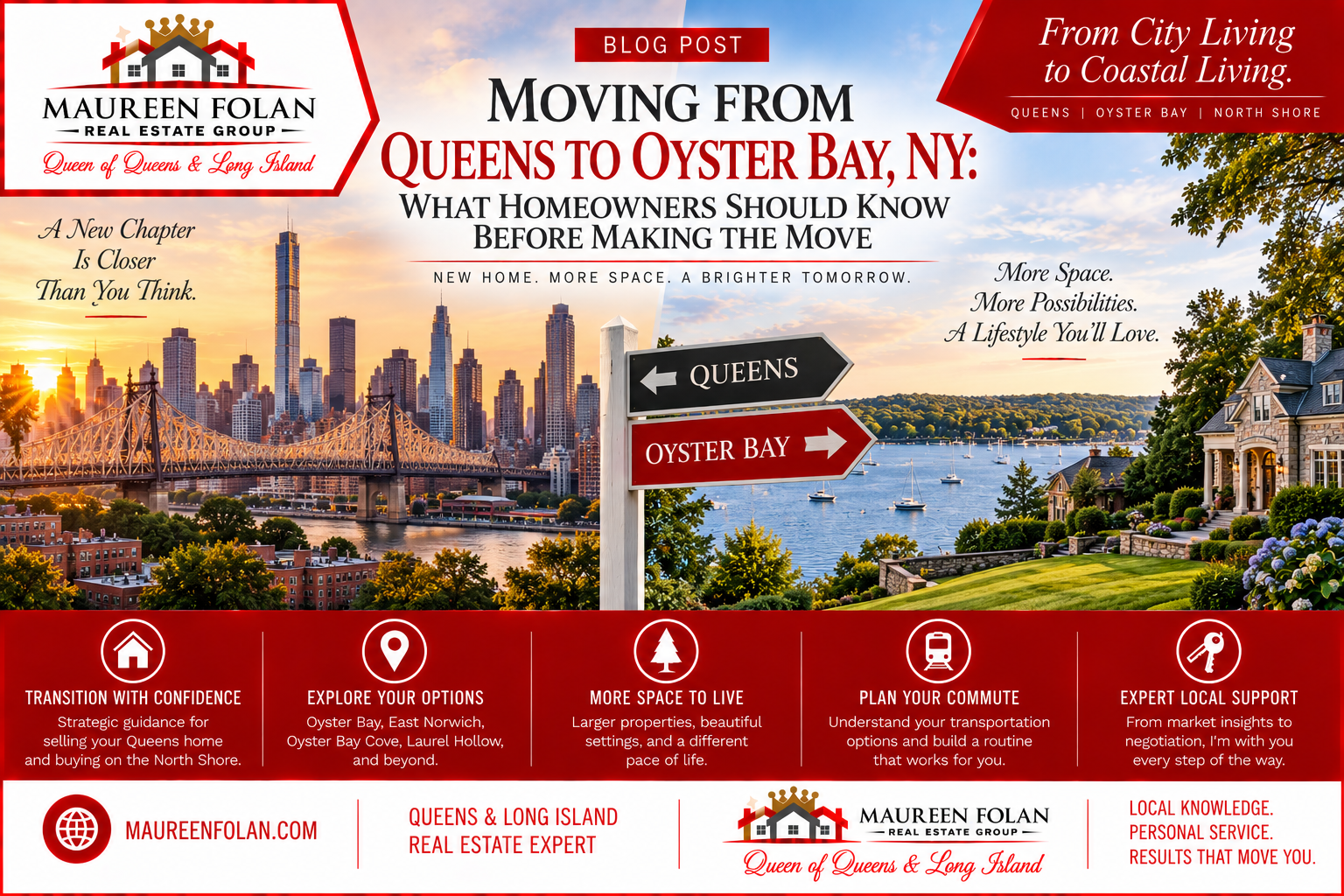
 Moving From Queens to Oyster Bay, NY: What Homeowners Should Know Before Making the Move
What should you know before moving from Queens to Oyster Bay, NY?
Moving from Queens to Oyster Bay can change much more than your address. You may be taking on a different type of home, more property, different ownership expenses, a new transportation routine, and additional maintenance responsibilities. If you already own in Queens, the smartest approach is to understand your current home's potential value first and coordinate its sale with your Oyster Bay purchase as one connected real estate strategy.
Moving From Queens to Oyster Bay, NY Starts With Your Current Home
When you're considering moving from Queens to Oyster Bay, NY, it's natural to start looking at homes for sale.
But if you already own property in Queens, your first step may actually be closer to home.
Before determining what you should spend in Oyster Bay, understand what your Queens property could realistically sell for in the current market.
That means evaluating more than an automated estimate.
A property-specific analysis should consider:
- Relevant recent sales
- Current competing listings
- Property type
- Condition
- Renovations and improvements
- Location
- Lot and layout
- Current buyer activity
Once you understand the potential value of the property you're leaving, you can build a much more realistic strategy for the home you're buying next.
Your Sale Price and Your Available Equity Are Different Numbers
Suppose your Queens property has appreciated substantially.
That's useful.
But the expected sale price isn't automatically the amount you'll have available for your Oyster Bay purchase.
You need to account for your remaining mortgage balance and transaction-related expenses when estimating your likely net proceeds.
Then decide how much equity you actually want to use.
You may want to preserve funds for:
Moving expenses.
Cash reserves.
Improvements.
Furniture.
Landscaping.
Maintenance.
Future capital projects.
The goal isn't necessarily to transfer every available dollar from one property into another.
It's to create a financial structure that works after the move is complete.
Understand Which “Oyster Bay” You're Considering
This is an important geographic distinction.
The Town of Oyster Bay covers a large portion of Nassau County and contains numerous villages and hamlets. The hamlet of Oyster Bay is one specific community within that larger town. Town of Oyster Bay
Nearby communities can include Oyster Bay Cove, East Norwich, Laurel Hollow, and others.
When you're searching listings, make sure you understand exactly where a property is located rather than assuming every “Oyster Bay” reference describes the same market.
Your taxes, property characteristics, transportation, and everyday routine can all depend on the specific location.
Decide What You're Trying to Gain From Leaving Queens
Before you start touring homes seriously, answer one question:
Why are you moving?
Perhaps you want more interior space.
Maybe outdoor property is the priority.
You may want a different type of home.
Perhaps you're looking for a North Shore setting.
Maybe your work situation has changed and you have greater geographic flexibility.
Whatever your reasons are, write them down.
Then evaluate each property against them.
If a home doesn't accomplish the things motivating your move, it may not be the right purchase regardless of how attractive it looks online.
Expect Your Housing Search to Become More Property-Focused
Depending on where you currently live in Queens, the Oyster Bay-area homes you're considering may introduce more variation in:
Lot size.
Age.
Architecture.
Condition.
Outdoor space.
Landscaping.
Maintenance.
Renovation requirements.
Two homes with similar purchase prices may therefore provide very different ownership experiences.
One may be completely updated on a more manageable property.
Another may need work but provide more land.
A third might offer distinctive architecture that you couldn't easily reproduce.
Your search should evaluate the complete property, not simply bedrooms and square footage.
More Space Isn't Automatically Better
One of the most common reasons homeowners consider moving from Queens to Long Island is additional space.
That's a legitimate goal.
But define what kind of space you actually want.
Do you need another bedroom?
A dedicated office?
More storage?
Outdoor entertaining space?
A larger kitchen?
More separation between rooms?
A larger yard?
Once you identify the purpose, you can shop more intelligently.
Otherwise, you may end up paying for square footage or acreage that doesn't materially improve your everyday life.
Outdoor Property Comes With Responsibilities
A larger yard can be exciting.
Then you own it.
Depending on the property, you may be responsible for:
Lawns.
Landscaping.
Trees.
Driveways.
Walkways.
Patios.
Exterior lighting.
Fences.
Drainage.
Seasonal cleanup.
Possibly a pool or other outdoor amenities.
None of this means more land is undesirable.
It means you should understand what comes with it.
Buy the amount of property you want to use and maintain, not simply the largest lot within your budget.
Decide How Much Renovation You're Willing to Take On
Your Oyster Bay search may include homes in very different conditions.
Before you fall in love with one, decide which type of buyer you are.
Move-in-ready: You want little immediate work.
Cosmetic-update: You're comfortable with paint, flooring, fixtures, and manageable projects.
Renovation opportunity: You're willing to undertake substantial work to obtain the right underlying property.
Knowing your tolerance can save considerable time.
It can also protect you from underestimating a project simply because you love the house.
Don't Confuse Dated With Defective
An older kitchen doesn't automatically mean a house is in poor condition.
A bathroom that isn't your preferred style may still function perfectly well.
Paint is easy to change.
Some flooring can be changed later.
When touring homes, separate:
Needs attention
from
Would like to change.
That's especially useful if you're moving from a Queens property that has already been renovated to your preferences.
Your next home doesn't necessarily need to be perfect on closing day.
It needs to have an improvement path you're comfortable with.
Older Homes Deserve Appropriate Due Diligence
The Oyster Bay area can include properties from different architectural periods.
If you consider an older home, don't judge it solely by age.
Age, condition, and appearance are different things.
A well-maintained older property may be a stronger purchase than a newer-looking home with unresolved issues.
If you decide to pursue a property, appropriate professional inspections and other due diligence can help you better understand its condition.
Your attorney and other qualified professionals should advise you on legal, title, documentation, or transaction-specific matters.
The objective isn't to find a maintenance-free home.
It's to know what you're buying.
Property Taxes Need to Be Part of the Search Early
Don't wait until you've found the house you love to investigate property-specific taxes.
They can materially affect your total housing expense.
And don't rely on a generalized estimate for “Oyster Bay taxes.”
Verify the information for the individual property.
When comparing homes, look at:
Purchase price + financing + property-specific taxes + insurance + maintenance + expected improvements.
That's a much more useful affordability comparison than asking price alone.
Consider Insurance and Operating Costs Too
A different type of property can bring different operating expenses.
A larger home may cost more to heat and cool.
More land may increase landscaping expenses.
A pool creates another maintenance category.
An older home may have future capital projects.
A water-adjacent property may introduce additional insurance considerations depending on its location.
Don't build your budget around the mortgage alone.
The home needs to work as an ongoing financial commitment.
Transportation May Be One of the Biggest Changes
If you're moving from Queens but continuing to work there or in Manhattan, transportation deserves serious attention.
The Oyster Bay Branch of the Long Island Rail Road serves the Oyster Bay area. Current schedules and service information should always be verified directly through the Long Island Rail Road.
But don't evaluate transportation from a station map alone.
Start at the actual house.
How long does it take to reach the station?
How will you get there?
Which train fits your schedule?
Does the trip require a transfer?
How does the return trip work?
What happens if you're driving instead?
Your real commute is door to door.
Test the Commute Before You Buy
If transportation is important, experience it.
Drive from the property toward Queens at the time you'd realistically travel.
Check the rail schedule for the trip you would actually take.
Consider the complete journey.
A route that seems reasonable during a weekend showing can feel very different on a weekday morning.
The more frequently you'll make the trip, the more weight transportation deserves in your property decision.
Your Everyday Errands May Change Too
Relocation isn't only about the commute.
Think about the small things.
Where will you shop?
Which restaurants or businesses do you expect to use?
How long will ordinary errands take?
Which public recreation or local destinations matter to you?
The Town of Oyster Bay maintains parks, beaches, recreational facilities, and other public resources throughout the township. Town of Oyster Bay Parks Department
Don't simply note that amenities exist.
Determine whether the ones relevant to you are convenient from the property you're considering.
Spend Time in Oyster Bay Without Touring Houses
This is one of the most useful relocation exercises.
Go there when you don't have a showing.
Walk or drive around the areas relevant to your search.
Run an ordinary errand.
Try your transportation route.
Visit at a different time of day.
You're trying to imagine ordinary life.
A beautiful listing tells you whether you're interested in a property.
Time spent in the location tells you whether the property works in the context of your routine.
Oyster Bay vs. East Norwich
If you're considering Oyster Bay, East Norwich may naturally appear in your search.
Don't assume you need to choose the community before you choose the house.
Compare what your budget buys in each.
Perhaps one property gives you more land.
Another is more updated.
One may work better for your transportation needs.
Another may have a layout or architecture you prefer.
The goal isn't to declare a winner.
It's to identify which property creates the best overall fit.
Oyster Bay Cove and Laurel Hollow May Enter the Search Too
If your budget and property requirements move into the luxury market, nearby Oyster Bay Cove and Laurel Hollow may become relevant.
Those searches can emphasize acreage, privacy, distinctive architecture, mature landscaping, and estate-style properties.
Internal link: Oyster Bay Cove vs. Laurel Hollow: What Luxury Buyers Should Compare
Again, keep the search broad enough that the right property can influence your geographic preference.
Your Queens Sale and Oyster Bay Purchase Need a Timeline
If you need proceeds from your Queens home to purchase your next property, determine the preferred sequence early.
Ask:
- Do I need to sell before I buy?
- How much equity do I expect to use?
- Can I comfortably own both properties temporarily?
- What happens if my Queens home sells first?
- What happens if I find the Oyster Bay home first?
- How much cash do I want to retain after closing?
- Which closing timeline would work best?
These questions can affect how you price your Queens property and how you structure your buying strategy.
Don't Evaluate Your Queens Offers in Isolation
If the Queens sale is funding your Oyster Bay purchase, offer terms can matter as much as they normally do—and perhaps more.
Price is important.
So are financing, contingencies, timing, and transaction certainty.
A slightly different offer structure may align more effectively with your next purchase.
The strongest decision considers the complete move.
Keep Financial Reserves After Closing
Moving into a larger or more complex property can make post-closing reserves especially useful.
Something will eventually need maintenance.
You may want to change the landscaping.
A room may need furniture.
You may discover a project after living in the house.
Don't assume every available dollar of Queens equity should go into maximizing the purchase price.
Your financial strategy continues after the keys are handed over.
Don't Let Competition Rewrite Your Budget
If a property attracts several interested buyers, emotions can move quickly.
Before that happens, know your limits.
What's your comfortable purchase price?
What are the property-specific taxes?
How much work does the home need?
What will the complete ownership cost look like?
Which features justify stretching your budget?
At what point would another property become the better choice?
Preparation helps you make decisions quickly without abandoning discipline.
Don't Choose Oyster Bay Based on Rankings or Assumptions
A relocation decision should be based on your individual housing needs—not generic rankings or assumptions about who should live in a particular community.
Focus on objective factors:
Price.
Property type.
Condition.
Taxes.
Lot.
Maintenance.
Transportation.
Amenities you personally use.
Total ownership costs.
Those factors help you determine whether a property works for you without relying on stereotypes or steering-oriented descriptions.
Five Questions to Answer Before Making the Move
Before committing to an Oyster Bay property, ask:
- Does this home accomplish the reasons I'm leaving Queens?
- Can I comfortably afford the complete ownership cost?
- Am I realistic about the maintenance and renovations involved?
- Does the location work for my actual transportation and everyday routine?
- Does the timing of my Queens sale support this purchase?
If you can answer those clearly, you're approaching the move from a much stronger position.
Final Takeaway: Moving From Queens to Oyster Bay, NY
If you're considering moving from Queens to Oyster Bay, NY, treat the move as more than a home search.
Start with the property you already own.
Understand its potential value and your likely net proceeds.
Decide how much equity you want to use.
Then compare Oyster Bay-area properties based on purchase price, property-specific taxes, condition, land, renovation needs, maintenance, insurance, transportation, and total ownership costs.
Spend time in the area outside of showings.
Test your commute.
Understand what you're trying to gain from the move.
And coordinate the Queens sale with the Long Island purchase before either transaction creates unnecessary pressure.
As Maureen Folan, Queens & Long Island Real Estate Expert, I help homeowners connect both sides of that transition so the sale of your current property and purchase of your next one support the same strategy.
Because moving from Queens to Oyster Bay isn't simply about finding a different house.
It's about making sure the property, finances, timing, and everyday routine all work together for your next chapter. 
Talk With a Queens & Long Island Real Estate Expert
Thinking about selling your Queens home and moving to Oyster Bay or another North Shore community?
Talk With a Queens & Long Island Real Estate Expert at Maureen Folan Real Estate Group.
We can begin by evaluating your current Queens property, estimating how your sale may affect your purchasing strategy, and comparing Oyster Bay, East Norwich, Oyster Bay Cove, Laurel Hollow, and other Long Island options based on your goals.
You can also request the Property Tax Guide to help organize one of the important ownership-cost questions you'll want to investigate as you compare properties.
Maureen Folan
Queens & Long Island Real Estate Expert
Maureen Folan Real Estate Group
MaureenFolan.com
:format(webp):quality(80)/u.realgeeks.media/maureenfolan/001.jpg)
:format(webp):quality(80)/u.realgeeks.media/maureenfolan/HVREPORT.png)