 New Hyde Park vs. Garden City Park, NY: What Homebuyers Should Compare Before Choosing
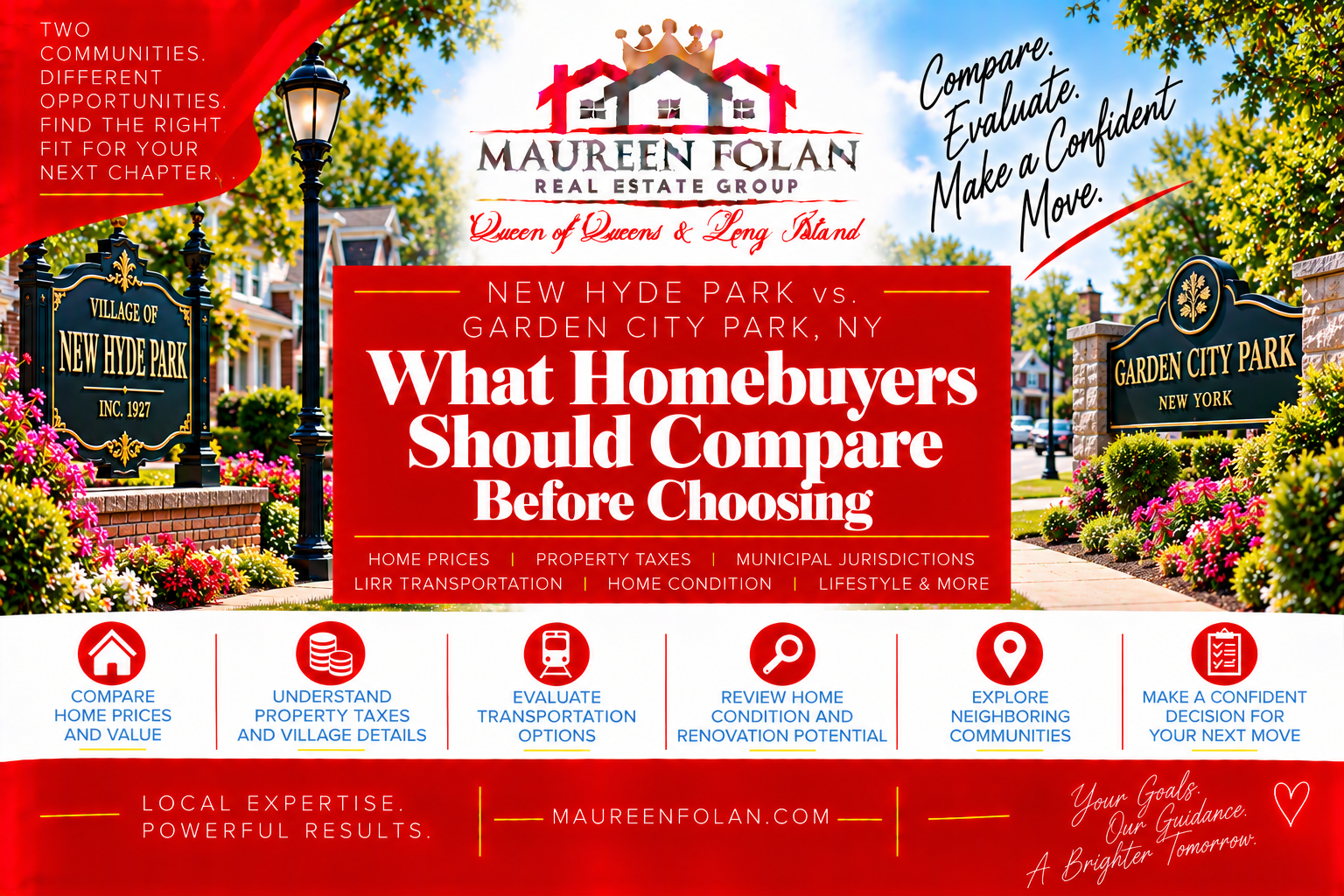
New Hyde Park vs. Garden City Park, NY: what should you compare before deciding where to buy a home?
When comparing New Hyde Park and Garden City Park, NY, you should evaluate individual properties based on purchase price, property taxes, municipal jurisdiction, home condition, transportation, and long-term ownership costs. An important distinction is that New Hyde Park includes an incorporated village, while Garden City Park is an unincorporated community within the Town of North Hempstead. Your best choice depends on the specific home and your priorities.
New Hyde Park vs. Garden City Park, NY: Start With Your Priorities
If you're comparing New Hyde Park vs. Garden City Park, NY, you may already be exploring properties in both communities.
Perhaps you're moving from Queens.
Maybe you're selling an existing Long Island home.
Or you may be looking for additional interior space, a different floor plan, better storage, or outdoor property.
Before deciding where to purchase, ask yourself:
- What purchase price is comfortable?
- How much usable interior space do I need?
- Which property features matter most?
- How important is transportation?
- Am I comfortable completing renovations?
- What maintenance responsibilities do I want?
Your answers should guide the comparison.
Rather than assuming one community is automatically preferable, evaluate what individual properties actually offer.
Understanding New Hyde Park and Garden City Park
New Hyde Park and Garden City Park are neighboring communities in Nassau County.
The incorporated Village of New Hyde Park is located within the Town of North Hempstead.
Garden City Park is an unincorporated community within the Town of North Hempstead.
However, not every property with a New Hyde Park mailing address falls within the incorporated village.
Some surrounding properties use New Hyde Park mailing addresses while being administered by other municipal jurisdictions.
Official information is available through the Village of New Hyde Park and the Town of North Hempstead.
Before purchasing, verify the actual property's jurisdiction.
That distinction may influence applicable taxes, services, permits, and local requirements.
Why Municipal Structure Matters
The incorporated Village of New Hyde Park has its own municipal government.
Garden City Park does not have a separate incorporated village government.
Depending on the property, relevant questions may involve:
Building permits.
Renovation approvals.
Property-related certificates.
Zoning requirements.
Applicable taxes.
Municipal services.
Property records.
Your attorney and appropriate professionals can help clarify transaction-specific requirements.
Don't assume two properties with similar mailing addresses have identical municipal obligations.
Compare What Your Budget Actually Buys
Imagine you're considering two homes.
One is in New Hyde Park and has an updated kitchen, a functional layout, and outdoor space you like.
The other is in Garden City Park and offers additional interior space but needs cosmetic improvements.
Both fall within your budget.
Which represents stronger value?
The answer depends on more than asking price.
Compare condition, layout, usable space, renovation requirements, lot characteristics, taxes, insurance, transportation, and maintenance.
A lower-priced property may require additional investment after closing.
New Hyde Park vs. Garden City Park Property Taxes
Property taxes are an important part of buying a home in Nassau County.
Don't assume two properties with similar asking prices have identical tax obligations.
Official assessment information is available through the Nassau County Department of Assessment.
For each property, verify the applicable taxing jurisdictions.
If the home is within the incorporated Village of New Hyde Park, investigate relevant village-related tax components and services.
For Garden City Park properties, verify the applicable town, county, and other taxing jurisdictions.
Current tax amounts may reflect exemptions or circumstances associated with the existing owner.
Your attorney and appropriate professionals can help clarify transaction-specific questions.
Compare verified property records rather than generalized community averages.
Understand the Complete Cost of Ownership
The purchase price is only one part of your financial decision.
For each serious property, consider:
Purchase price + financing costs + property-specific taxes + insurance + utilities + maintenance + landscaping + expected repairs and improvements.
One home may require substantial renovation.
Another may have more outdoor property to maintain.
A different home may have older components requiring attention sooner.
Your goal isn't simply to purchase the least expensive property.
It's to choose a home whose complete ownership costs fit your financial plans.
Compare Long Island Rail Road Transportation
Transportation may be important if you regularly travel toward Queens or Manhattan.
New Hyde Park has an LIRR station on the Main Line.
Garden City Park does not have an LIRR station within the community, so buyers should evaluate access to nearby stations, including New Hyde Park, based on the individual property's location.
Current schedules and station information are available through the Long Island Rail Road.
Don't assume every property provides identical station access or commuting convenience.
The complete journey depends on the actual address, schedule, and destination.
Calculate Your Complete Door-to-Door Commute
For each property, ask:
How would I reach the station?
How long would that take?
Would I walk, drive, or use another transportation option?
Which train would I realistically use?
Would I need a transfer?
What does the return trip look like?
If you'll primarily drive, evaluate those routes too.
A property that appears convenient on a map may create a different transportation routine than expected.
Test Transportation Under Realistic Conditions
A weekend trip may not represent your weekday commute.
If transportation matters significantly, test your likely route under realistic conditions when practical.
This can be especially useful if you're moving from Queens and expect to continue traveling there or into Manhattan.
Then ask yourself:
What does each property provide in exchange for the transportation routine it creates?
That's a more useful comparison than choosing based on community names alone.
Evaluate Home Condition Before Cosmetic Finishes
Two homes can look very different in listing photographs.
One may have a newly renovated kitchen.
Another may feature older finishes but have been carefully maintained.
Separate three categories:
Appearance: How the home looks.
Age: How old individual features and components are.
Condition: How those components function and have been maintained.
Appropriate professional inspections and due diligence can help you better understand a property's physical condition.
Don't allow attractive finishes to distract you from more important ownership considerations.
Understand Renovation History and Property Documentation
Individual homes can change significantly over time.
A property may have additions, conversions, renovations, or other substantial improvements.
Before purchasing, investigate what work was completed and what documentation exists.
Your attorney and other appropriate professionals can help evaluate relevant permits, certificates, surveys, title information, and transaction-specific records.
The objective isn't to assume modifications are problematic.
It's to understand the property you're purchasing.
Decide Your Renovation Tolerance Before Choosing
Before making an offer, determine whether you're primarily a:
Move-in-ready buyer: You prefer relatively little immediate work.
Cosmetic-update buyer: You're comfortable changing finishes gradually.
Renovation buyer: You're willing to undertake substantial improvements to obtain the underlying property you want.
All three approaches can work.
But if a property only meets your needs after significant construction, investigate realistic costs and timelines before committing.
Don't Confuse Dated With Defective
An older kitchen isn't automatically a problem.
Neither is a bathroom that doesn't match your preferred style.
Paint can change.
Fixtures can change.
Some flooring can change.
Separate what genuinely needs attention from what you'd simply prefer to update.
This can help you recognize strong properties that may not have the newest finishes.
Layout Can Matter More Than Square Footage
Suppose the Garden City Park property offers more reported square footage than the New Hyde Park home.
Does that automatically make it more useful?
Not necessarily.
Walk through both homes as though you've already moved in.
Where do you enter?
How does the kitchen connect with the living areas?
Where would you work?
How much storage exists?
Which rooms would you actually use?
How do you access outdoor areas?
A functional layout may provide more practical value than additional space you won't regularly use.
Compare Storage Directly
A larger home doesn't automatically provide better storage.
Look at closets, pantries, garages, utility areas, and other available storage spaces.
Imagine your actual belongings in each property.
If storage is one reason you're moving, make sure the home genuinely solves that need.
Compare Lots and Outdoor Responsibilities
Outdoor property deserves its own evaluation.
Look beyond lot size.
Consider usability, landscaping, trees, driveways, patios or decks, outdoor entertaining areas, maintenance, and the relationship between the house and yard.
A larger lot may offer more space but also involve additional responsibilities.
Choose outdoor property that supports how you want to use and maintain your home.
Explore New Hyde Park Beyond the Listings
Online photographs and property descriptions can't fully explain your everyday routine.
Spend time in New Hyde Park outside of real estate showings.
Run an ordinary errand.
Test transportation.
Explore local restaurants, shopping areas, public parks, and other destinations relevant to your interests.
Drive routes you expect to use regularly.
You're determining whether the individual location supports your routine.
Explore Garden City Park Beyond the Listings
Apply the same approach in Garden City Park.
Visit public destinations relevant to your interests.
Explore commercial areas.
Test your likely transportation routes.
Consider how frequently you'd use nearby amenities.
Return at another time.
The objective isn't to rank communities.
It's to understand which property and location work best for you.
If You're Moving From Queens, Start With Your Current Home
If you already own in Queens, your existing property may provide much of the financial foundation for your next Long Island purchase.
Before establishing your budget, understand what your Queens home may realistically sell for.
Estimate likely net proceeds after accounting for your remaining mortgage and applicable transaction expenses.
Then determine how much equity you want to use.
You may prefer to preserve funds for moving, repairs, renovations, insurance, future maintenance, and cash reserves.
Your next purchase should leave you financially comfortable after closing.
Coordinate Your Queens Sale With Your Long Island Purchase
If your next purchase depends on the proceeds of your Queens home, establish your preferred transaction sequence early.
Ask:
Do I need to sell before buying?
Could I purchase first?
Can I comfortably own both properties temporarily?
How much equity do I want to use?
How much liquidity should I preserve?
What happens if my Queens property sells before I find the right home?
Your attorney and other appropriate professionals can help address transaction-specific questions.
Planning both transactions together can provide greater flexibility.
New Hyde Park vs. Garden City Park: Homebuyer Comparison Checklist
Use this framework when evaluating individual properties.
| Consideration | New Hyde Park Home | Garden City Park Home |
|---|---|---|
| Purchase price | Compare | Compare |
| Property taxes | Verify | Verify |
| Municipal jurisdiction | Confirm village or other jurisdiction | Confirm applicable jurisdictions |
| Home condition | Evaluate | Evaluate |
| Renovation documentation | Verify | Verify |
| Interior layout | Compare | Compare |
| Usable space | Compare | Compare |
| Storage | Compare | Compare |
| Lot and outdoor space | Compare | Compare |
| LIRR transportation | Evaluate New Hyde Park station access | Evaluate nearby station options |
| Insurance expenses | Obtain estimates | Obtain estimates |
| Maintenance costs | Estimate | Estimate |
| Total ownership costs | Calculate | Calculate |
Not every category should carry equal weight.
Prioritize the factors that matter most to your purchase.
Know Your Non-Negotiables Before Competition Begins
Before making an offer, establish your boundaries.
Comfortable purchase ceiling.
Total ownership-cost limit.
Transportation requirements.
Renovation tolerance.
Lot preferences.
Condition expectations.
Desired cash reserves.
Then determine which preferences are flexible.
Maybe cosmetic finishes can change.
Maybe your transportation routine cannot.
Knowing the difference can help you make decisions without abandoning your broader strategy.
Seven Questions to Ask Before Choosing
Before submitting an offer, ask:
- Which property better accomplishes the reasons I'm moving?
- Which home offers the layout and usable space I need?
- What are the verified property-specific taxes and municipal obligations?
- Which transportation routine works better for my schedule?
- What renovations or maintenance will each property require?
- What are the complete ownership costs?
- Which property can I comfortably own over the long term?
These questions help you focus on the practical realities of ownership.
Final Takeaway: New Hyde Park vs. Garden City Park, NY
When comparing New Hyde Park vs. Garden City Park, NY, don't assume one community is automatically the stronger choice.
The incorporated Village of New Hyde Park has its own municipal government.
Garden City Park is an unincorporated community within the Town of North Hempstead.
New Hyde Park has an LIRR station, while Garden City Park buyers should evaluate nearby station options.
Individual homes can vary substantially in price, condition, layout, taxes, transportation, and maintenance responsibilities.
Compare actual properties.
Verify municipal and tax information.
Test your commute.
Understand renovation requirements.
And calculate total ownership costs before making your decision.
As Maureen Folan, Queens & Long Island Real Estate Expert, I help buyers compare properties based on their individual priorities and long-term goals.
Because choosing between New Hyde Park and Garden City Park isn't simply about selecting a community.
It's about finding the home, location, ownership costs, and everyday routine that make the most sense for your next chapter. 
Schedule a Buyer Consultation
Comparing homes in New Hyde Park, Garden City Park, Floral Park, or nearby Long Island communities?
Schedule a Buyer Consultation with Maureen Folan Real Estate Group.
We'll discuss your budget, property priorities, transportation requirements, condition preferences, renovation tolerance, and ownership-cost expectations.
If you're moving from Queens, we can also develop a coordinated strategy for selling your current home and purchasing your next property.
You can also request the Property Tax Guide to help organize important questions before making an offer.
Maureen Folan
Queens & Long Island Real Estate Expert
Maureen Folan Real Estate Group
MaureenFolan.com