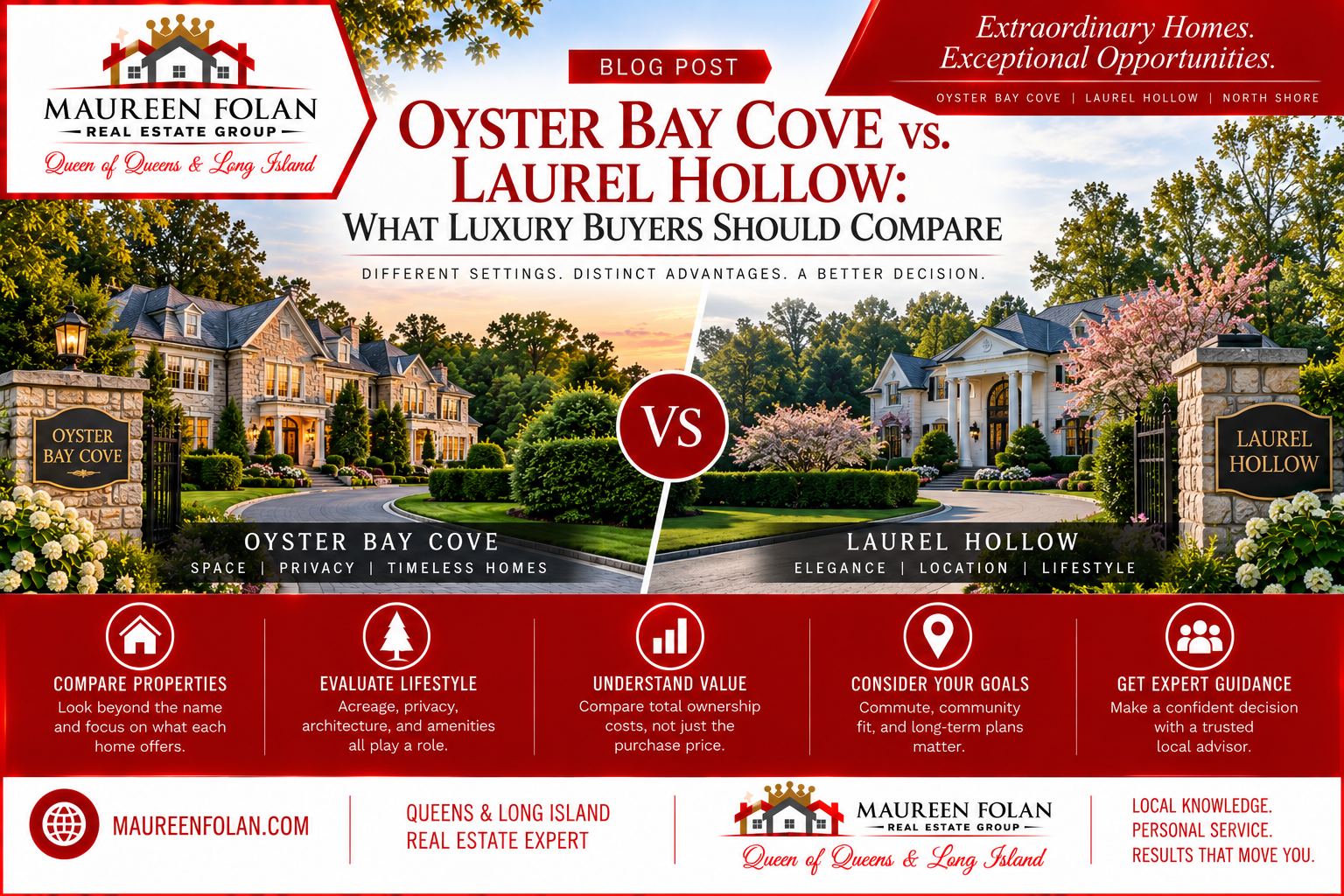
 Oyster Bay Cove vs. Laurel Hollow: What Luxury Buyers Should Compare
Oyster Bay Cove vs. Laurel Hollow: what should you compare before choosing where to buy a luxury home?
Both communities can offer substantial North Shore properties where acreage, privacy, architecture, landscaping, condition, and outdoor amenities play an important role in the purchase. Rather than trying to decide which community is universally “better,” compare the actual homes available within your budget, their total ownership costs, and which property delivers the setting and ownership experience you value most.
Oyster Bay Cove vs. Laurel Hollow Starts With the Property
When you're shopping for luxury real estate on Long Island's North Shore, community names can carry a lot of weight.
But they shouldn't make the decision for you.
If you're comparing Oyster Bay Cove vs. Laurel Hollow, begin with a different question:
What exactly do I want my next property to provide?
More land?
Privacy?
Distinctive architecture?
Move-in-ready condition?
Outdoor entertaining?
A pool?
A particular North Shore location?
A manageable commute?
Once you've defined those priorities, you can compare actual properties instead of two names on a map.
Both Are Incorporated North Shore Villages
Oyster Bay Cove and Laurel Hollow are neighboring incorporated villages within the Town of Oyster Bay in Nassau County.
That gives buyers useful geographic context, but the individual properties can vary dramatically.
Oyster Bay Cove maintains its own village government and municipal resources. Village of Oyster Bay Cove
Laurel Hollow is also an incorporated village with its own local government. Village of Laurel Hollow
For your real estate search, the important takeaway is simple:
Don't assume two nearby luxury markets produce interchangeable properties.
They don't.
Start With What Your Budget Actually Buys
Luxury buyers sometimes try to choose the community before looking seriously at inventory.
Reverse the process.
Establish your comfortable purchase range.
Then examine what that budget currently buys in Oyster Bay Cove and Laurel Hollow.
Perhaps one market gives you more acreage.
Maybe another provides a home requiring less renovation.
One property could offer extraordinary landscaping.
Another might have architecture you prefer.
A third could provide better transportation logistics for your routine.
Now you're making a meaningful comparison.
The real question isn't:
“Which village is better?”
It's:
“Which of these properties gives me more of what I value?”
Acreage Can Be a Major Part of the Comparison
If you're considering either community, land may be one reason you're looking there.
But acreage alone doesn't determine the usefulness or value of a property.
Suppose two homes each occupy substantial lots.
One offers broad, usable lawns and clearly defined outdoor areas.
The other includes significant wooded or sloped terrain.
Those properties may provide completely different experiences despite similar acreage.
When touring, evaluate:
- Lot configuration
- Usable outdoor space
- Topography
- Mature landscaping
- Privacy
- House placement
- Outdoor amenities
- Driveway and arrival
- Maintenance requirements
Buy the land that supports what you actually want to do with it.
Privacy Needs to Be Experienced in Person
“Private” is one of the most common descriptions in luxury listings.
It can also mean several different things.
In Oyster Bay Cove, one property may achieve privacy through acreage and setback.
Another may depend heavily on mature landscaping.
A Laurel Hollow property may use topography, orientation, or a combination of land and vegetation.
Don't simply count acres.
Stand inside the home.
Look out from the main rooms.
Walk the property where appropriate.
Notice neighboring homes.
Then ask:
Does this property actually feel private to me?
That's the standard that matters.
What Creates the Privacy Also Affects Maintenance
This is an easily overlooked part of the luxury-home comparison.
Suppose mature trees and extensive landscaping create much of a property's privacy.
That's attractive.
Those trees and plantings also require care.
A larger setback may mean a longer driveway.
Extensive grounds can require landscaping, irrigation, exterior lighting, drainage management, and seasonal maintenance.
Privacy has value.
It also has an operating cost.
Understanding both sides helps you compare properties more intelligently.
Architecture May Matter More Than the Village Name
Luxury buyers often begin with geography and end up choosing architecture.
You may walk into a home and discover that the proportions, natural light, materials, layout, and relationship to the property are exactly what you've been searching for.
At that point, whether the address says Oyster Bay Cove or Laurel Hollow may become less important.
Pay attention to what can't easily be changed.
The fundamental architecture.
Room proportions.
Placement on the land.
Natural light.
Views.
Relationship between indoor and outdoor spaces.
Those characteristics can matter much more over years of ownership than a countertop you can replace.
Don't Confuse Newer With Better
A completely renovated property can be extremely appealing.
You know what you're buying.
Immediate projects may be limited.
The home may feel easy to occupy from the first day.
But don't automatically assume it is the better luxury purchase.
An older home might offer superior architecture, more compelling land, mature landscaping, or another difficult-to-replicate characteristic.
The question is whether you're comfortable with its condition and future projects.
A luxury buyer should distinguish between:
New. Updated. Well maintained. Architecturally significant.
They're not synonymous.
Renovation Quality Deserves Scrutiny
If a property has been extensively renovated, look beyond the phrase “fully updated.”
Does the renovation fit the architecture?
How is the craftsmanship?
Are the materials appropriate for the price point?
Was the work primarily cosmetic?
Were major systems also addressed?
Where relevant, what documentation is available regarding significant improvements?
A recent renovation can create value.
A thoughtful renovation can create more.
Condition Can Change the Financial Comparison
Suppose the Oyster Bay Cove home costs less but requires substantial work.
The Laurel Hollow property is more expensive but largely move-in-ready.
Which is the better value?
You need a larger equation:
Purchase price + immediate repairs + planned renovations + time + disruption + ongoing ownership costs.
Then compare that with the move-in-ready alternative.
The less expensive home may still be the better purchase.
But you won't know that by looking at asking prices alone.
Total Ownership Cost Matters at Luxury Price Points Too
For every serious property, calculate beyond the purchase.
Consider:
Purchase price + financing where applicable + property-specific taxes + insurance + utilities + landscaping + maintenance + expected improvements.
A larger home can cost more to operate.
More acreage can cost more to maintain.
Pools and specialized outdoor amenities add responsibilities.
Older properties may require future capital projects.
The strongest luxury purchase is the one you're comfortable owning—not simply the one you can afford to close on.
Verify Property Taxes Individually
Don't assume similar asking prices mean similar taxes.
Verify the property-specific tax information for every serious home.
This becomes particularly useful when comparing Oyster Bay Cove with Laurel Hollow because a difference in ongoing expenses may affect how you view two otherwise similar opportunities.
A purchase price is visible immediately.
The ownership cost follows you every year.
Outdoor Amenities Should Have Personal Value
A pool looks impressive during a showing.
So does an elaborate outdoor kitchen.
Formal gardens can be beautiful.
A large terrace can transform entertaining.
But ask whether you'll use those features.
A buyer who wants a pool may consider it a significant asset.
Another buyer may see maintenance.
The same feature can therefore have very different personal value.
When comparing properties, separate:
“This is impressive.”
from
“This improves the way I want to live.”
That distinction can save you from paying a premium for amenities you don't actually want.
Mature Landscaping Can Be Difficult to Reproduce
One advantage of established luxury properties can be landscaping that has developed over decades.
Mature trees.
Screening.
Gardens.
Hedges.
Established plantings.
These features can create privacy and character that a newly landscaped property can't immediately reproduce.
If mature landscaping is part of what attracts you, consider it a legitimate property feature.
Then investigate the maintenance involved.
Scarcity and responsibility often come together.
The Arrival Experience Can Tell You a Lot
On a substantial property, pay attention before you reach the front door.
How does the property announce itself?
Is there a long approach?
How does the house first become visible?
Does the landscaping complement the architecture?
Does the home feel appropriately positioned on the land?
Luxury real estate can have an experiential component that isn't captured by bedroom counts.
If the arrival feels meaningful to you every time you come home, that can be part of the property's appeal.
Location Still Matters When the Property Feels Secluded
Privacy doesn't mean isolation from practical needs.
Test the location from the actual home.
How long does it take to reach places you expect to use regularly?
What does your work trip look like?
Where will you handle ordinary errands?
If rail transportation is relevant, investigate the stations and schedules you'd realistically use through the Long Island Rail Road.
Don't let a peaceful showing distract you from evaluating Monday morning.
Test Your Actual Transportation Routine
Drive the route if possible.
Do it at a realistic time.
A difference that looks insignificant on a map may matter when repeated regularly.
If you only commute occasionally, transportation may carry less weight.
If you're making the trip several times each week, it may become one of the most important differences between two otherwise compelling homes.
Your search priorities should reflect your schedule, not a generic commute description.
Spend Time in the Broader Oyster Bay Area
Don't make every visit a showing appointment.
Spend time around the broader area.
Drive through Oyster Bay.
Visit public destinations you expect to use.
Try an ordinary errand.
Explore nearby routes.
Return at another time of day.
You're not trying to determine which community is “nicer.”
You're trying to understand whether the broader location works with your everyday life.
That information can be surprisingly influential once two properties are otherwise close.
Scarcity Becomes More Important as Your Requirements Increase
Luxury inventory can become extremely limited when you combine several requirements.
Imagine you want:
At least a certain amount of usable acreage.
Significant privacy.
A pool.
Move-in-ready condition.
A particular architectural style.
A specific purchase range.
A manageable commute.
You may wait for the right combination.
That's normal.
Scarcity is part of the luxury search.
But scarcity shouldn't make every qualifying property automatically worth its asking price.
Rare and appropriately valued are two different things.
Keep Your Search Geographic Enough to Find the Right Home
If you're open to both Oyster Bay Cove and Laurel Hollow, you may benefit from remaining open to other nearby North Shore opportunities as well.
The property may matter more than the municipality.
A home in Cold Spring Harbor might unexpectedly fit your requirements.
Another North Shore property may deliver the acreage or architecture you're trying to find.
Your search can be focused without becoming unnecessarily rigid.
If You're Moving From Queens, Start With the Home You Own
For Queens homeowners, the move into either community can represent a substantial property transition.
Start by understanding your current home's potential market value.
Then estimate the proceeds that may realistically be available after your remaining mortgage and transaction-related expenses.
Decide how much of that equity you want to deploy.
And consider reserves.
Moving from a Queens property into a larger North Shore home may increase your landscaping, maintenance, utilities, and future capital-project exposure.
Your purchase budget should reflect that.
Don't Automatically Use Every Dollar of Equity
If your Queens home has appreciated substantially, you may have meaningful equity available.
That doesn't mean all of it belongs in the next down payment.
A luxury property may benefit from greater post-closing liquidity.
You might want to make improvements.
Landscaping requires ongoing attention.
Unexpected repairs happen.
Ownership expenses continue.
Think about the balance between purchase power and financial flexibility.
Appropriate Inspections and Due Diligence Matter
Luxury doesn't mean problem-free.
If you decide to pursue a property, appropriate professional inspections and due diligence can help you better understand its condition.
Depending on the home, additional evaluation may be relevant for particular systems, structures, outdoor amenities, or other property features.
Your attorney and other qualified professionals should guide you on legal and transaction-specific matters.
The purpose isn't to eliminate every future maintenance expense.
It's to understand the asset you're purchasing.
Compare Your Best Option in Each Community
Once you've toured enough homes, create a direct comparison.
| Factor | Oyster Bay Cove Option | Laurel Hollow Option |
|---|---|---|
| Purchase price | Compare | Compare |
| Property-specific taxes | Compare | Compare |
| Architecture | Compare | Compare |
| Interior condition | Compare | Compare |
| Usable acreage | Compare | Compare |
| Privacy | Compare | Compare |
| Landscaping | Compare | Compare |
| Outdoor amenities | Compare | Compare |
| Renovation needs | Compare | Compare |
| Transportation | Compare | Compare |
| Maintenance | Compare | Compare |
| Total ownership cost | Compare | Compare |
Then decide which categories actually matter most to you.
Not every row deserves equal weight.
That's where the decision becomes personal.
Oyster Bay Cove May Fit You Better If...
Oyster Bay Cove may rise to the top when the specific properties available there give you the combination of acreage, privacy, architecture, outdoor environment, and location you're looking for.
You may simply find a home there whose land and setting are difficult to reproduce elsewhere.
That's enough reason to choose it.
You don't need to prove Oyster Bay Cove is universally superior.
Laurel Hollow May Fit You Better If...
Laurel Hollow may become the stronger choice when the available property there gives you a better combination of house, land, privacy, condition, location, and ownership costs.
Perhaps the architecture is exactly right.
Maybe the outdoor environment works better.
Perhaps its particular location makes more sense for your routine.
Again, let the home lead.
Don't Choose Based on Status
This matters particularly in luxury real estate.
Don't buy in either community because you believe the address itself is what makes the purchase worthwhile.
Ask what you're receiving for the premium.
Land?
Privacy?
Architecture?
Condition?
Outdoor amenities?
Location?
Scarcity?
If those characteristics are valuable to you, the premium may make sense.
Luxury should serve your life—not simply signal a price point.
Final Takeaway: Oyster Bay Cove vs. Laurel Hollow
So, Oyster Bay Cove vs. Laurel Hollow—which is right for you?
Both can present luxury buyers with substantial North Shore properties where acreage, privacy, architecture, mature landscaping, and outdoor amenities may be important parts of the purchase.
But neither community wins in the abstract.
Your decision should come down to the best actual properties available and how they compare on:
Price.
Property-specific taxes.
Condition.
Usable land.
Privacy.
Architecture.
Outdoor amenities.
Maintenance.
Transportation.
Total ownership cost.
As Maureen Folan, Queens & Long Island Real Estate Expert, I help buyers compare North Shore luxury homes at that property level—because that's where the differences that actually affect your ownership experience become clear.
The strongest answer to Oyster Bay Cove vs. Laurel Hollow isn't a community ranking.
It's the property that gives you more of what you value without asking you to own more than you want. 
Schedule a Buyer Consultation
Comparing luxury homes in Oyster Bay Cove and Laurel Hollow?
Schedule a Buyer Consultation with Maureen Folan Real Estate Group.
We'll compare current properties based on your budget, architecture preferences, acreage and privacy priorities, condition tolerance, transportation requirements, and long-term ownership goals.
If you're moving from Queens, we can also connect your current-home sale with your North Shore purchase through one coordinated strategy.
Maureen Folan
Queens & Long Island Real Estate Expert
Maureen Folan Real Estate Group
MaureenFolan.com
:format(webp):quality(80)/u.realgeeks.media/maureenfolan/001.jpg)
:format(webp):quality(80)/u.realgeeks.media/maureenfolan/HVREPORT.png)