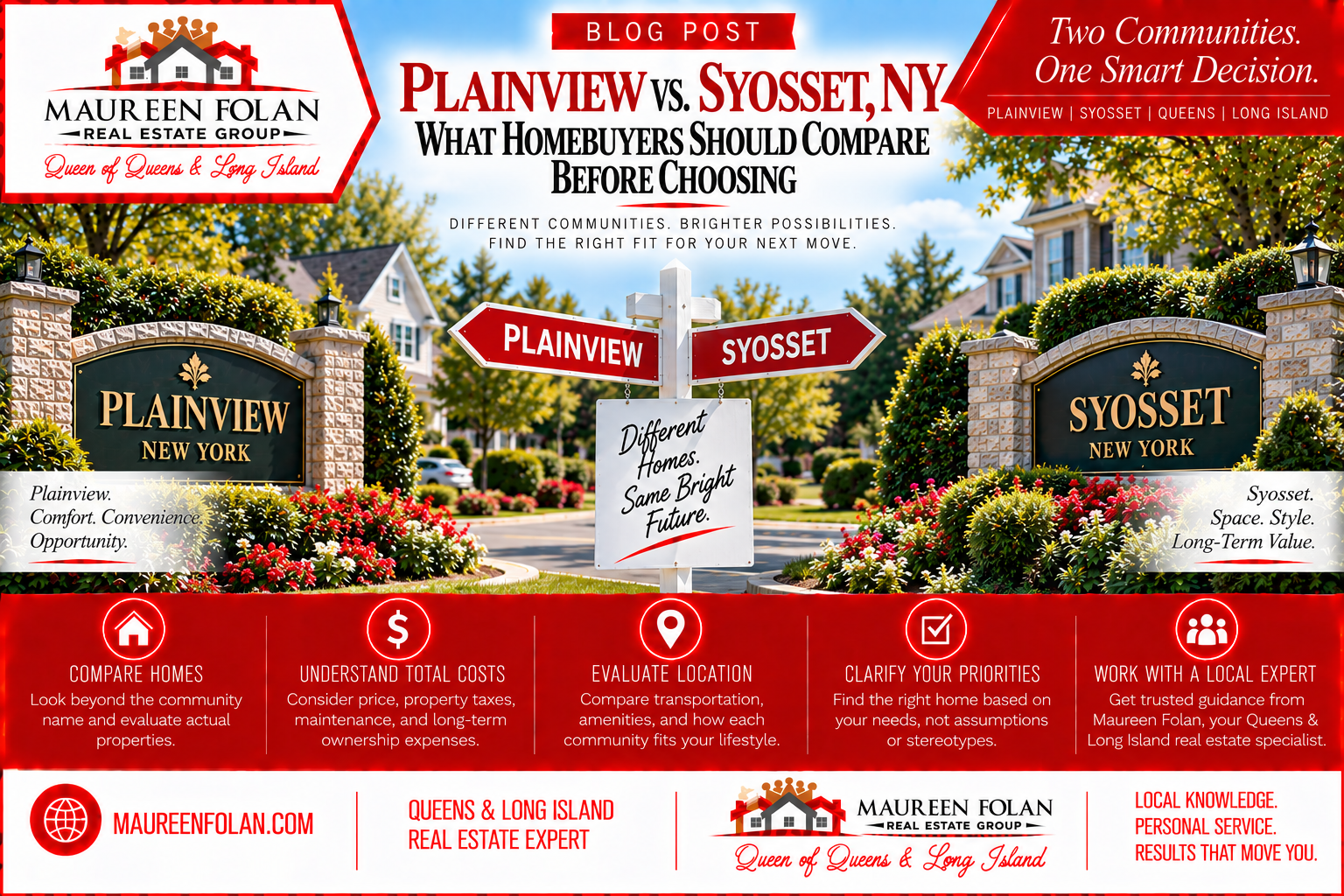
 Plainview vs. Syosset, NY: What Homebuyers Should Compare Before Choosing
Plainview vs. Syosset, NY: what should you compare before deciding where to buy your next Long Island home?
Plainview and Syosset are neighboring Nassau County communities within the Town of Oyster Bay, but individual properties can create very different ownership experiences. Instead of trying to determine which community is universally “better,” compare the actual homes available within your budget, property-specific taxes, condition, layout, lot, transportation, maintenance requirements, renovation needs, and total ownership costs.
Plainview vs. Syosset, NY Starts With the Property
If you're comparing Plainview vs. Syosset, NY, it can be tempting to choose the community first.
Then look for a house.
Consider reversing that process.
Define your priorities.
Establish your comfortable budget.
Determine your transportation requirements.
Decide how much renovation and maintenance you're willing to accept.
Then compare the strongest properties available in both locations.
You may discover that the right home makes the community decision much easier.
Understand the Geographic Context
Plainview and Syosset are both Nassau County hamlets within the Town of Oyster Bay.
The Town of Oyster Bay provides official municipal information and services, while Nassau County maintains property-assessment resources through its Department of Assessment.
That geographic proximity can naturally put both communities into the same buyer search.
But proximity doesn't make the homes interchangeable.
The property still determines what you're actually buying.
Start With What Your Budget Buys Today
Broad community comparisons can become abstract quickly.
Real listings make the decision concrete.
Suppose your comfortable budget gives you:
A renovated Plainview home with a manageable lot.
And a Syosset property offering more space but requiring cosmetic improvements.
Now you have a meaningful comparison.
Ask:
Which layout works better?
Which condition are you more comfortable with?
How do the ownership costs compare?
Which transportation routine works for you?
Which property's strengths are hardest to reproduce?
That's more useful than asking which community has the stronger reputation.
Compare Complete Ownership Costs
Two homes can have nearly identical asking prices and create different financial experiences.
For each property, calculate:
Purchase price + financing + property-specific taxes + insurance + utilities + landscaping + maintenance + expected repairs and improvements.
Perhaps the lower-priced home needs substantial renovation.
Maybe the larger property costs more to maintain.
One could have different taxes.
The asking price is only the beginning of the comparison.
Verify Property Taxes Individually
Avoid relying on generalized statements about taxes in either Plainview or Syosset.
Research the actual homes.
Nassau County provides official assessment resources through its Department of Assessment.
Current tax information may reflect exemptions or circumstances associated with the existing owner.
Your attorney and other appropriate professionals can help you understand information relevant to your transaction.
Compare property-specific facts rather than community assumptions.
Condition Can Completely Change the Value Equation
Imagine the Plainview property is largely move-in-ready.
The Syosset home costs somewhat less but needs significant updating.
Which offers stronger value?
You need more information.
For the less updated property, consider:
Immediate repairs.
Desired renovations.
Professional costs where applicable.
Time.
Construction disruption.
Then compare the complete project.
The less expensive asking price may still produce the stronger opportunity.
Or the move-in-ready premium may be worth paying.
Decide Your Renovation Tolerance First
This is one of the best filters you can establish before choosing between communities.
Are you a:
Move-in-ready buyer?
Cosmetic-update buyer?
Renovation buyer?
If you have no interest in managing construction, a property requiring major work may not be a bargain for you.
If you're comfortable renovating, condition may matter less than lot, architecture, or location.
Your tolerance changes the comparison.
Dated Doesn't Automatically Mean Poor Condition
An older kitchen isn't necessarily defective.
Neither is a bathroom that isn't your style.
Paint can change.
Fixtures can change.
Some flooring can change.
Try separating:
Needs attention
from
Would like to change.
That prevents cosmetic reactions from overpowering more permanent property characteristics.
New Finishes Don't Tell the Entire Story Either
A newly renovated interior can be attractive.
Still evaluate the whole property.
Look at:
Layout.
Storage.
Natural light.
Lot.
General maintenance.
Outdoor spaces.
Major components where appropriate.
Transportation.
Taxes.
A beautiful kitchen is one part of the ownership experience.
Don't let it become the entire analysis.
Compare Layout Before Square Footage
Suppose the Syosset home is larger.
Does that automatically make it more useful?
Walk through both properties and imagine your routine.
Where do you enter?
How does the kitchen connect with living spaces?
Where would you work?
How much storage exists?
Which rooms would you actually use?
How do you reach the outdoor areas?
Useful square footage can matter more than total square footage.
Don't Pay for Rooms You Don't Need
More interior space means more to:
Furnish.
Clean.
Heat.
Cool.
Maintain.
Eventually repair.
If the additional rooms solve a genuine need, that can be valuable.
If you can't identify how you'd use them, the smaller property may offer a more efficient ownership experience.
Buy the space that serves you.
Compare the Lots Carefully
Outdoor property can materially change the decision.
Don't compare only lot size.
Evaluate:
Usability.
Topography.
Privacy.
Landscaping.
Trees.
Driveway.
Outdoor entertaining areas.
Maintenance.
Relationship between the house and yard.
A smaller, highly functional lot can sometimes provide more value to you than additional land.
Ask How Much Property You Want to Maintain
If you're moving from Queens, more outdoor space may be one of your goals.
Just remember that more property creates more responsibilities.
Lawns.
Trees.
Landscaping.
Irrigation where applicable.
Driveways.
Walkways.
Patios or decks.
Seasonal cleanup.
The right lot is the one you want to use and maintain.
Storage Can Resolve the Comparison
A larger home doesn't automatically have better storage.
Look at:
Closets.
Pantry.
Garage.
Basement or other areas where applicable.
Utility storage.
Imagine your actual belongings in each property.
If lack of storage is one reason you're moving, give this category appropriate weight.
Natural Light Is Worth Comparing in Person
Listing photography can make both properties look bright.
Visit them.
How do the main rooms feel?
What do the windows face?
How does each home sit on its lot?
Do mature trees affect the light?
Paint can change.
The home's orientation is much harder to alter.
Natural light may become an important differentiator.
Transportation Is One Meaningful Difference to Investigate
Syosset has a Long Island Rail Road station.
Plainview does not have its own LIRR station, so a Plainview buyer planning to use rail service would need to determine which nearby station and route make sense from the specific home.
Current station, schedule, and service information should always be verified through the Long Island Rail Road.
That distinction doesn't automatically make one property better.
It gives you something concrete to compare.
Compare Door-to-Door Transportation
For each home, calculate the actual journey.
From the Plainview property:
Which station would you use?
How would you reach it?
How long would that take?
Now do the same from the Syosset home.
Then compare the trains you'd realistically use.
If you're driving, compare those routes too.
Your commute isn't a community statistic.
It's a repeated trip from a specific front door.
Test Transportation Under Realistic Conditions
If your commute is important, test it at a relevant time when practical.
This becomes particularly useful if you're moving from Queens and plan to continue working there or in Manhattan.
Compare both Long Island options with your current routine.
Then ask:
What am I gaining from each property in exchange for the transportation change?
That puts the commute into context.
Spend Time in Both Locations Without Looking at Houses
Not every visit needs to be a showing.
Spend some ordinary time in Plainview.
Do the same in Syosset.
Run errands.
Test transportation.
Drive from the areas you're considering to places you personally expect to use.
Return at different times.
You're not trying to rank the communities.
You're testing whether the individual locations work for your routine.
If You're Moving From Queens, Compare Both Against Your Current Property
This can make the decision much clearer.
Ask how the Plainview option changes:
Interior space.
Outdoor property.
Transportation.
Taxes.
Maintenance.
Ownership costs.
Now ask the same questions about the Syosset property.
Which move accomplishes more of the reasons you're leaving Queens?
That's often more useful than comparing Plainview and Syosset only with each other.
Internal link: Moving From Queens to Plainview, NY: What Homeowners Should Know Before Relocating
Start With Your Queens Equity
If you already own in Queens, understand what your current property may realistically sell for.
Then estimate likely net proceeds.
That gives you a clearer idea of your purchasing power.
But don't automatically convert all available equity into a larger purchase.
Decide how much you want to deploy and how much you want to retain.
Preserve Financial Flexibility
Your next home may involve expenses you didn't have previously.
More landscaping.
More maintenance.
Renovation.
Furniture.
Moving costs.
Future capital projects.
Financial reserves can give you flexibility after closing.
The strongest purchase isn't necessarily the most expensive home your Queens equity allows you to buy.
Plainview May Fit Your Search When...
A particular Plainview home may become more compelling when its combination of:
Price.
Taxes.
Condition.
Layout.
Lot.
Transportation.
Maintenance.
Total ownership costs.
aligns more closely with your priorities.
That's a property-specific conclusion.
It doesn't mean Plainview is universally superior.
Syosset May Fit Your Search When...
Likewise, a particular Syosset property may become more compelling because its condition, layout, lot, transportation, ownership costs, or another characteristic better fits what you need.
Again, let the actual home lead.
You're buying a property, not winning a community comparison.
Build a Plainview vs. Syosset Comparison Sheet
Once you've identified serious properties, put them side by side:
| Factor | Plainview Home | Syosset Home |
|---|---|---|
| Purchase price | Compare | Compare |
| Property-specific taxes | Verify | Verify |
| Condition | Compare | Compare |
| Layout | Compare | Compare |
| Usable lot | Compare | Compare |
| Storage | Compare | Compare |
| Natural light | Compare | Compare |
| Renovation needs | Compare | Compare |
| Transportation | Compare | Compare |
| Maintenance | Compare | Compare |
| Total ownership cost | Compare | Compare |
Then decide which categories matter most.
They shouldn't all receive equal weight.
Know Your Non-Negotiables Before Making an Offer
Before competition enters the picture, establish your boundaries.
Comfortable purchase ceiling.
Total ownership-cost limit.
Transportation requirement.
Renovation tolerance.
Lot preference.
Condition requirement.
Desired cash reserves.
Then identify your preferences.
Maybe paint doesn't matter.
Maybe transportation does.
Knowing the difference helps you act decisively without abandoning your strategy.
Don't Choose Based on Rankings or Demographic Assumptions
A Plainview vs. Syosset, NY decision should be based on objective property and location characteristics relevant to you.
Avoid generalized claims about who lives in either community or who should move there.
Instead, compare:
Property.
Price.
Taxes.
Condition.
Layout.
Lot.
Transportation.
Maintenance.
Amenities you personally use.
Total ownership costs.
Long-term plans.
That keeps the decision centered on your actual needs.
Seven Questions That Can Clarify Plainview vs. Syosset
Before choosing, ask:
- Which property better accomplishes the reasons I'm moving?
- Which complete ownership cost is more comfortable?
- Which layout better supports my routine?
- Which lot gives me the outdoor space I actually want?
- Which transportation routine works better for my schedule?
- Which renovation and maintenance responsibilities am I more comfortable accepting?
- If both homes disappeared tomorrow, which features would I search for again?
That final question can help reveal what you genuinely value.
Final Takeaway: Plainview vs. Syosset, NY
If you're comparing Plainview vs. Syosset, NY, don't try to declare a universal winner.
Compare actual properties.
Look at their purchase prices, property-specific taxes, condition, layouts, lots, storage, natural light, renovation requirements, transportation, maintenance, and total ownership costs.
Spend time in both locations.
Test your commute.
If you're moving from Queens, compare each option with your current property and determine which move better accomplishes your actual goals.
As Maureen Folan, Queens & Long Island Real Estate Expert, I help buyers compare these decisions property by property rather than relying on broad rankings.
Because the strongest answer to Plainview vs. Syosset isn't one community name.
It's the home, costs, location, and ownership experience that fit your next move. 
Schedule a Buyer Consultation
Comparing Plainview and Syosset—or exploring Woodbury, Jericho, and other Long Island communities?
Schedule a Buyer Consultation with Maureen Folan Real Estate Group.
We'll compare current properties based on your budget, condition preferences, lot requirements, transportation, renovation tolerance, maintenance expectations, and total ownership costs.
If you're moving from Queens, we can also coordinate your current-home sale with your Long Island purchase through one Queens-to-Long-Island strategy.
You can also request the Property Tax Guide to help organize the ownership-cost questions worth investigating before making your decision.
Maureen Folan
Queens & Long Island Real Estate Expert
Maureen Folan Real Estate Group
MaureenFolan.com

