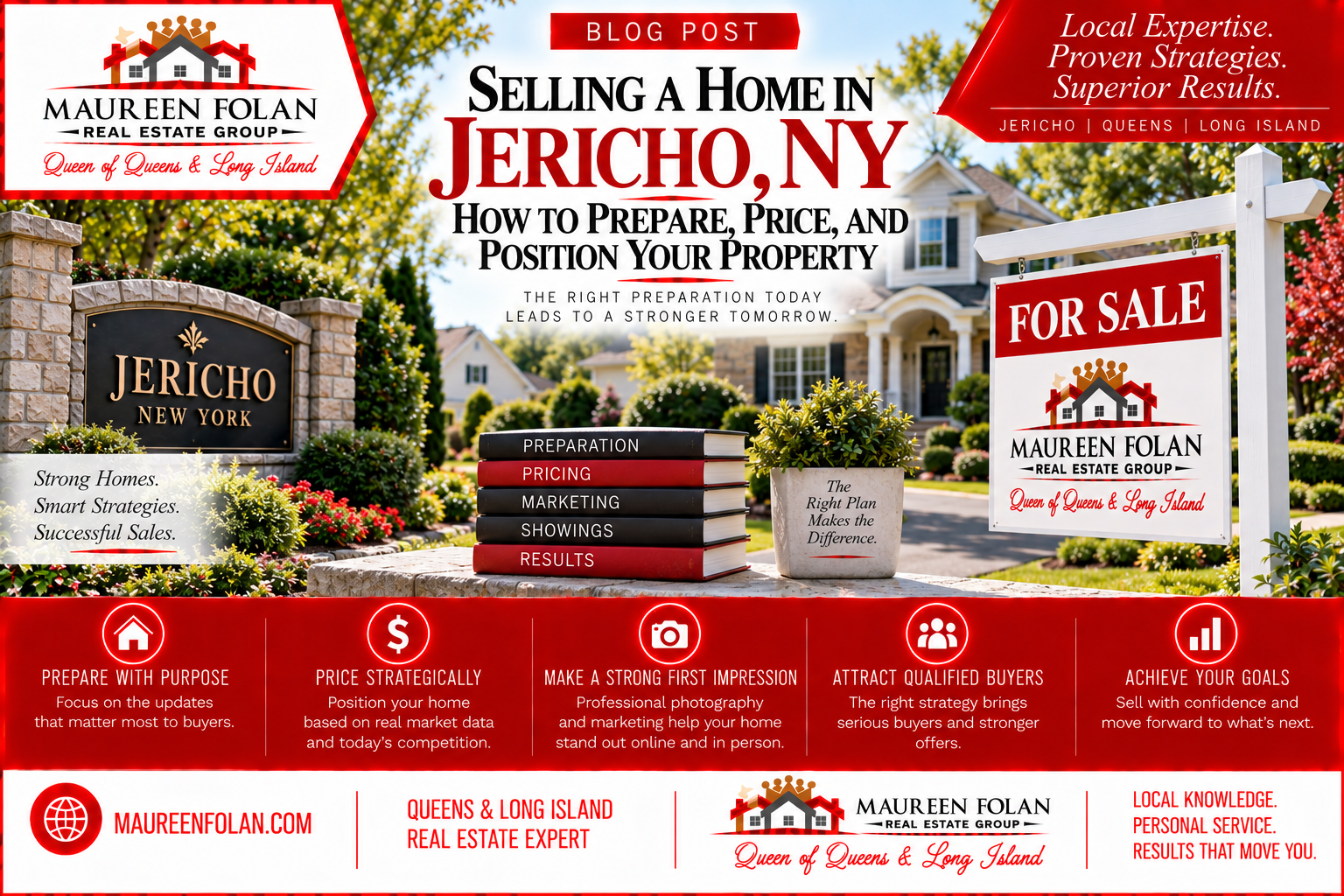
 Selling a Home in Jericho, NY: How to Prepare, Price, and Position Your Property
What should you do before selling a home in Jericho, NY?
Before listing your Jericho home, determine how it compares with the properties buyers can purchase today. A strong selling strategy aligns your home's condition, preparation, pricing, photography, marketing, showing access, and distinctive property features so buyers can quickly understand its value relative to the competition.
Selling a Home in Jericho, NY Starts With the Buyer's Alternatives
If you're thinking about selling a home in Jericho, NY, your first instinct may be to ask:
“How much is my home worth?”
That's important.
But there's another question that helps answer it:
“What else could a buyer purchase instead of my home?”
Buyers don't evaluate your property in isolation.
They compare it with other listings based on:
Price.
Condition.
Interior space.
Lot.
Layout.
Renovations.
Property-specific taxes.
Location.
Maintenance.
Presentation.
Your selling strategy begins by understanding where your home fits among those alternatives.
Start With a Property-Specific Value Analysis
An online estimate can provide a reference point.
A serious pricing strategy needs more context.
Your home's potential market position should account for factors including:
- Relevant recent sales
- Current competing listings
- Property condition
- Renovations and improvements
- Interior size
- Layout
- Lot characteristics
- Outdoor spaces
- Architecture
- Property-specific location
- Current buyer activity
The goal isn't to find the highest nearby sale.
It's to understand which transactions are genuinely relevant to the property you're selling.
Jericho Is Part of the Town of Oyster Bay
Jericho is located within the Town of Oyster Bay in Nassau County.
The Town of Oyster Bay provides official municipal information and resources, while Nassau County maintains property-assessment information through its Department of Assessment.
For sellers, geography is useful context.
But even within the same community, individual properties can differ considerably.
That's why the strongest comparable isn't necessarily the nearest sale.
It's the property buyers would realistically compare with yours.
Don't Anchor Your Price to One Neighbor's Sale
Suppose a nearby home sold for an impressive number.
Naturally, you want to know whether your property could achieve something similar.
Start by investigating the differences.
Was that home extensively renovated?
How did the lot compare?
Did it offer more usable interior space?
Was the layout similar?
What outdoor features did it have?
How did its condition compare?
When did it sell?
A sale price without property context can create unrealistic expectations.
The useful information is why the buyer paid that amount.
Active Listings Matter Just as Much
Closed sales tell you what buyers paid.
Active listings tell you what buyers can purchase right now.
Imagine recent transactions appear to support your intended price.
Then two strong competing homes enter the market just before you list.
Your buyer sees them too.
Compare your property with those homes.
Where is yours stronger?
Where are they stronger?
How does the condition compare?
What about lot, layout, renovation, and presentation?
Today's competition should influence today's strategy.
Price and Condition Need to Tell the Same Story
Buyers evaluate price and condition together.
An extensively renovated home may occupy a different competitive position from one requiring significant cosmetic work.
That doesn't mean an older kitchen prevents a strong sale.
Maybe your home offers:
A compelling lot.
A layout buyers value.
Useful interior space.
Distinctive architecture.
Outdoor areas.
Another difficult-to-reproduce characteristic.
But the asking price needs to make the complete package understandable.
You Don't Automatically Need a New Kitchen
This is where sellers can spend substantial money before establishing whether the expense is necessary.
Before remodeling, ask:
Is the kitchen functional?
Is it maintained?
How does it compare with current competition?
Could smaller improvements strengthen its presentation?
Would a renovation materially change the property's competitive category?
How much would the project cost?
How long would it delay your sale?
Would buyers value your selections?
Renovation should be a strategy.
Not a reflex.
Divide Preparation Into Repairs, Refreshes, and Renovations
This framework can help control your pre-listing budget.
Repairs
Things that are damaged, malfunctioning, unfinished, or visibly need attention.
Refreshes
Cleaning, decluttering, lighting, paint, landscaping, furniture editing, and other targeted cosmetic improvements.
Renovations
Major projects involving substantial construction, cost, and time.
Work through those categories in order.
The larger the project, the stronger the market-based justification should be.
Repair Visible Maintenance First
A buyer may not care about one loose handle.
But several visible maintenance items can create a broader impression.
Check for:
Failed lighting.
Dripping fixtures.
Damaged trim.
Sticking doors.
Peeling paint.
Broken exterior elements.
Unfinished work.
Loose hardware.
These aren't necessarily major problems.
That's exactly why allowing them to distract buyers can be unnecessary.
Deep Cleaning Can Change Buyer Perception
A clean property often feels better maintained.
Pay attention to:
Floors.
Windows.
Kitchens.
Bathrooms.
Fixtures.
Appliances.
Cabinet surfaces.
Baseboards.
Storage areas.
An older but exceptionally clean home can create a very different impression from one that feels neglected.
Before spending heavily on upgrades, make the existing property look its best.
Declutter Before You Decide You Need Staging
Some properties benefit from professional staging.
Others simply contain too much furniture or too many belongings.
Start by editing.
Can buyers understand the room's size?
Are important windows blocked?
Can they see the floor?
Does furniture interrupt natural pathways?
Are countertops crowded?
Are closets completely full?
Your objective isn't to remove all personality.
It's to make the property easier to understand.
Lighting Is a Relatively Manageable Improvement
Check every important fixture.
Replace failed bulbs.
Clean fixtures.
Consider whether a few highly visible dated fixtures distract from otherwise attractive rooms.
Then look at natural light.
Open appropriate window coverings.
Clean windows.
Remove unnecessary objects blocking light.
You want buyers to experience the brightness the home genuinely offers.
Use Paint Strategically
Don't automatically repaint every room.
Focus on areas where the existing finish is:
Damaged.
Heavily worn.
Visually distracting.
Inconsistent with the rest of the home.
Interfering with photography.
Paint should help buyers focus on the property.
It doesn't need to erase every sign that somebody has lived there.
Prepare the Exterior Before Photography
Your home's exterior is part of its first impression both online and in person.
Look at:
Landscaping.
Driveway.
Walkways.
Front steps.
Railings.
Exterior condition.
Lighting.
Front entrance.
Outdoor areas.
Start with maintenance rather than expensive redesign.
The objective is to communicate care.
Make the Front Entrance Intentional
Buyers often spend more time at the front door than sellers realize.
They may stand there while their agent opens the property.
That gives them time to notice details.
Clean the area.
Address obvious maintenance.
Check lighting.
Look at the door and hardware.
Make sure steps and railings appear appropriately maintained.
A relatively modest amount of attention here can improve the beginning of the showing.
Outdoor Space Should Be Easy to Understand
If your property has a patio, deck, garden, yard, pool, or another significant outdoor feature, prepare it deliberately.
Clean it.
Remove unnecessary objects.
Address visible maintenance.
Arrange furniture appropriately where applicable.
Help buyers understand how the space relates to the home.
The yard shouldn't feel like something they need to decode.
Don't Renovate Based Solely on What You Personally Dislike
You've lived with the home for years.
You may be tired of the kitchen.
A bathroom may feel old to you.
That doesn't necessarily mean the buyer sees those spaces the same way.
Before undertaking a major project, determine whether the market actually considers the condition a significant disadvantage at your intended price.
Your familiarity with a room can make it feel more outdated to you than it does to someone seeing the home for the first time.
Renovation Cost Doesn't Equal Market Value
Suppose you spend $75,000 on improvements.
The market doesn't automatically add $75,000 to the property's value.
Buyers evaluate the result against competing homes.
They consider:
Quality.
Functionality.
Design.
Condition.
Relevance.
Overall property.
An improvement may strengthen marketability without returning every dollar.
That's why major pre-sale spending deserves careful analysis.
Preserve Architectural Features When They Add Character
Older doesn't automatically mean undesirable.
If your home has distinctive architectural details in good condition, consider whether they contribute to its identity.
Millwork.
Fireplaces.
Doors.
Built-ins.
Room proportions.
Other established features.
Don't replace something simply because it isn't new.
Distinguish character from deferred maintenance.
Professional Photography Is Part of Your Pricing Strategy
Buyers may first encounter your home online.
Professional-quality photography should help them understand:
Exterior presentation.
Primary rooms.
Natural light.
Layout.
Outdoor spaces.
Distinctive property features.
If your price suggests a premium position but your photography doesn't communicate the property's strengths, buyers may not understand the value proposition.
Price and presentation need to reinforce each other.
The Listing Should Tell a Clear Property Story
What should buyers remember after seeing your home?
Maybe it's:
The lot.
Layout.
Renovation.
Natural light.
Outdoor space.
Storage.
Architecture.
Location.
Your marketing doesn't need twenty generic adjectives.
It needs a few genuine differentiators supported by the photography and property itself.
Specificity is more persuasive than hype.
Avoid Marketing Based on Who You Think Should Buy the Home
Strong real estate marketing should describe the property and objective location characteristics—not define the type of person who belongs there.
Focus on:
House features.
Land.
Condition.
Transportation.
Verified amenities.
Property improvements.
Location details relevant to buyers.
Let the buyer decide whether those characteristics fit their needs.
Pricing Is Competitive Positioning
Your asking price determines which homes buyers compare with yours.
Suppose your property is highly compelling in one price range.
Move the price substantially higher.
Now buyers may expect:
More renovation.
More space.
A different lot.
Additional amenities.
Another property type.
The home hasn't changed.
Its competitive category has.
That's why pricing is more than choosing a number.
“We Can Always Reduce Later” Has a Cost
Yes, you can.
But you can't recreate the first time buyers see your listing.
Active buyers may notice a new property quickly.
If the price appears disconnected from the alternatives, they may skip it.
Some may return after a reduction.
Others may have already purchased another home.
Strategic launch pricing gives you the best opportunity to capitalize on initial attention.
Don't Price From an Automated Estimate Alone
Automated valuations can be useful references.
But they may not fully understand:
Actual condition.
Renovation quality.
Layout.
Usable lot characteristics.
Natural light.
Outdoor spaces.
Current competing inventory.
How the property presents.
Use technology as one data point.
Then evaluate the real home.
Don't Price From What You Need for the Next Purchase
Maybe you need a certain amount to purchase your next property.
That's important to your planning.
It doesn't establish market value.
Buyers don't know what you need.
They know what else they can purchase.
First determine the property's likely market range.
Then evaluate whether the expected proceeds support your next move.
Property Taxes Are Part of the Buyer's Calculation
Buyers may evaluate your property based on more than asking price.
Property-specific taxes, insurance, maintenance, and anticipated improvements can all affect their affordability calculation.
Official Nassau County assessment information is available through the Nassau County Department of Assessment.
As a seller, you don't control every ownership expense.
You should understand that buyers may consider the complete cost when comparing your home with alternatives.
Make the Home Reasonably Accessible for Showings
Once the property launches, buyers need an opportunity to experience it.
Establish a showing process before listing.
How much notice do you need?
Which times genuinely don't work?
How quickly can requests be confirmed?
How will the home be prepared?
You don't need unlimited access.
You do want to avoid unnecessary barriers that prevent serious buyers from seeing the property.
Watch Market Response After Launch
Your strategy doesn't end when the listing becomes active.
Track:
Showing volume.
Second visits.
Buyer questions.
Feedback.
Offers.
New competition.
Competing homes going under contract.
Price adjustments.
The market begins giving you information immediately.
Use it.
Don't Overreact to One Buyer's Opinion
One buyer may dislike your kitchen.
Another may like it.
Someone may want a larger yard.
Another may prefer less maintenance.
Individual preferences vary.
Patterns are more useful.
If several buyers independently identify the same issue, investigate.
Then compare the feedback with actual market activity.
Low Activity Is Feedback Too
Suppose your home receives fewer showing requests than expected.
Ask why.
Is the price competitive?
Are the photographs strong?
Is the property easy to show?
Does the condition make sense at the asking price?
Has stronger competition entered?
Don't interpret low activity emotionally.
Treat it as information.
Multiple Offers Don't Automatically Mean You Underpriced
If several buyers compete, sellers sometimes wonder whether they should have started higher.
Not necessarily.
Competition can be evidence that buyers recognized value and had a reason to act.
The ultimate outcome matters more than proving your original asking price was the maximum number you could have chosen.
Strong engagement can create negotiating options.
Evaluate Offers as Complete Packages
Price matters.
Depending on your circumstances, financing, contingencies, timing, and transaction certainty may matter too.
Your attorney and other appropriate professionals can help you understand transaction-specific terms.
The strongest offer is the one that best supports the complete objectives of your sale.
Know Your Next Move Before You List
Where are you going afterward?
Buying elsewhere on Long Island?
Moving to Queens?
Relocating?
Downsizing?
Your answer can affect:
Timing.
Preparation budget.
Offer priorities.
Desired certainty.
Closing preferences.
Selling is easier to plan when you know what the sale needs to accomplish.
Moving Between Jericho and Queens Requires Coordination
If your Jericho sale is funding a Queens purchase—or your Queens sale is helping you move to Jericho—the transactions may be financially connected.
Understand:
Potential sale proceeds.
Purchase budget.
Equity.
Cash reserves.
Timing.
Closing preferences.
Maureen Folan's Queens and Long Island focus can help connect both sides of the transition rather than treating them as unrelated transactions.
What Should You Do Before Listing a Jericho Home?
A practical sequence is:
- Establish a property-specific value range.
- Review relevant recent sales.
- Study current competing listings.
- Identify your home's strongest differentiators.
- Address visible maintenance.
- Deep clean and declutter.
- Improve lighting where appropriate.
- Evaluate strategic paint and cosmetic refreshes.
- Prepare landscaping and outdoor spaces.
- Consider major renovations cautiously.
- Plan professional photography and marketing.
- Establish pricing and showing strategy.
- Connect the sale with your next move.
That's how you prepare for a strategic launch rather than simply putting a property online.
Final Takeaway: Selling a Home in Jericho, NY
If you're selling a home in Jericho, NY, begin with the buyer's alternatives.
Understand your competition.
Evaluate your property's condition, layout, lot, improvements, and distinguishing features.
Then align:
Preparation.
Price.
Photography.
Marketing.
Showing access.
Your next move.
You don't automatically need a new kitchen.
You don't need to remodel every bathroom.
And the highest possible asking price isn't necessarily the strongest pricing strategy.
Your goal is to create a property that buyers understand and a price they can justify relative to their alternatives.
As Maureen Folan, Queens & Long Island Real Estate Expert, I help Jericho homeowners make those decisions before their listing reaches the market.
Because a successful sale isn't simply about getting your home listed.
It's about positioning it so the right buyers have a reason to act. 
Get a Personalized Home Value Estimate
Thinking about selling your Jericho home?
Get a Personalized Home Value Estimate from Maureen Folan Real Estate Group.
We'll evaluate your property's condition, layout, lot, improvements, relevant recent sales, and current competition to help determine how your home may fit within today's market.
You can also request the Home Seller Preparation Checklist before spending money on repairs, paint, landscaping, staging, or major renovations.
Maureen Folan
Queens & Long Island Real Estate Expert
Maureen Folan Real Estate Group
MaureenFolan.com

