 Selling a Mineola Home With Unpermitted Renovations: What to Check Before Listing
Can you sell a house with unpermitted renovations in Mineola, NY, and what should you check before listing?
Selling a house with unpermitted work in Mineola, NY, may be possible, but the property's specific circumstances, applicable municipal requirements, title issues, and contract terms must be evaluated. Before listing, identify the renovations, review available permits and certificates, verify records with the appropriate authorities, and consult your attorney and qualified professionals about any unresolved issues. Understanding the facts early can help you develop an accurate pricing and marketing strategy.
Selling a House With Unpermitted Work in Mineola, NY: Start With the Facts
If you're researching selling a house with unpermitted work in Mineola NY, you may be concerned about improvements made during your ownership—or before you purchased the property.
Perhaps a basement was finished.
Maybe a bathroom was added.
An attic may have been converted.
A wall may have been removed.
Or an addition may have been constructed many years ago.
You might not know whether the work required permits or whether the appropriate approvals were obtained.
Before assuming the property has a problem, determine what actually happened.
Missing paperwork, unpermitted construction, and work that does not comply with applicable requirements are not necessarily the same thing.
Your first goal is to establish the facts.
Why Permit Records Matter When Selling a Mineola Home
Buyers want to understand what they're purchasing.
If a home contains substantial renovations or additions, they may ask whether the work was approved and documented.
Permit and certificate questions can affect buyer due diligence, financing considerations, insurance questions, contract negotiations, and closing preparations.
The specific implications depend on the property and transaction.
As a seller, addressing uncertainty before listing may help you avoid making important decisions under time pressure.
Understand the Village of Mineola's Role
Mineola is an incorporated village in Nassau County within the Town of North Hempstead.
The Village of Mineola has its own municipal government.
Depending on the work and property, village building, zoning, or other administrative requirements may apply.
Official municipal information is available through the Village of Mineola.
Don't assume that every improvement requires the same approval or that every older project was subject to today's requirements.
Verify the applicable rules and records for your specific property.
Don't Assume Every Renovation Required a Permit
Different types of work may be subject to different requirements.
A cosmetic update may be treated differently from an addition, structural alteration, plumbing change, electrical project, or change in use.
Requirements can also depend on when the work was performed.
Before labeling a project unpermitted, investigate whether approval was required at the time and whether records exist.
Your attorney and qualified professionals can help identify the appropriate questions.
Start With a Renovation Inventory
Walk through your Mineola home and make a list of substantial improvements.
Consider:
- Additions
- Finished basements
- Attic modifications
- Room conversions
- Added bathrooms
- Kitchen relocations
- Structural changes
- Major electrical or plumbing work
- Garage conversions
- Decks or other exterior construction
This inventory is a starting point, not a conclusion that any particular project required a permit.
The purpose is to identify work that may deserve additional documentation review.
Gather the Documents You Already Have
Before contacting municipal authorities, organize your available property records.
Depending on your ownership history, these may include:
- Building permits
- Approved plans
- Certificates of occupancy or completion, where applicable
- Surveys
- Contractor invoices
- Renovation contracts
- Prior listing descriptions
- Closing documents
- Property-related correspondence
Some records may be incomplete.
Others may refer to work completed by a previous owner.
Organize what you have and identify what remains unclear.
What If the Renovation Was Completed Before You Bought the House?
This situation is worth investigating carefully.
A prior owner may have completed work before your purchase.
You may have limited information about the project.
Begin with the documents from your original transaction.
Review any surveys, permits, certificates, or other records that were provided.
Then discuss unresolved questions with your attorney and qualified professionals.
Don't assume that purchasing the property years ago automatically establishes the approval status of every improvement.
What If You Can't Find the Permit?
A missing document doesn't necessarily mean no permit was issued.
Records may exist with the relevant municipal authority even if you don't have a copy.
Before making claims about the work, investigate the official records.
Your attorney can help determine the appropriate process for obtaining and reviewing relevant documentation.
Avoid guessing about permit status based solely on what is—or isn't—in your personal files.
Finished Basements Deserve Careful Review
Finished basements can raise questions about how space is described and marketed.
A finished basement may provide useful space.
However, that doesn't automatically establish that it is approved for every possible use.
Before describing basement areas in a listing, investigate applicable records and requirements.
Your attorney and appropriate professionals can help clarify the property's documented status.
Usable finished space and legally recognized living space aren't always interchangeable terms.
Attic Conversions and Additional Rooms
Attic modifications and room conversions may also require closer review.
A space may have been finished or adapted over time.
But its physical appearance doesn't establish its approved use.
Before representing the area as a bedroom, living area, or another specific use, investigate relevant requirements and records.
Accurate marketing is essential.
Additions Can Affect More Than Square Footage
An addition may change the property's footprint, layout, or usable space.
It may also raise questions about approvals, surveys, zoning, or other documentation.
If your Mineola home has an addition, gather the available records before listing.
Your attorney and appropriate professionals can help evaluate whether additional review is needed.
Don't assume every addition has the same administrative requirements.
What About Added Bathrooms or Kitchen Changes?
A property may have undergone plumbing or layout modifications over time.
Depending on the work and applicable rules, permits or approvals may have been required.
Before listing, determine what changes were made and what documentation exists.
If you're unsure, seek property-specific guidance rather than making assumptions.
Can You Sell the Property As-Is?
An as-is sale may be worth considering depending on the property's circumstances.
However, selling as-is doesn't automatically eliminate applicable disclosure obligations, municipal requirements, buyer due diligence, or contractual responsibilities.
The legal implications depend on the transaction.
Your attorney can explain the requirements that apply to your sale.
Don't use the phrase as-is as a substitute for investigating known documentation questions.
Understand New York Seller Disclosure Requirements
New York residential real estate transactions may involve disclosure requirements under applicable state law.
The specific obligations depend on the property and transaction.
If you know of renovations with uncertain approval status, discuss the relevant facts with your attorney before marketing the property.
Avoid making unsupported claims about permits, certificates, or approved uses.
Accurate information helps buyers evaluate the property on a reliable basis.
Should You Try to Resolve Permit Questions Before Listing?
That depends on the specific issue.
Some documentation questions may be straightforward to clarify.
Others may require more extensive professional evaluation, applications, inspections, or other steps.
Before beginning a process, ask:
What exactly is missing or unresolved?
Which authority has jurisdiction?
What requirements apply?
What costs might be involved?
How long could the process take?
How would the outcome affect the planned sale?
Your attorney and qualified professionals can help evaluate the available options.
Don't Assume Every Issue Can Be Corrected Quickly
Some homeowners hope to resolve a permit question shortly before closing.
But administrative procedures can involve documentation, reviews, inspections, or other requirements.
The timing depends on the issue and the relevant authority.
Don't promise a buyer that an unresolved matter will be corrected by a specific date unless you have a reliable basis for that commitment.
Build realistic expectations into your selling strategy.
What If You Don't Want to Complete Additional Work?
You may prefer not to undertake major construction or a lengthy approval process before selling.
That preference is understandable.
However, your available options depend on the property's circumstances, applicable requirements, and contractual terms.
Your attorney can help explain the legal considerations.
A property-specific market analysis can help you understand how unresolved issues may influence buyer interest and pricing.
How Unpermitted Work Can Affect Your Home's Market Value
There isn't a universal percentage discount for unpermitted renovations.
The impact depends on the nature of the work, the documentation, the property's condition, the potential cost of addressing issues, and buyer response.
A minor documentation question may be viewed differently from a substantial addition with unresolved approval requirements.
The right pricing strategy should reflect the actual facts.
Don't apply an arbitrary discount without evaluating the property.
Compare Your Home With Relevant Properties
When pricing your Mineola home, review recent comparable sales and current competing listings.
Consider:
- Property type
- Location
- Condition
- Layout
- Documented improvements
- Usable space
- Lot characteristics
- Transportation access
- Current buyer activity
If a comparable property has fully documented improvements and yours has unresolved questions, that difference may need to be considered.
However, the effect should be evaluated rather than assumed.
Avoid Counting Unverified Space Incorrectly
Accurate listing information matters.
If the status of an addition, finished basement, attic conversion, or other area is uncertain, investigate before representing it as approved living space.
Don't assume every finished area can automatically be included in a particular square-footage figure or room count.
Your attorney and qualified professionals can help clarify property-specific questions.
The goal is to market the property accurately.
How Buyers May Respond to Permit Questions
Different buyers have different priorities.
Some may be comfortable evaluating a property with documentation questions.
Others may prefer a home with more complete records.
The specific issue may also affect financing, insurance, inspections, negotiations, or transaction requirements.
Don't assume every buyer will respond the same way.
Provide accurate information and allow interested buyers to complete appropriate due diligence.
Buyer Inspections and Municipal Records Serve Different Purposes
A home inspection may help a buyer understand observable physical conditions.
Municipal records may help clarify the documented approval status of certain improvements.
These are different forms of information.
A physical inspection doesn't automatically establish that work was legally approved.
Likewise, a permit record doesn't necessarily guarantee that every component is currently functioning properly.
Both may be relevant to a buyer's evaluation.
Prepare Your Home for Sale Without Misrepresenting It
Even if permit questions remain unresolved, presentation still matters.
You can evaluate cleaning, decluttering, lighting, visible maintenance, landscaping, and professional photography.
However, marketing materials should accurately represent the property's features and condition.
Avoid descriptions that imply an area has an approved use when that status hasn't been verified.
Clear presentation and accurate information should work together.
Price According to Current Competition
Your asking price determines which properties buyers compare with yours.
A home with unresolved documentation questions should be evaluated in the context of its actual condition, features, location, and current competition.
Don't price solely according to a fully renovated property without considering meaningful differences.
And don't assume the property has no value simply because documentation needs review.
A competitive pricing strategy should be grounded in market evidence and the property's individual circumstances.
Coordinate Documentation Review With Your Selling Timeline
If you're purchasing another property, the timing of your Mineola sale may be important.
Unresolved documentation questions can create additional planning considerations.
Before listing, determine which matters require investigation and how they may affect your preferred timeline.
Your attorney and appropriate professionals can help evaluate transaction-specific requirements.
Planning early can reduce unnecessary pressure later.
Evaluate Offers Beyond Purchase Price
The highest offer isn't automatically the strongest complete offer.
Depending on the transaction, relevant considerations may include financing, contingencies, closing timing, contractual terms, and the buyer's ability to complete appropriate due diligence.
If the property has unresolved documentation questions, those issues may influence negotiations.
Your attorney can help evaluate transaction-specific terms.
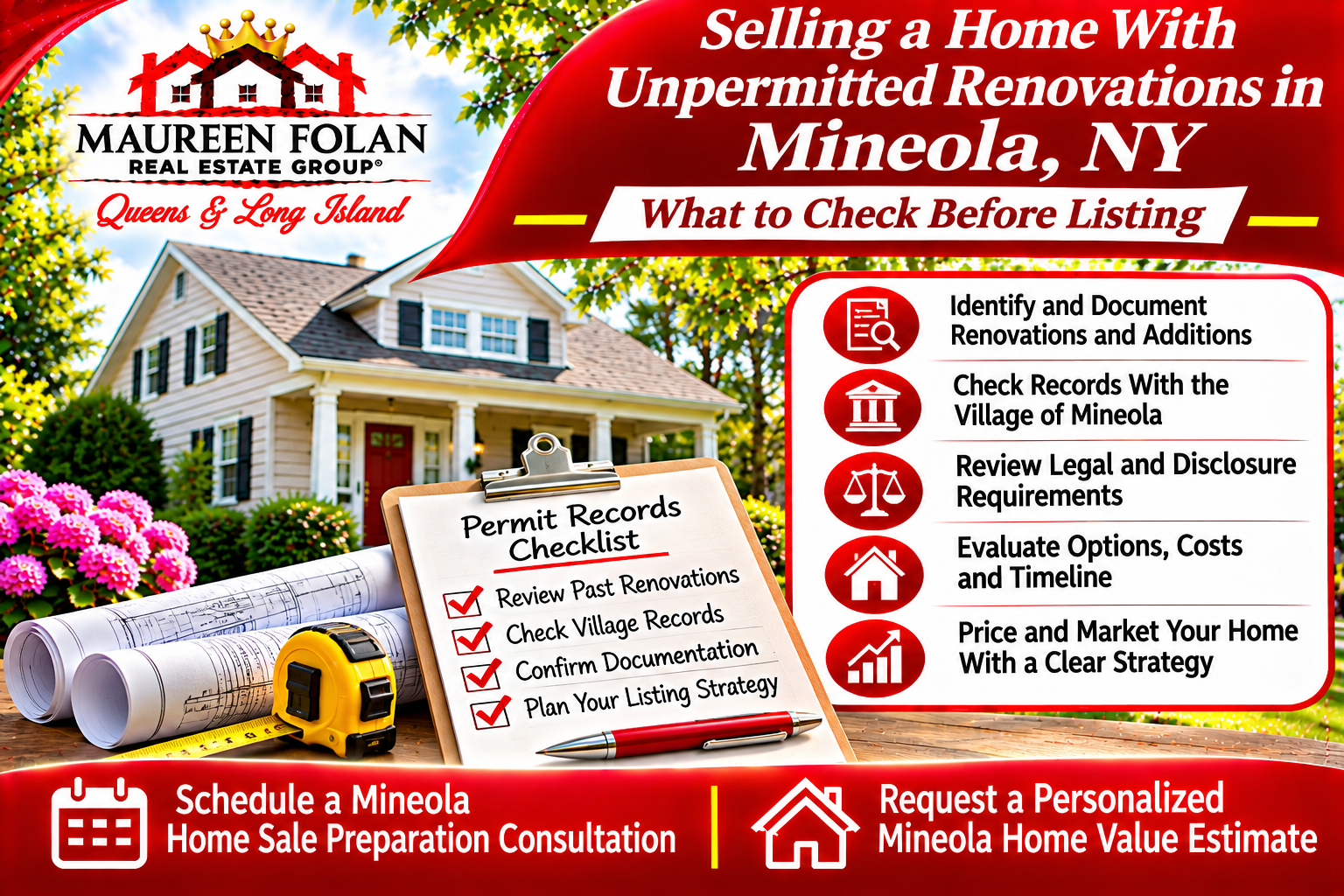
A Mineola Permit and Renovation Documentation Checklist
Before listing, work through these steps:
- Create an inventory of significant renovations and additions.
- Identify work completed by previous owners.
- Gather available permits and certificates.
- Review surveys and relevant closing documents.
- Verify municipal records with the appropriate authority.
- Determine which requirements may apply to each project.
- Consult your attorney about legal and disclosure obligations.
- Seek qualified professional evaluation where appropriate.
- Avoid assuming missing paperwork proves a violation.
- Avoid representing unverified space as approved living area.
- Evaluate whether unresolved issues should be addressed before listing.
- Consider potential costs and timelines.
- Request a property-specific market value estimate.
- Prepare accurate listing descriptions and photography.
- Establish a competitive pricing strategy.
- Review buyer questions and offers with appropriate professionals.
- Coordinate the sale with your next move.
This process helps you make decisions based on verified information rather than assumptions.
Final Takeaway: Selling a Mineola Home With Unpermitted Renovations
If you're considering selling a house with unpermitted work in Mineola NY, begin by determining what work was completed and what documentation exists.
Don't assume every renovation required a permit.
Don't assume missing paperwork automatically proves the work was unpermitted.
And don't assume selling as-is eliminates applicable legal or municipal obligations.
Review the property's records.
Verify the relevant requirements.
Consult your attorney and qualified professionals.
Then evaluate the home's market position based on its actual condition, features, documented improvements, and current competition.
As Maureen Folan, Queens & Long Island Real Estate Expert, I help homeowners develop property-specific selling strategies while appropriate professionals address legal, municipal, and technical questions.
Because the objective isn't simply to list your Mineola home quickly.
It's to understand the property you're selling, represent it accurately, and develop a strategy that supports an informed transaction. 
Schedule a Mineola Home Sale Preparation Consultation
Thinking about selling a Mineola home with renovations, additions, or incomplete property records?
Schedule a Mineola Home Sale Preparation Consultation with Maureen Folan Real Estate Group.
We'll discuss your property's condition, layout, documented improvements, relevant comparable sales, and current competition to help you understand how it may be positioned in today's market.
We'll also identify property-related information that may be useful to organize before listing, while your attorney and qualified professionals address legal, municipal, and technical requirements.
You can also request a Personalized Mineola Home Value Estimate to better understand your property's potential market position.
Maureen Folan
Queens & Long Island Real Estate Expert
Maureen Folan Real Estate Group
MaureenFolan.com