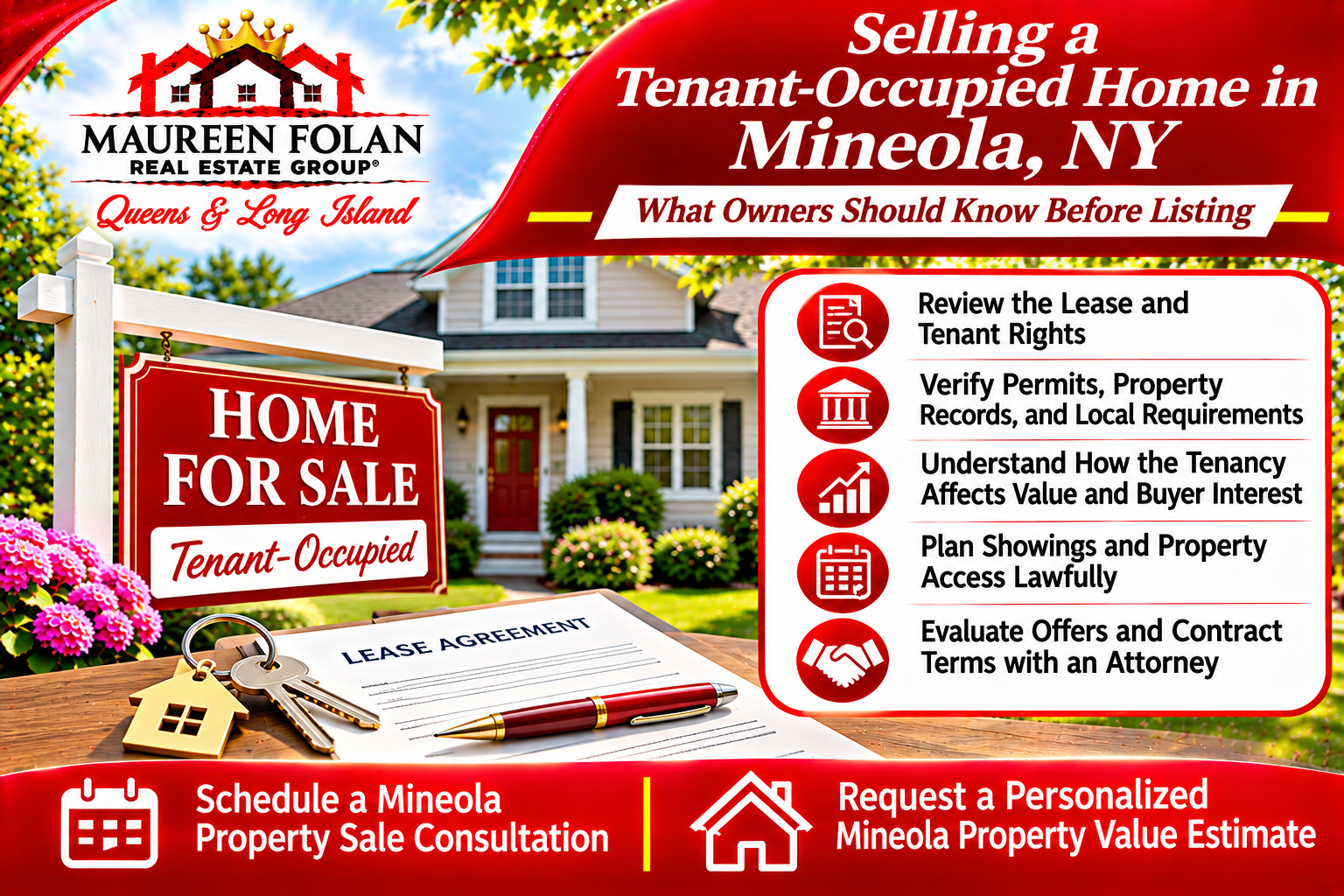
 Selling a Tenant-Occupied Home in Mineola, NY: What Owners Should Know Before Listing
Can you sell a tenant-occupied home in Mineola, NY, and what should you do before listing it?
You may be able to sell a tenant-occupied home in Mineola, NY, but the process depends on the property's ownership, existing lease agreements, applicable New York and local laws, and the terms of the sale. Before listing, review the tenancy, verify rental and property records, understand lawful showing arrangements, and determine how the existing occupancy may affect pricing, marketing, and closing.
Selling a Tenant-Occupied Home in Mineola, NY: Start With the Lease
If you're researching selling a tenant-occupied home in Mineola NY, you may own a property that you no longer want to maintain as a rental.
Perhaps you're considering selling an investment property.
Maybe you're relocating or restructuring your real estate holdings.
Or you may have inherited a property with an existing tenant.
Whatever your circumstances, selling an occupied property involves considerations that differ from selling your own residence.
Your first step isn't scheduling photography or choosing an asking price.
It's understanding the existing tenancy and your obligations as the property owner.
Can You Sell a House With Tenants Living in It?
A property can generally be offered for sale while occupied by tenants.
However, selling the property does not automatically terminate a tenancy or eliminate the owner's legal obligations.
The effect of a sale depends on the lease, applicable law, and the property's circumstances.
A buyer may acquire the property subject to an existing tenancy.
Before marketing the home as available for immediate occupancy, consult a New York attorney familiar with residential landlord-tenant and real estate law.
Don't assume that selling gives you an automatic right to require a tenant to leave.
Review the Existing Lease Before Listing
If the property is rented, gather the current lease and any relevant amendments or renewal documents.
Review the information with your attorney.
Important questions may include:
- Is there a written lease?
- What is its current term?
- Are there renewal provisions?
- What rent is currently payable?
- Are there outstanding balances or disputes?
- What provisions address property access?
- Are there additional occupants or agreements?
- What deposits or prepaid amounts are being held?
The answers may affect how the property is marketed and what a buyer needs to understand.
Understand Fixed-Term and Month-to-Month Tenancies
Different tenancy arrangements can involve different rights and obligations.
A fixed-term lease may establish an agreed rental period.
A month-to-month tenancy may involve different notice and termination requirements.
However, the applicable rules can depend on New York law, local requirements, the property's circumstances, and any relevant statutory protections.
Don't assume a month-to-month tenant can be required to leave immediately.
Have your attorney review the specific tenancy before establishing a marketing or closing strategy.
Understand Applicable New York Tenant Protections
New York has laws governing residential tenancies, notices, housing conditions, and certain landlord-tenant procedures.
Depending on the property and tenancy, additional protections or requirements may apply.
These issues can affect proposed changes to occupancy, lease termination, and other decisions.
Official information is available through New York State Homes and Community Renewal and the New York State Unified Court System.
Your attorney should evaluate which rules apply to your specific Mineola property.
Avoid making decisions based on assumptions about what an owner can require during a sale.
Understand Whether the Property Is Subject to Additional Rental Requirements
Not every rental property is governed by identical rules.
Depending on the building and tenancy, relevant questions may involve registration, regulatory status, applicable rental protections, or other legal requirements.
Before listing, verify the property's actual status.
Your attorney can help determine whether additional research or documentation is necessary.
Don't advertise the property as free of rental restrictions unless that has been established.
Determine Whether You're Selling to an Investor or an Owner-Occupant
The property's occupancy status may influence which buyers are interested.
An investor may evaluate the rental arrangement, operating expenses, and property condition.
A buyer who intends to occupy the property may focus on when lawful possession could become available.
Neither outcome should be assumed.
The appropriate marketing strategy depends on the actual lease, legal requirements, and transaction terms.
Your listing should accurately describe the property's occupancy status.
How Much Is a Tenant-Occupied Mineola Home Worth?
A tenant-occupied property should be evaluated based on its individual characteristics and current market competition.
A personalized market analysis may consider:
- Property type and configuration
- Relevant recent comparable sales
- Current competing listings
- Interior and exterior condition
- Layout and usable space
- Documented improvements
- Existing tenancy terms
- Property-specific taxes
- Operating expenses, where relevant
- Applicable legal or contractual obligations
Occupancy is one consideration among several.
Don't assume a tenant-occupied property automatically sells for less—or for more—than a vacant property.
The market impact depends on the actual circumstances.
Compare the Property With Relevant Sales
When reviewing comparable sales, consider whether the properties had similar ownership and occupancy characteristics.
A vacant detached home may attract a different range of purchase considerations than a property being sold subject to a tenancy.
The comparison should also account for condition, layout, location, documented improvements, and other relevant differences.
A strong valuation explains why the selected comparables are useful.
Rental Income and Property Value
If the property is being marketed to investors, documented rental income and operating expenses may be relevant.
Potential buyers may request records showing actual rental amounts, payment history, expenses, and other information necessary for their evaluation.
Provide accurate information.
Don't represent hypothetical future rental income as guaranteed.
Likewise, don't promise that rent can be increased or a tenancy changed without verifying applicable legal requirements.
Prepare Accurate Financial Records
Before listing a rental property, organize relevant financial information.
Depending on the circumstances, this may include:
- Current lease and amendments
- Documented rental income
- Property tax information
- Insurance expenses
- Utilities paid by the owner
- Maintenance expenses
- Association fees, if applicable
- Other property operating expenses
- Your attorney and appropriate financial professionals can help determine which information should be disclosed or reviewed.
Accurate records help buyers evaluate the property without relying on unsupported assumptions.
Understand Mineola Property Taxes
Mineola is an incorporated village in Nassau County.
Property owners should verify applicable taxing jurisdictions and property-specific tax obligations.
Official assessment information is available through the Nassau County Department of Assessment.
Current tax amounts may reflect exemptions or circumstances associated with the existing owner.
The next owner's obligations may differ.
If the property's occupancy or ownership status affects a particular exemption, verify the applicable rules.
Don't promise a buyer that your current tax bill will remain unchanged.
Property Access and Showings Require Planning
Selling an occupied property can involve additional scheduling considerations.
Tenants have legal rights, and the property owner's access rights depend on applicable law and the tenancy agreement.
Before arranging showings, review the relevant requirements with your attorney.
Then establish a practical process for communicating with the tenant.
Don't assume that placing a home on the market gives unrestricted access to the interior.
Create a Showing Plan That Respects the Tenancy
A clear showing process can help reduce confusion.
Depending on the applicable requirements and agreement, consider how requests will be communicated, how appointments will be confirmed, and how access will be managed.
Explain the process accurately to prospective buyers.
Don't promise unlimited showing availability unless it is actually possible and lawful.
The objective is to market the property effectively while respecting the existing tenancy.
Communicate Clearly With the Tenant
If you're preparing to sell, thoughtful communication can help everyone understand the process.
Explain that the property is being marketed and how showing arrangements will be handled.
Avoid making promises about lease termination, future ownership decisions, or moving dates that have not been legally established.
Where appropriate, coordinate important communications through your attorney.
A clear process can reduce misunderstandings during the transaction.
What If the Tenant Doesn't Want Showings?
Access disagreements can complicate a sale.
However, the appropriate response depends on the lease and applicable law.
Don't attempt to resolve a dispute through unauthorized entry, threats, utility interruptions, or other improper pressure.
Consult your attorney about lawful options.
A selling strategy should account for realistic access arrangements rather than assuming cooperation can be compelled.
Preparing a Tenant-Occupied Property for Photography
Professional photography can help buyers understand a property's layout and features.
But an occupied property requires coordination.
Before scheduling photography, review access requirements and communicate the proposed arrangements appropriately.
Respect the tenant's belongings and privacy.
Don't assume that the owner can remove, rearrange, or photograph personal possessions without considering applicable rights and permissions.
What If the Tenant's Furniture Makes Rooms Look Smaller?
An occupied property may contain furniture and belongings that influence how rooms appear.
You may want to discuss reasonable preparation arrangements, but those discussions should respect the tenant's rights and the existing agreement.
Avoid presenting a tenant's personal possessions as a problem the owner can simply eliminate.
Professional photography should accurately represent the property.
Should You Renovate Before Selling a Tenant-Occupied Home?
Renovation decisions can be more complicated when a property is occupied.
Before beginning work, consider the property's condition, likely market benefit, project cost, timing, tenant rights, and applicable approval requirements.
Some maintenance may be necessary.
Other improvements may be optional.
Your attorney and qualified professionals can help evaluate obligations and proposed work.
Don't assume that a sale creates an unrestricted right to undertake disruptive renovations.
Understand the Village of Mineola's Requirements
Mineola has its own municipal government.
Depending on the property and proposed work, village building, zoning, or other administrative requirements may apply.
Official information is available through the Village of Mineola.
If the property contains additions, conversions, or other significant modifications, investigate relevant permits and records.
Your attorney and qualified professionals can help evaluate property-specific questions.
What If the Property Has More Than One Unit?
If your Mineola property contains multiple residential units or spaces being used separately, verify the property's documented configuration and applicable approvals.
Don't assume that the number of occupied spaces establishes the number of legally recognized dwelling units.
Review municipal records and relevant documentation.
Accurate marketing is particularly important when a buyer is evaluating rental arrangements.
Don't Advertise Unverified Rental Uses
If part of the property has been rented or used as a separate living area, investigate its documented status before describing it as an approved rental unit.
Physical use and municipal approval are different questions.
Your attorney and qualified professionals can help clarify the property's circumstances.
The goal is to represent the property accurately and avoid unsupported claims about permitted uses.
What Happens to a Security Deposit When the Property Is Sold?
Security deposits and prepaid amounts may require particular handling when ownership changes.
The applicable requirements depend on New York law, the tenancy, and transaction circumstances.
Before closing, review these matters with your attorney.
Don't assume the deposit simply becomes part of the seller's proceeds.
Accurate records and appropriate transfer arrangements are important.
What Happens to the Lease After Closing?
A property sale does not automatically erase an existing lease.
The buyer's rights and obligations depend on the tenancy and applicable law.
Before accepting an offer, clarify whether the transaction is intended to proceed subject to the existing tenancy and what the contract will require.
Your attorney should review the relevant terms.
Avoid promising vacant possession unless there is a lawful and realistic basis for that commitment.
Can You Sell With a Tenant Who Has a Long-Term Lease?
A long-term lease may affect how a buyer evaluates the property.
An investor may consider the rental arrangement as part of the ownership opportunity.
A buyer intending to occupy the property may need to evaluate the timing and legal implications of the existing tenancy.
The impact depends on the actual agreement and applicable law.
Don't assume that a buyer can disregard the lease after closing.
What If You Want to Sell the Property Vacant?
You may prefer to market the home without an existing tenancy.
However, whether and when vacant possession can lawfully be obtained depends on the lease, applicable law, and the specific circumstances.
Don't attempt to create vacancy through improper pressure or unilateral actions.
Consult your attorney before discussing termination, surrender agreements, notices, or other legal procedures.
The timing and outcome should not be assumed.
Understand Your Selling Timeline
A tenant-occupied property sale may require additional planning.
Before listing, identify the lease term, legal requirements, available documentation, showing arrangements, and your preferred closing timeline.
If your next purchase depends on the sale proceeds, consider how these factors may influence the transaction.
A realistic plan is more useful than assuming the property will sell or become vacant by a particular date.
Price According to the Actual Property and Tenancy
Your asking price should reflect the property's characteristics and current market competition.
If the home is being sold subject to a tenancy, that fact should be considered in the marketing and valuation strategy.
Don't price solely according to a comparable vacant property without evaluating meaningful differences.
And don't assume the tenancy automatically establishes a specific discount.
Use relevant market evidence.
Evaluate Offers Beyond Purchase Price
The highest offer isn't automatically the strongest complete offer.
Depending on the transaction, relevant considerations may include financing, contingencies, closing timing, contractual terms, and the buyer's understanding of the existing tenancy.
Your attorney can help evaluate transaction-specific terms.
The strongest offer should support the seller's objectives while reflecting the property's actual legal and occupancy circumstances.
A Mineola Tenant-Occupied Property Seller's Checklist
Before listing, work through these steps:
- Confirm the property's legal ownership and configuration.
- Gather all leases and relevant amendments.
- Review tenancy terms with a New York attorney.
- Verify applicable tenant protections and legal requirements.
- Organize accurate rental and expense records.
- Review security deposits and prepaid amounts.
- Verify property taxes and municipal information.
- Investigate relevant permits and property records.
- Request a personalized market value estimate.
- Review comparable sales and current competition.
- Determine how the existing tenancy affects your marketing strategy.
- Establish lawful showing arrangements.
- Coordinate photography appropriately.
- Prepare accurate listing descriptions.
- Avoid unsupported promises about future occupancy or rental income.
- Review offers and contract terms with your attorney.
- Coordinate the sale with your next move or investment plans.
This process helps you approach the sale with a clearer understanding of the property's legal, financial, and market considerations.
Final Takeaway: Selling a Tenant-Occupied Home in Mineola, NY
If you're considering selling a tenant-occupied home in Mineola NY, begin with the lease and applicable legal requirements.
Confirm the property's ownership and documented configuration.
Review the tenancy.
Organize rental and expense records.
Verify property taxes and municipal information.
Establish lawful showing arrangements.
Then develop a market-based pricing and marketing strategy that reflects the property's condition, features, occupancy, and current competition.
Don't assume a sale automatically ends a lease.
Don't promise vacant possession without a reliable legal basis.
And don't treat tenant rights as an obstacle that can simply be ignored.
As Maureen Folan, Queens & Long Island Real Estate Expert, I help property owners develop selling strategies based on the individual property and current market.
Because selling a tenant-occupied home isn't simply about putting a listing online.
It's about coordinating the property's tenancy, documentation, ownership costs, marketing, pricing, and transaction terms through an informed plan. 
Schedule a Mineola Property Sale Consultation
Considering selling a tenant-occupied home or rental property in Mineola, NY?
Schedule a Mineola Property Sale Consultation with Maureen Folan Real Estate Group.
We'll discuss your property's type, condition, location, documented improvements, current competition, and potential market position.
We'll also identify property-related information that may be useful to organize before listing, while your attorney and appropriate professionals address tenancy, legal, and financial requirements.
You can also request a Personalized Mineola Property Value Estimate to better understand how your property may compete in today's market.
Maureen Folan
Queens & Long Island Real Estate Expert
Maureen Folan Real Estate Group
MaureenFolan.com