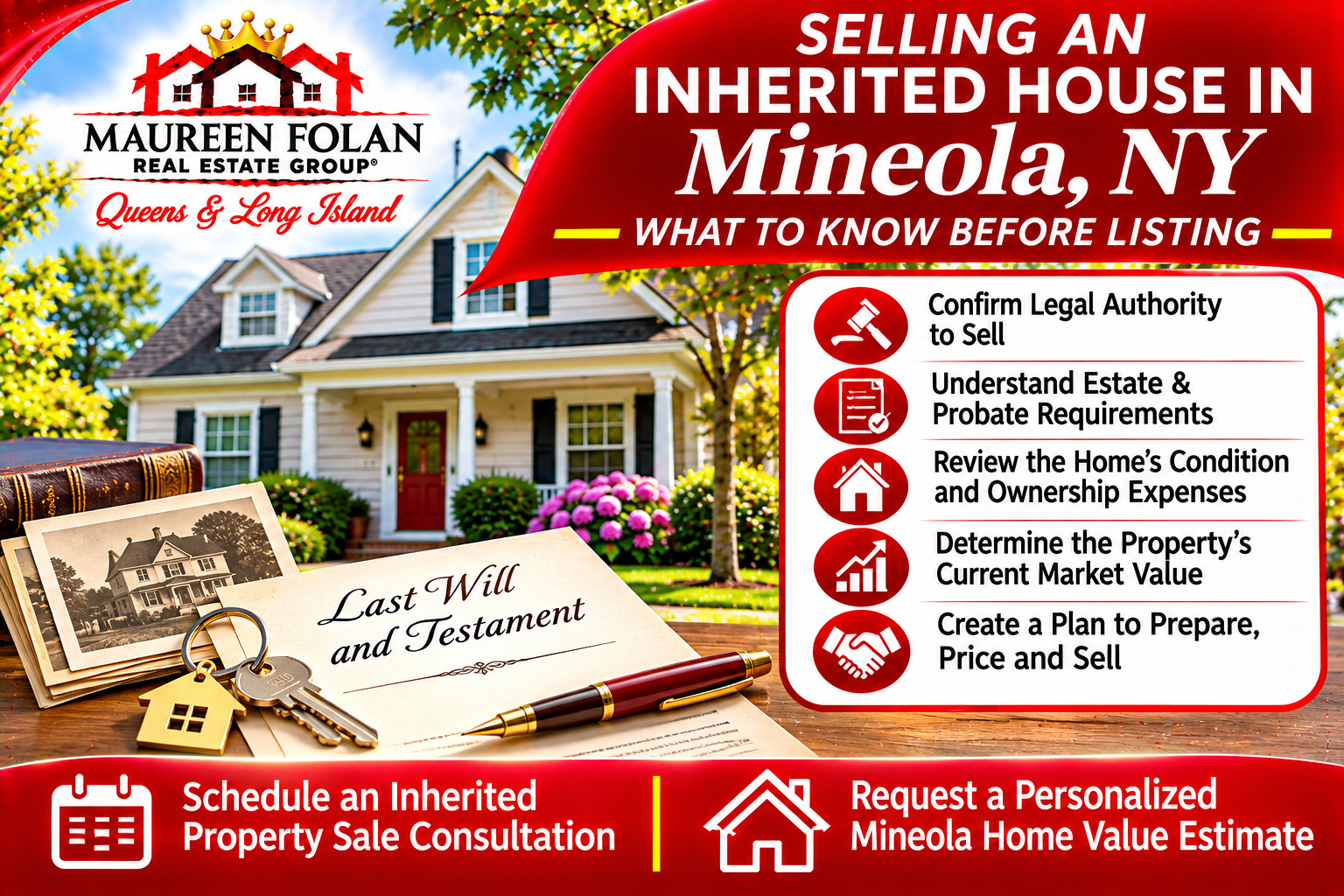
 Selling an Inherited House in Mineola, NY: What to Know Before Listing
What should you know before selling an inherited house in Mineola, NY?
Before selling an inherited house in Mineola, NY, you should confirm who has legal authority to sell, understand the property's ownership and estate status, estimate its market value, and review any outstanding mortgage, taxes, liens, or maintenance expenses. You should also evaluate the home's condition, organize relevant records, and develop a selling strategy that accounts for estate requirements and your timeline.
Selling an Inherited House in Mineola, NY: Where Should You Start?
If you're researching selling an inherited house in Mineola NY, you may be managing a property that has been owned for many years.
Perhaps the home belonged to a parent or another relative.
Maybe several people have an interest in the estate.
Or you may be responsible for coordinating the property sale while also handling other estate matters.
Selling an inherited property can involve different questions from selling a home you personally purchased.
Before thinking about painting, staging, or choosing an asking price, establish three things:
Who owns the property, who has authority to sell it, and what needs to happen before a sale can proceed.
Those answers create the foundation for everything that follows.
Confirm Who Has Legal Authority to Sell
An inherited property cannot necessarily be sold simply because a relative wants to list it.
The legal authority to sell depends on how the property was owned, the estate's circumstances, and applicable New York law.
Depending on the situation, relevant parties may include an executor, administrator, surviving joint owner, trustee, or heirs.
The appropriate documentation and procedures can differ.
Before signing a listing agreement or accepting an offer, consult a New York attorney experienced in estate or real estate matters.
Your attorney can help determine who must authorize the transaction and what documentation is required.
Does an Inherited Mineola Home Need to Go Through Probate?
Not every inherited property follows the same legal process.
Some estates may require probate or administration proceedings.
Other properties may pass through different ownership arrangements.
Whether probate is required depends on the circumstances, including how title was held and whether a valid will exists.
New York's Surrogate's Court system handles probate and estate administration matters.
Official information is available through the New York State Unified Court System.
For Nassau County estate matters, your attorney can help identify the appropriate court procedures and documents.
Don't assume a property can be sold immediately after an owner's death.
Understand the Difference Between an Executor and an Administrator
An executor is generally a person appointed to administer an estate under a will.
An administrator is generally appointed to administer an estate when appropriate under applicable law, such as when there is no valid will naming an executor.
The authority and documentation associated with these roles depend on the estate proceedings.
If you're handling an inherited Mineola property, verify your legal role before taking action.
Your attorney can explain which decisions you're authorized to make.
What If Several People Inherit the Property?
An inherited home may involve more than one beneficiary or owner.
One person may want to sell immediately.
Another may prefer to keep the property.
Someone else may want to renovate before listing.
These differences can complicate decisions about pricing, preparation, timing, and acceptable offers.
Before beginning the marketing process, clarify the legal ownership structure and decision-making authority.
Where appropriate, establish a practical communication process among the relevant parties.
The goal is to make important decisions with a clear understanding of who has authority to act.
Understand the Property's Current Financial Obligations
Before listing an inherited Mineola home, identify the expenses associated with ownership.
Depending on the property, these may include:
- Outstanding mortgage balances
- Property taxes
- Insurance
- Utilities
- Maintenance
- Association fees, if applicable
- Outstanding liens or judgments
- Other property-related obligations
Some expenses may continue while the estate is being administered.
Your attorney and appropriate financial professionals can help determine which obligations apply and how they should be addressed.
Review Mineola Property Taxes
Mineola is an incorporated village in Nassau County.
Property owners should investigate the applicable taxing jurisdictions and current tax obligations.
Official assessment information is available through the Nassau County Department of Assessment.
If the previous owner received exemptions or benefits, don't assume those will continue under new ownership.
Eligibility and administration vary by program.
Verify the property's current records and discuss estate-specific questions with appropriate professionals.
Accurate tax information is important for both estate planning and prospective buyers.
Keep Property Expenses Organized
If an inherited home remains vacant or is awaiting sale, expenses may continue.
Create a record of property-related payments and obligations.
Track taxes, insurance, utilities, maintenance, and other costs.
If several people are involved in the estate, organized records can make financial discussions easier.
Your attorney and appropriate financial professionals can help determine how expenses should be handled within the estate.
How Much Is an Inherited Mineola House Worth?
An inherited property's market value should be evaluated the same way as other residential real estate: by examining relevant comparable sales, current competing listings, and the home's individual characteristics.
A personalized market analysis should consider:
- Property type
- Location
- Interior and exterior condition
- Layout and usable space
- Architectural features
- Documented improvements
- Lot size and configuration, where applicable
- Renovation needs
- Current competing listings
- Recent buyer activity
The objective isn't to assume that a longtime-owned property is worth less because it's older.
It's to determine how the home compares with realistic alternatives available to buyers.
Market Value and Estate Valuation Aren't Necessarily the Same
An inherited property may require valuations for legal, tax, accounting, or estate administration purposes.
Those valuations may involve specific dates and standards.
A real estate comparative market analysis, meanwhile, helps evaluate how the property may compete in the current housing market.
These serve different purposes.
Your attorney and appropriate tax professionals can explain which valuations may be required for the estate.
A market analysis can help establish a selling strategy based on current real estate conditions.
Understand Potential Tax Consequences Before Selling
Selling inherited real estate can involve tax considerations that differ from selling a home you personally purchased.
Depending on the circumstances, questions may involve the property's tax basis, valuation date, capital gains, estate obligations, and other applicable rules.
The treatment of inherited property depends on the specific facts.
Don't assume the entire selling price represents taxable profit.
And don't assume there will be no tax consequences.
Consult an appropriate tax professional before making decisions based on estimated proceeds.
Should You Sell the Inherited Home As-Is?
Some inherited properties have been owned for decades.
The kitchen may be dated.
Bathrooms may have older finishes.
There may be unfinished projects or deferred maintenance.
You may be wondering whether it's better to sell the property in its current condition.
An as-is sale may be worth considering, particularly if the estate prefers not to manage major improvements.
However, selling as-is doesn't automatically eliminate applicable disclosure obligations, buyer inspections, contractual responsibilities, or other legal requirements.
Your attorney can explain the requirements that apply to the transaction.
Don't Assume You Need to Renovate Everything
A longtime-owned Mineola home doesn't necessarily need a new kitchen or bathrooms before listing.
Major renovations can involve substantial expense, time, and coordination.
Before approving work, ask:
What might the property sell for in its current condition?
What do competing homes offer?
Which improvements could meaningfully affect buyer perception?
What would the project cost?
How long would it delay the sale?
Would the expected benefit justify the investment?
Analyze the property's market position before committing estate funds to major improvements.
Separate Necessary Repairs From Cosmetic Preferences
When evaluating an inherited home, distinguish between three categories.
Repairs: Damaged, malfunctioning, visibly deteriorated, or unfinished items.
Cosmetic improvements: Painting, cleaning, decluttering, lighting, landscaping, and presentation.
Major renovations: Substantial kitchen, bathroom, structural, or layout projects.
The appropriate strategy depends on the property's condition, the estate's available resources, the legal authority to approve expenses, and the expected market benefit.
What If the House Contains Decades of Belongings?
An inherited property may contain furniture, documents, photographs, household items, and other personal belongings.
Before removing or disposing of items, determine who has authority to make those decisions.
Some belongings may have financial or personal significance.
A practical process may involve documenting contents, identifying important records, and coordinating decisions with the authorized parties.
Once those matters are addressed, decluttering can help prepare the property for photography and showings.
Organize Property Documents Before Listing
An inherited Mineola home may have a long ownership history.
Begin gathering relevant records.
Depending on the property, these may include:
- Deeds and title information
- Mortgage records
- Property tax bills
- Surveys
- Building permits
- Certificates and approvals
- Renovation records
- Warranties or receipts
- Association documents, if applicable
- Other property-related records
Your attorney can help determine which documents are necessary for the transaction.
Organized information can make buyer due diligence easier to manage.
Understand Village of Mineola Requirements
Mineola is an incorporated village with its own municipal government.
Certain property-related matters may be administered through village or other applicable authorities.
Official information is available through the Village of Mineola.
If the inherited property has additions, conversions, or significant renovations, investigate relevant records.
Your attorney and appropriate professionals can help evaluate transaction-specific requirements.
Don't assume every finished area can automatically be represented as legally recognized living space.
What If the Property Has Been Expanded or Modified?
Older homes sometimes change substantially over time.
A basement may have been finished.
An attic may have been modified.
A room may have been converted.
An addition may have been constructed.
Before marketing the space, investigate what work was completed and what documentation exists.
The objective isn't to assume modifications are problematic.
It's to understand what is being sold and represent the property accurately.
Prepare the Property for Professional Photography
Even if you're selling an inherited home as-is, presentation matters.
Deep cleaning, decluttering, appropriate lighting, and thoughtful furniture arrangement may help buyers understand the home's layout and usable space.
Professional-quality photographs should accurately communicate the property's features and condition.
Avoid marketing that materially misrepresents the home.
The goal is to make its genuine strengths easy to recognize.
Price the Inherited Home According to Current Competition
An inherited property's asking price should reflect current market evidence.
Review relevant recent sales and active competing listings.
Consider condition, layout, usable space, architectural characteristics, improvements, lot, and location.
Don't price solely according to an automated estimate or one nearby transaction.
A competitive asking price should help buyers understand the property's value in its actual condition.
Why Starting Too High Can Be Risky
Some sellers prefer to start above the anticipated market range.
The reasoning is understandable:
"We can always reduce the price."
But a property only launches as a new listing once.
Active buyers may notice it quickly.
If they perceive stronger value elsewhere, some may move on.
A later adjustment can improve the property's competitive position.
It doesn't guarantee those buyers return.
Consider the Estate's Timeline
An inherited property sale may involve legal, financial, and practical timing considerations.
Before choosing a listing date, determine:
Who must approve the sale?
What estate documents are required?
What property preparation remains?
Are there outstanding financial obligations?
What transaction timeline is realistic?
Your attorney can help clarify the legal requirements.
Your real estate strategy should reflect those constraints rather than assuming the property can close on a particular date.
Evaluate Offers Beyond the Purchase Price
The highest offer isn't automatically the strongest complete offer.
Depending on the transaction, relevant considerations may include financing, contingencies, closing timing, contractual terms, and transaction certainty.
For an estate sale, legal authority and transaction-specific requirements may also affect the process.
Your attorney and appropriate professionals can help evaluate the offers and applicable obligations.
The strongest offer should support the estate's authorized objectives and practical timeline.
What If the Inherited Property Is a Condominium?
Mineola includes different residential property types, including condominiums.
If you've inherited a condominium or another association-governed property, additional considerations may apply.
These can include association fees, governing documents, maintenance responsibilities, restrictions, and other obligations.
Your attorney and appropriate professionals can help determine which documents and procedures are relevant.
Don't assume a condominium sale follows exactly the same process as a detached-home sale.
A Mineola Inherited Property Seller's Checklist
Before listing, work through these steps:
- Confirm legal ownership and authority to sell.
- Consult an appropriate New York attorney about estate requirements.
- Identify any probate or administration procedures that apply.
- Clarify decision-making authority among relevant parties.
- Review outstanding mortgages, taxes, liens, and other obligations.
- Organize ongoing property expenses.
- Request a personalized market value estimate.
- Review relevant comparable sales and competing listings.
- Evaluate the home's actual condition.
- Separate repairs from cosmetic preferences.
- Consider major renovations cautiously.
- Organize property and renovation records.
- Address personal belongings through an authorized process.
- Prepare accurate professional photography and marketing.
- Establish a competitive asking price.
- Review offers and transaction terms with appropriate professionals.
- Coordinate the sale with the estate's legal and financial requirements.
This process helps you approach the transaction with a clearer plan.
Final Takeaway: Selling an Inherited House in Mineola, NY
If you're considering selling an inherited house in Mineola NY, begin with legal authority and ownership documentation.
Understand the estate's requirements.
Review outstanding property obligations.
Verify taxes and relevant records.
Then determine the home's current market value and evaluate its condition.
Don't assume you need to renovate everything.
And don't assume selling as-is automatically resolves disclosure or documentation questions.
Develop a preparation and pricing strategy based on the property's actual characteristics and current competition.
As Maureen Folan, Queens & Long Island Real Estate Expert, I help property owners and authorized representatives evaluate inherited real estate with a clear, property-specific approach.
Because selling an inherited home isn't simply about choosing an asking price.
It's about coordinating the property's legal, financial, physical, and market considerations so the transaction can move forward on an informed basis. 
Schedule an Inherited Property Sale Consultation
Responsible for an inherited home in Mineola, NY?
Schedule an Inherited Property Sale Consultation with Maureen Folan Real Estate Group.
We'll discuss the property's condition, location, documented improvements, likely market position, preparation options, and selling timeline.
We'll also identify the property-related information that may be useful to organize before listing, while your attorney and appropriate professionals address the estate's legal and tax requirements.
You can also request a Personalized Mineola Home Value Estimate to better understand how the property may compete in today's market.
Maureen Folan
Queens & Long Island Real Estate Expert
Maureen Folan Real Estate Group
MaureenFolan.com