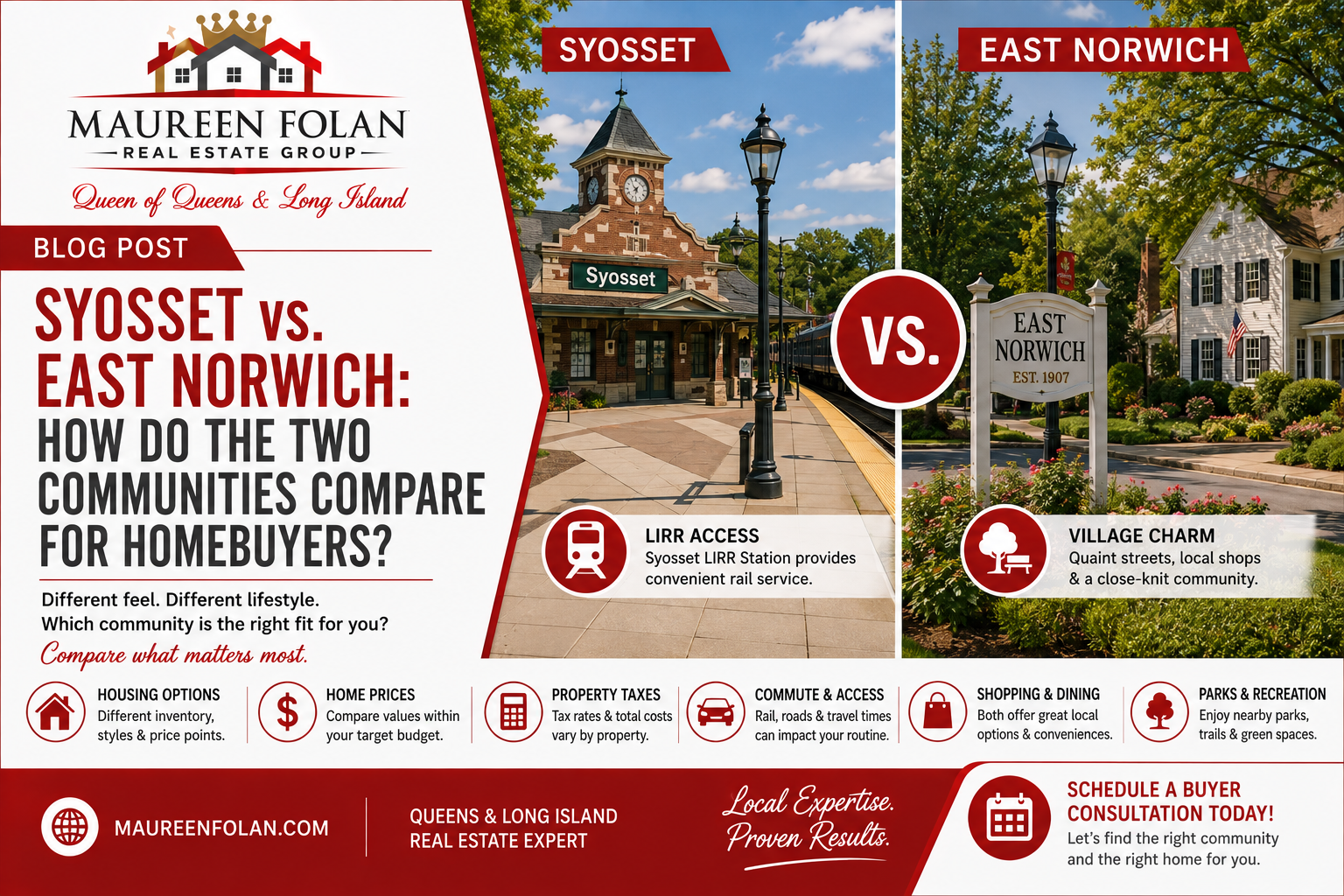
 Syosset vs. East Norwich: How Do the Two Communities Compare for Homebuyers?
Syosset vs. East Norwich: what should you compare before deciding where to buy a home?
The most useful differences aren't about declaring one community “better.” You should compare available homes, price, property taxes and total ownership costs, lot and housing characteristics, transportation, proximity to the places you use, and the type of residential setting you prefer. Syosset and East Norwich are close geographically, but your home-buying experience can be quite different depending on the individual property.
Syosset vs. East Norwich: Start With the Home, Not the Town Name
If you're deciding between Syosset and East Norwich, you may be tempted to research both communities until you can declare a winner.
There's a better approach.
Start with your priorities.
How much do you want to spend?
What kind of property are you looking for?
How much outdoor space do you want?
Do you need rail transportation regularly?
Would you rather purchase something updated or take on renovations?
Which destinations do you need to reach most often?
Once you answer those questions, you can compare actual properties in both communities instead of comparing two labels.
That's particularly useful because Syosset and East Norwich sit relatively close to one another in Nassau County, yet the inventory available within your budget can produce very different choices.
How Does the Syosset Real Estate Market Compare?
Syosset is an established and competitive residential market.
Current Redfin data tracks Syosset sale prices, market time, sale-to-list relationships, and other indicators. Those figures can help you understand the broad environment in which you're shopping. Current Syosset housing-market data
But don't use a townwide median as your purchasing budget.
The home you want may sit substantially above or below that figure depending on its size, condition, lot, location, and other characteristics.
The better exercise is to define a realistic range—perhaps the amount you are comfortable spending rather than the maximum you could theoretically borrow—and examine what is actually available in Syosset within it.
Then perform the same exercise in East Norwich.
That's when the comparison becomes meaningful.
East Norwich Gives Buyers Another North Shore-Area Option
East Norwich is a hamlet within the Town of Oyster Bay, placing it within a different local context from Syosset while keeping buyers near other North Shore communities.
The Town of Oyster Bay provides parks, recreation facilities, beaches, marinas, and other municipal resources throughout the town. Town of Oyster Bay parks and recreation
For a buyer, however, the important question isn't how many amenities appear on a municipal website.
It's which ones you expect to use and how conveniently a particular home allows you to reach them.
That property-specific approach keeps your comparison practical.
Housing Inventory May Make the Decision for You
Sometimes buyers spend weeks trying to decide between communities only to discover that the available homes make the answer much clearer.
Imagine you have a particular budget.
In Syosset, that budget might give you several homes with one combination of size, lot, condition, and location.
In East Norwich, it may produce a different combination.
Now you're making a real comparison.
Perhaps one property is extensively renovated but has less outdoor space.
Another may need cosmetic updates but offers a layout you prefer.
A third could have a larger lot but create a less convenient transportation routine.
Instead of asking:
“Is Syosset or East Norwich better?”
ask:
“Which of these actual homes gives me the best combination of the things I value?”
That question is far more useful.
Compare Condition as Well as Purchase Price
Purchase price alone can make two homes appear more similar than they really are.
Suppose a Syosset property and an East Norwich property are offered at roughly the same price.
One is move-in-ready.
The other needs a kitchen renovation, flooring, painting, and exterior work.
Those aren't financially equivalent choices simply because the asking prices match.
For the property requiring work, consider:
Purchase price + immediate repairs + planned renovations + time + disruption.
For the updated home, ask whether you're paying a premium for improvements you genuinely value.
Neither answer is automatically right.
Some buyers would rather avoid renovation entirely.
Others see an older home as an opportunity to customize a property over time.
Knowing which type of buyer you are can simplify your search considerably.
Property Taxes Should Be Evaluated Home by Home
Taxes can have a meaningful effect on your total housing expense.
But don't compare Syosset and East Norwich using a generalized statement about which community has “higher taxes.”
Verify the taxes for the actual properties you're considering.
Two homes with similar prices can have different tax obligations, which can affect your monthly cost and long-term budget.
For each property, consider:
Purchase price + financing + property-specific taxes + insurance + maintenance + anticipated improvements.
That produces a much clearer comparison of affordability.
If you're moving from Queens, this calculation becomes especially important because your next home's ownership costs may be structured differently from those of your current property.
Transportation Can Be a Major Difference
If you expect to use the Long Island Rail Road frequently, transportation deserves careful consideration.
Syosset has its own LIRR station on the Port Jefferson Branch. The MTA provides current schedules and service information, which you should check against your actual work or travel schedule. Long Island Rail Road information
If you're considering East Norwich, evaluate the transportation options from the specific property rather than assuming the same routine applies.
How would you reach the station you expect to use?
How long would that take?
What are the current train options?
Would you drive instead?
Where do you travel most frequently?
This can be one of the clearest examples of why nearby communities don't necessarily create identical lifestyles.
A few miles can matter when you make the trip every day.
Test Your Actual Commute
Online maps are useful.
A real-world test is better.
If commuting is important, visit a property at a realistic time and drive the route you expect to use.
If you plan to take the train, investigate the complete journey rather than only looking at scheduled rail time.
That includes getting from the home to the station, parking or drop-off logistics where applicable, the train itself, transfers, and the final portion of your trip.
The best transportation choice isn't the one that sounds most convenient.
It's the one that works for your routine.
How Much Property Do You Want?
Lot size can look exciting in listing photos.
Then you have to maintain it.
If one of your reasons for moving is to gain more outdoor space, decide what you actually want that space to accomplish.
Do you want room for entertaining?
Gardening?
Privacy?
Recreation?
Or do you simply want some outdoor space without a large maintenance commitment?
A larger property isn't automatically a better property.
It should serve a purpose that matters to you.
When comparing Syosset and East Norwich homes, look at lot usability, not simply the number attached to the acreage or square footage.
Look Closely at Older Homes
The approved East Norwich content plan specifically includes helping buyers understand older properties, and that's an important consideration when comparing homes.
Age by itself isn't a reason to reject a property.
Older homes can offer architecture, layouts, materials, or property characteristics that appeal to buyers.
But age makes due diligence important.
During your initial tour, pay attention to visible condition and the improvements that appear to have been made over time.
If you decide to pursue the property, appropriate professional inspections and other due diligence can help you better understand its condition.
Don't assume an older home is problematic.
And don't assume a beautifully updated interior means every component of the property is new.
Evaluate the complete home.
Think About Renovation Tolerance Before You Shop
Before touring either community, decide how much work you're willing to take on.
You can divide your tolerance into three categories:
Move-in-ready: You want minimal immediate work.
Cosmetic opportunity: You're comfortable with paint, flooring, fixtures, and other manageable improvements.
Renovation project: You're willing to undertake substantial improvements to get the location or underlying property you want.
Knowing where you fall can prevent you from wasting time touring homes that don't fit your real expectations.
It also helps you compare value more intelligently.
What About Shopping, Recreation, and Everyday Errands?
Buyers often focus so heavily on the house that they forget to test everyday life.
Where will you buy groceries?
Where will you go for dinner?
Where are the parks or recreational facilities you expect to use?
How long will routine errands take?
You don't need every amenity within walking distance.
You do need to understand whether the home's location works for the way you spend your time.
Visit both areas.
Drive around without a showing appointment.
Make a normal errand.
Have lunch nearby.
See what the routes actually feel like.
You'll learn more than you will from a generic online ranking.
If You're Moving From Queens, Compare What You're Gaining—and Changing
A Syosset vs. East Norwich decision can look different when you're coming from Queens.
You may be moving because you want a different type of home, more outdoor space, a different daily routine, or another Long Island location.
Be specific about that goal.
What are you trying to gain?
Then identify what changes come with it.
You may have more property to maintain.
Your commute may change.
Property-specific taxes may become a larger part of your housing budget.
Driving may play a different role in your daily routine.
The objective isn't to decide whether those changes are universally good or bad.
It's to determine whether they work for you.
Coordinate Your Queens Sale With Your Purchase
If you already own a home in Queens, don't evaluate your next purchase without understanding your current property's potential value.
Your expected net proceeds may influence your down payment, financing strategy, renovation budget, and comfortable purchase range.
Timing matters too.
Do you need to sell before buying?
Can you buy first?
What happens if you find an East Norwich or Syosset home before your Queens property sells?
What happens if the Queens sale happens first?
Working through these possibilities early can help you approach the buying process with more confidence.
Don't Use Community Rankings to Make the Decision
A comparison article should help you understand differences—not tell you which type of person belongs in which community.
That's why I recommend avoiding “best town” thinking.
Instead, use measurable and personal factors:
- Current homes available within your budget
- Property condition
- Total ownership cost
- Lot and layout
- Transportation
- Distance to your regular destinations
- Renovation requirements
- Maintenance expectations
- Your anticipated length of ownership
Those considerations help you make an individualized decision without relying on stereotypes or assumptions.
Syosset May Be the Better Fit If...
Syosset may move higher on your list if the specific homes available there better match your budget and property requirements, or if access to the Syosset LIRR station works particularly well for your transportation needs.
You may also simply find a home there with the right combination of layout, condition, lot, and location.
That's enough reason to choose it.
You don't need a broader justification.
East Norwich May Be the Better Fit If...
East Norwich may move higher on your list if the properties you find there provide a combination of housing characteristics, lot, location, and access to the broader Oyster Bay area that better fits your priorities.
Again, the property should lead the decision.
If an East Norwich home works better for your finances and daily routine, that's more meaningful than a generic comparison between the two communities.
Final Takeaway: Syosset vs. East Norwich
So, Syosset vs. East Norwich—which should you choose?
Start with your budget and the actual homes available.
Then compare condition, property-specific taxes, renovation needs, lot characteristics, transportation, maintenance, and proximity to the places you use regularly.
Syosset's direct LIRR station may be particularly relevant for some buyers, while East Norwich's location within the broader Oyster Bay area can create a different property and location equation.
Neither community needs to “win.”
The right answer is the home that gives you the strongest combination of property, price, location, ownership costs, and everyday practicality.
As Maureen Folan, Queens & Long Island Real Estate Expert, I help buyers compare those factors at the property level—especially when you're considering multiple Long Island communities or coordinating a move from Queens.
Because the best comparison isn't Syosset versus East Norwich in the abstract.
It's your best Syosset option versus your best East Norwich option. 
Schedule a Buyer Consultation
Trying to decide between Syosset and East Norwich?
Schedule a Buyer Consultation with Maureen Folan Real Estate Group.
We can compare current properties in both markets, look at the practical differences in price, condition, taxes, transportation, and location, and help you determine which options best fit your next move.
If you're relocating from Queens, we can also connect your current-home strategy with your Long Island purchase.
And ask for the Property Tax Guide to help organize one of the important financial considerations when comparing Long Island homes.
Maureen Folan
Queens & Long Island Real Estate Expert
Maureen Folan Real Estate Group
MaureenFolan.com
:format(webp):quality(80)/u.realgeeks.media/maureenfolan/001.jpg)
:format(webp):quality(80)/u.realgeeks.media/maureenfolan/HVREPORT.png)