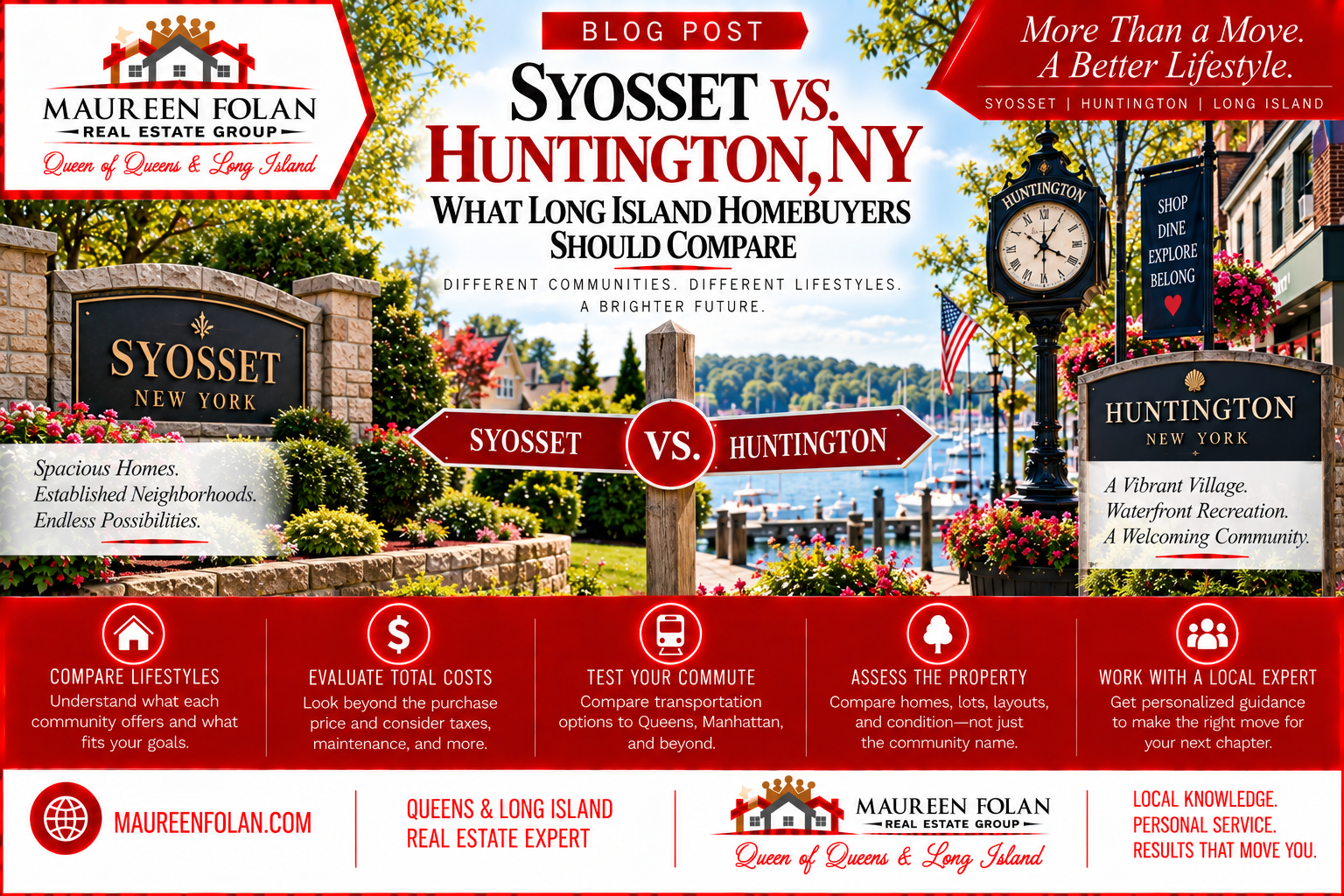
 Syosset vs. Huntington, NY: What Long Island Homebuyers Should Compare
Syosset vs. Huntington, NY: what should you compare before deciding where to buy your next home?
Syosset and Huntington can provide very different Long Island home-buying experiences. Rather than trying to determine which community is universally “better,” compare the actual homes available within your budget, property-specific taxes, transportation, lot and maintenance requirements, condition, proximity to the places you use, and total ownership costs.
Syosset vs. Huntington, NY Starts With Your Priorities
If you're comparing Syosset vs. Huntington, NY, you may be approaching the decision from the wrong direction if your first question is:
“Which one is better?”
Neither community needs to win.
The more useful question is:
“Which available property gives me the combination of home, location, costs, and everyday routine I'm looking for?”
That distinction matters because buyers don't purchase communities in the abstract.
You purchase one house.
On one lot.
With one tax bill.
From one specific location.
And that individual property will influence your everyday experience far more than a generalized community ranking.
First, Understand the Geographic Difference
Syosset is located in Nassau County within the Town of Oyster Bay.
Huntington is in Suffolk County. Huntington itself is a hamlet within the much larger Town of Huntington, which contains numerous communities across Long Island's North Shore.
Official municipal information is available through the Town of Oyster Bay and Town of Huntington.
That county and municipal distinction is useful context.
But it doesn't tell you which home to buy.
For that, you need to compare the properties.
Start With What Your Budget Actually Buys
Establish your comfortable purchase range first.
Then look at the strongest Syosset and Huntington homes available within it.
Don't compare median homes in your imagination.
Compare real options.
Perhaps your budget gives you a more extensively renovated property in Syosset.
Maybe the Huntington option has a larger or more usable lot.
One home could have the layout you prefer.
Another may be closer to places you expect to use frequently.
This is where the comparison becomes meaningful.
You're no longer choosing between two names.
You're choosing between two ownership experiences.
Property Taxes Need to Be Compared Home by Home
Property taxes can materially affect your ownership budget, but broad statements about one community having “high” or “low” taxes aren't particularly useful.
Verify the tax information associated with each individual property.
For Syosset properties, the Nassau County Department of Assessment provides official property-assessment resources.
For either option, review relevant property-specific information with the appropriate professionals involved in your transaction.
Then compare taxes as part of your complete housing cost.
The asking price alone doesn't tell you which property is more affordable.
Compare Total Ownership Cost Instead of Purchase Price
Suppose the Huntington home costs slightly less than the Syosset property.
Does that make Huntington less expensive?
Not necessarily.
Perhaps the Huntington home requires significant renovation.
Maybe one property has a larger lot requiring more maintenance.
Property-specific taxes may differ.
Insurance and utilities may differ.
One home could have an outdoor amenity that adds ongoing expenses.
Your comparison should look like:
Purchase price + financing + property-specific taxes + insurance + utilities + maintenance + landscaping + expected repairs and improvements.
That's the number that matters.
Transportation May Be One of the Most Important Differences
If you travel regularly to Queens or Manhattan, transportation deserves substantial attention.
Both Syosset and Huntington have Long Island Rail Road service, but your actual experience depends on the property, station access, current schedules, and your final destination.
Current service should always be verified directly through the Long Island Rail Road.
Don't simply compare station names.
Start at each house.
How long does it take to reach the station?
How will you get there?
Which train would you realistically use?
What does the entire door-to-door journey look like?
That's the comparison that affects your life.
Test Both Commutes Under Realistic Conditions
If transportation is important, experience the routes when practical.
Drive from the Syosset property at a realistic time.
Do the same from Huntington.
Review the rail trip you'd actually take.
Compare the complete journey with your current routine.
A difference that looks small on a map can become significant when repeated several times each week.
If you work remotely most of the time, transportation may deserve less weight.
Your priorities should reflect your life.
Huntington Village Creates One Location Consideration
Huntington's recognizable Village downtown can become part of the decision for buyers who expect to use it.
The area contains restaurants, shops, services, entertainment, and cultural destinations, including The Paramount and the Heckscher Museum of Art.
If that kind of downtown environment matters to you, Huntington may deserve additional consideration.
But don't automatically pay a premium for proximity because it sounds attractive.
Ask how often you'd realistically use it.
Internal link: Why Buyers Are Drawn to Living in Huntington, NY
Don't Turn Lifestyle Into a Ranking
One buyer may highly value having a recognizable downtown nearby.
Another may barely use it.
One buyer may prioritize a particular transportation routine.
Another may care far more about the lot.
These aren't objective measures of which community is superior.
They're personal preferences.
That's why your comparison should focus on:
What will I actually use?
and
What am I paying to obtain it?
Those questions keep the search grounded.
Compare the Actual Lots
If you're looking for outdoor space, don't assume one community automatically gives you “more.”
Look at the properties.
Lot size is only the beginning.
Evaluate:
Usable yard.
Topography.
Privacy.
Landscaping.
Trees.
Driveway.
Patios or decks.
Outdoor amenities.
Maintenance.
Relationship between the house and property.
A smaller, highly usable lot may serve you better than substantially more land.
Ask How Much Property You Want to Maintain
This becomes particularly important if you're moving from Queens.
A larger Long Island property may feel exciting during a showing.
Then you own it.
Lawns need care.
Trees need attention.
Driveways require maintenance.
Landscaping grows.
Outdoor spaces need cleaning and repair.
More land can be exactly what you want.
Just make sure you're buying the amount of property you want to operate, not merely admire.
Compare Layout Before Square Footage
Suppose the Huntington home is larger.
Does that automatically make it more useful?
No.
Walk through each property and imagine your normal routine.
Where do you enter?
How does the kitchen connect with the living spaces?
Where would you work?
How much storage exists?
Which rooms would you actually use?
How do indoor areas connect with the yard?
A smaller property with a better layout may function more effectively.
Condition Can Completely Change the Comparison
Imagine a renovated Syosset home and a less updated Huntington property.
The Huntington home costs less.
Now add the renovations you want.
How much do they cost?
How long might they take?
How much disruption are you willing to accept?
The Huntington home may still represent the stronger opportunity.
Or the Syosset premium may suddenly look reasonable.
Compare the complete project, not simply the asking prices.
Decide Your Renovation Tolerance Before Choosing
This is one of the best filters you can establish.
Are you a:
Move-in-ready buyer?
Cosmetic-update buyer?
Major-renovation buyer?
Your answer may eliminate one property immediately.
That's useful.
A house with extraordinary potential isn't a strong purchase for you if you have no desire to execute that potential.
Don't Confuse Newer Finishes With Better Condition
A beautifully renovated interior can create a strong first impression.
Still investigate the complete property.
An older-looking home can also be well maintained.
Try to distinguish:
Age.
Appearance.
Condition.
If you become serious about either property, appropriate professional inspections and due diligence can help you better understand what you're buying.
Architecture May Become the Deciding Factor
Sometimes buyers begin with a community preference and end up choosing a house because they simply prefer its architecture.
That's legitimate.
Look at:
Room proportions.
Natural light.
Materials.
Layout.
Relationship to the lot.
Exterior character.
How renovations integrate with the original home.
The fundamental architecture may affect your experience every day.
Don't ignore it because it isn't easily represented in a comparison spreadsheet.
Storage Should Be Compared Too
If you're moving because you need more space, don't focus only on bedrooms.
Look at storage.
Closets.
Pantry.
Garage.
Basement or other areas where applicable.
Utility storage.
Imagine your actual belongings in both homes.
A larger property can surprisingly offer less functional storage than a smaller one.
Make sure your next house solves the problem you're moving to address.
Natural Light Can Be Hard to Change
Pay attention during showings.
Which home has stronger natural light in the spaces you'll use most?
How does the house sit on the lot?
Do trees affect light?
What do major windows face?
You can repaint a dark wall.
Changing the fundamental orientation of a house is much harder.
This is one of those property characteristics worth evaluating beyond photographs.
Maintenance Can Change the Value of “More”
Suppose one property gives you:
More house.
More land.
A pool.
Extensive landscaping.
Those can all be valuable.
They also require maintenance.
Another property may provide less but be much easier to operate.
Neither is inherently the better purchase.
Ask whether the additional features provide enough personal value to justify the additional responsibility.
Luxury isn't the only market where this matters.
Every buyer should think about it.
Visit Both Areas Without Touring Houses
Spend time in Syosset and Huntington when you don't have real estate appointments.
Drive the routes you'd use.
Run ordinary errands.
Test transportation.
Visit public destinations relevant to you.
If Huntington Village is part of the attraction, spend time there.
Then return at another time of day.
The goal isn't to decide which place is “nicer.”
It's to determine which location fits your actual routine.
If You're Moving From Queens, Compare Both Against Your Current Life
This can make the decision much clearer.
Don't compare only Syosset with Huntington.
Compare each with your current Queens situation.
How would the Syosset move change:
Space?
Property?
Transportation?
Taxes?
Maintenance?
Routine?
Now ask the same questions about Huntington.
Which move accomplishes more of the reasons you're leaving?
That's often the comparison that matters most.
Start With Your Queens Home's Potential Value
If you're a Queens homeowner, understand what your current property may realistically sell for before deciding how much to spend in either market.
Estimate potential net proceeds.
Then determine how much equity you want to use.
Keep reserves in mind.
A larger Long Island home may introduce maintenance, landscaping, improvements, and other ownership expenses you don't currently have.
Your equity should support the move.
It shouldn't pressure you into maximizing the purchase price.
Internal link: Moving From Queens to Syosset, NY: What Homeowners Should Know Before Relocating
Internal link: Moving From Queens to Huntington, NY: What Homeowners Should Know Before Relocating
Don't Assume You Need to Use All Your Equity
Suppose your Queens sale provides enough proceeds to stretch into a significantly more expensive property.
Should you?
Maybe.
But evaluate what the additional money actually buys.
More useful space?
A better location for your routine?
A difficult-to-reproduce lot?
Condition that eliminates major renovation?
Or simply a larger house?
Keep enough financial flexibility that your next home remains comfortable after closing.
Build a Direct Syosset vs. Huntington Comparison
Once you've identified serious properties, put them side by side:
| Factor | Syosset Home | Huntington Home |
|---|---|---|
| Purchase price | Compare | Compare |
| Property-specific taxes | Verify | Verify |
| Condition | Compare | Compare |
| Layout | Compare | Compare |
| Usable lot | Compare | Compare |
| Renovation needs | Compare | Compare |
| Transportation | Compare | Compare |
| Storage | Compare | Compare |
| Maintenance | Compare | Compare |
| Location conveniences | Compare | Compare |
| Total ownership cost | Compare | Compare |
Then decide which factors deserve the most weight.
They shouldn't all count equally.
Know Your Non-Negotiables
Before making an offer on either property, establish your boundaries.
Comfortable purchase ceiling.
Total ownership-cost limit.
Transportation requirement.
Condition tolerance.
Renovation budget.
Lot requirement.
Desired financial reserves.
Then identify your preferences.
You may be willing to compromise on cosmetic finishes.
You may not be willing to compromise on transportation.
Knowing the difference protects you when competition creates urgency.
Don't Choose Based on Rankings or Demographics
A Syosset vs. Huntington, NY decision shouldn't rely on a website ranking or assumptions about the people who live in either location.
Focus on objective characteristics relevant to your own purchase:
Property.
Price.
Taxes.
Condition.
Layout.
Lot.
Transportation.
Maintenance.
Amenities you personally expect to use.
Total ownership costs.
Your long-term plans.
The strongest choice is individual to your circumstances.
Syosset May Fit Your Search When...
Syosset may remain high on your list when the specific properties available there, combined with the transportation, ownership costs, lot, condition, and location characteristics, align closely with your priorities.
That's enough.
You don't need to conclude that Syosset is universally better than Huntington.
You need the Syosset home to work better for you.
Huntington May Fit Your Search When...
Huntington may remain high on your list when the specific property, combined with its transportation, lot, condition, ownership costs, and access to places such as Huntington Village that you personally expect to use, creates the stronger overall fit.
Again, the property should lead.
Not the label.
Seven Questions That Can Resolve the Comparison
Before choosing, ask:
- Which property better accomplishes the reasons I'm moving?
- Which complete ownership cost is more comfortable?
- Which transportation routine works better for my schedule?
- Which layout supports my everyday life?
- Which lot gives me the amount of property I actually want?
- Which renovation and maintenance responsibilities am I more comfortable accepting?
- If both homes disappeared tomorrow, which characteristics would I search for again?
That last question helps separate the property features you truly value from the excitement of a particular listing.
Final Takeaway: Syosset vs. Huntington, NY
If you're comparing Syosset vs. Huntington, NY, don't try to declare a universal winner.
Start with the actual homes.
Compare their purchase prices, property-specific taxes, condition, layouts, usable lots, transportation, renovation needs, maintenance, location conveniences, and total ownership costs.
Spend time in both locations outside of showings.
Test your commute.
If you're moving from Queens, compare each option with your current lifestyle and determine which move actually accomplishes more of your goals.
And if you're selling a Queens home to fund the purchase, coordinate the current-home sale and Long Island purchase through one financial and real estate strategy.
As Maureen Folan, Queens & Long Island Real Estate Expert, I help buyers compare Syosset, Huntington, and other Long Island options property by property rather than relying on broad rankings.
Because the answer to Syosset vs. Huntington isn't one community.
It's the property, location, costs, and routine that make the most sense for your next move. 
Schedule a Buyer Consultation
Comparing Syosset and Huntington—or exploring other Long Island communities?
Schedule a Buyer Consultation with Maureen Folan Real Estate Group.
We'll compare current properties based on your budget, condition preferences, lot requirements, transportation, renovation tolerance, maintenance expectations, and total ownership costs.
If you're moving from Queens, we can also connect your current-home sale with your Long Island purchase through one coordinated relocation strategy.
You can also request the Property Tax Guide to help organize the ownership-cost questions worth investigating before you make your decision.
Maureen Folan
Queens & Long Island Real Estate Expert
Maureen Folan Real Estate Group
MaureenFolan.com

