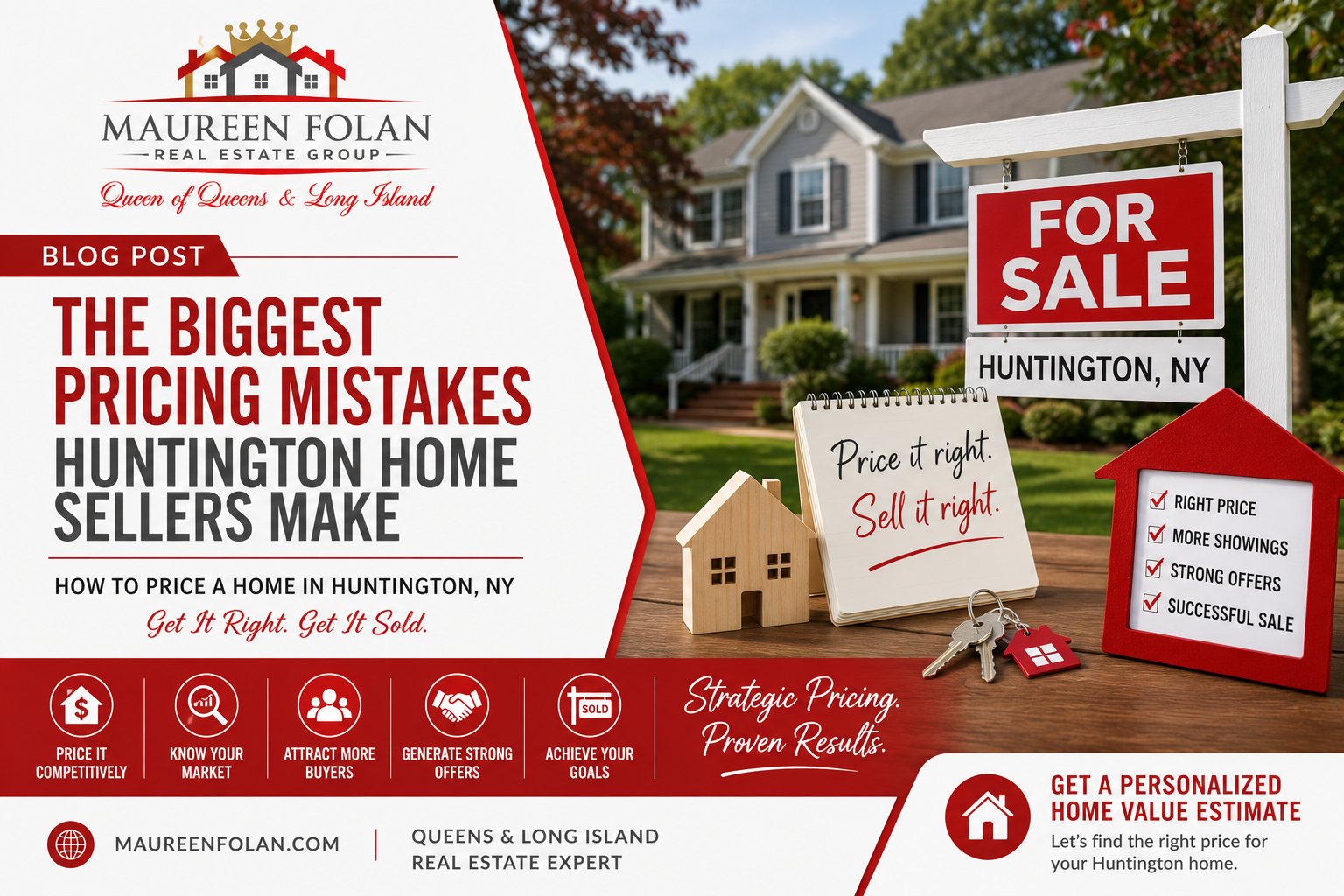
 The Biggest Pricing Mistakes Huntington Home Sellers Make
What are the biggest pricing mistakes Huntington home sellers make when putting their property on the market?
The biggest mistakes usually happen before the first showing: pricing from emotion, relying too heavily on automated estimates, choosing the wrong comparable sales, ignoring active competition, and starting high with the assumption that you can reduce the price later. If you're deciding how to price a home in Huntington, NY, your strongest strategy is to position the property based on its specific competitive market—not simply choose the highest number that sounds achievable.
Why Pricing a Huntington Home Correctly Matters From Day One
When you sell a home, there are many things you can change after the listing goes live.
You can adjust the description.
You can improve presentation.
You can modify your marketing.
You can even reduce the price.
But there is one thing you can't recreate:
Your home's first day on the market.
New listings receive attention because buyers and real estate agents are actively watching for properties that match their criteria. Your asking price helps determine whether those buyers immediately see your home as a serious option.
If the price and perceived value don't align, some buyers may simply move on.
That's why understanding how to price a home in Huntington, NY isn't about guessing the maximum amount someone might pay.
It's about creating the strongest possible position when your home enters the market.
Pricing Mistake #1: Starting With What You “Need” to Get
One of the easiest pricing mistakes is also one of the most understandable.
You begin with your financial goal.
Maybe you want a certain amount available for your next purchase. Perhaps you've invested significantly in renovations. Or you have a specific number in mind based on what you believe your home should be worth.
Those considerations matter to your financial plan.
They don't establish market value.
Buyers compare your property with the other homes available to them. They generally don't adjust what they're willing to pay because of how much you spent on an improvement or how much you need for your next move.
So separate these two questions:
What do I want or need to net from the sale?
and
What does current market evidence suggest buyers may pay for this property?
You need answers to both, but they aren't interchangeable.
Pricing Mistake #2: Treating an Online Estimate as an Appraisal
Automated home valuations can be useful as a starting point.
They are not a substitute for a property-specific pricing analysis.
An algorithm can process public records and historical sales, but your home has characteristics that may require more context.
Has the kitchen been renovated?
How does the floor plan compare with nearby sales?
What is the condition of the bathrooms?
How does the lot compare?
Does the home require substantial updating?
Are there features buyers in your price range are likely to value?
Those differences can matter.
An automated estimate also may not fully reflect the competitive environment your property will enter on the day you list.
Use online valuations as one data point, not the entire pricing strategy.
Pricing Mistake #3: Using the Wrong Comparable Sales
A nearby home sold for a certain amount, so yours should sell for the same—or more.
It sounds logical.
But proximity alone doesn't make a property comparable.
A useful comparable sale should be evaluated for characteristics such as:
- Location
- Property type
- Living area
- Lot characteristics
- Bedroom and bathroom configuration
- Condition
- Renovation level
- Amenities and notable features
- Timing of the sale
- Overall buyer appeal
The closest sale geographically may not be the most useful comparable.
Likewise, the property that achieved the highest price isn't automatically the best benchmark for your home.
The objective is to identify the properties buyers would reasonably compare with yours.
Pricing Mistake #4: Looking Only at Sold Homes
Closed sales are extremely important because they show what buyers actually paid.
But they're only part of your pricing picture.
You should also pay attention to what is competing for buyers right now.
Imagine comparable homes recently sold around one price point, but several attractive new listings have entered the market at lower prices.
Those active listings matter.
A buyer deciding whether to tour your home isn't choosing between your property and something that sold three months ago. They're choosing between your home and the alternatives available today.
That's why a pricing strategy should consider both historical evidence and current competition.
Pricing Mistake #5: “Let's Start High and See What Happens”
This is one of the most common pricing strategies sellers consider.
Why not test the market?
If someone pays the higher price, great. If they don't, you can always reduce it.
The problem is that a price reduction doesn't reset the clock.
Buyers and their agents can see that a property has been on the market and that its price has changed. More importantly, the buyers who were most interested when the property first appeared may already have dismissed it or purchased something else.
A high initial price can also change how your home competes.
Suppose your home would be compelling against properties in one price bracket, but an aggressive asking price pushes it into another bracket where buyers expect larger, newer, or more extensively renovated homes.
Now your property may be competing against the wrong alternatives.
The better question isn't:
“How high can we start?”
It's:
“At what price will buyers see the strongest relationship between this home and its competition?”
Pricing Mistake #6: Assuming a Strong Huntington Market Will Fix an Aggressive Price
Recent Huntington market data shows why sellers may feel confident.
For the three months ending June 2026, Redfin reported a median Huntington sale price of about $999,000, an increase of 5.2% compared with the same period a year earlier. Homes averaged 21 days on the market during that period, and Redfin characterized the market as highly competitive.
That's encouraging context for homeowners.
It does not mean every Huntington property can be priced aggressively and expect the market to absorb it.
A townwide median combines many individual transactions. Your property will compete within a much narrower segment based on its price, size, condition, location and features.
Strong demand can reward a well-positioned property.
It doesn't eliminate the importance of positioning.
Pricing Mistake #7: Adding Renovation Costs Dollar for Dollar
Suppose you've spent $100,000 improving your home.
Does that automatically mean your property is worth $100,000 more?
Not necessarily.
Renovations can absolutely affect marketability and buyer perception, but cost and market value are two different concepts.
Some improvements may substantially strengthen a home's competitive position. Others may reflect personal preferences that a future buyer doesn't value at the same level.
Condition matters too.
A renovated home may attract buyers looking for move-in-ready properties, while a property requiring significant work may appeal to a different buyer at a different price.
The correct question is not:
“How much did I spend?”
It's:
“How does the market currently value the result?”
Pricing Mistake #8: Ignoring the Search Brackets Buyers Use
Pricing can also influence whether buyers find your listing at all.
Many home searches are organized around maximum and minimum price thresholds.
That means a relatively small pricing decision can sometimes affect which buyers encounter your property in their search results.
This is one reason strategic pricing involves more than calculating a theoretical value and adding a cushion.
You need to think about buyer behavior.
Which properties will appear next to yours?
What will buyers see when they compare the photos, condition, size and features?
What expectations exist at that price?
Your asking price communicates more than a number.
It establishes the competitive category in which buyers evaluate your home.
Pricing Mistake #9: Refusing to Respond to New Market Information
Your pricing work isn't finished when the listing goes live.
The market starts giving you feedback immediately.
Showings, inquiries, online engagement, buyer comments, competing listings, new contracts and new inventory can all provide information.
If the response differs substantially from what you expected, you should investigate why.
That doesn't mean automatically reducing the price after a quiet weekend.
It means having a process for evaluating market feedback rather than becoming emotionally attached to the original strategy.
Sometimes the issue is presentation.
Sometimes the competitive landscape changes.
Sometimes buyers consistently identify the same objection.
And sometimes the price simply isn't creating enough perceived value.
The strongest sellers remain strategic when new evidence appears.
Pricing Mistake #10: Choosing a Listing Strategy Based on the Highest Suggested Price
If you're interviewing real estate professionals, you may hear different opinions about your home's value.
The highest number can naturally be appealing.
But a pricing recommendation should be supported by evidence.
Ask:
Which sales support this number?
Which current listings will compete with me?
How is my property different?
What buyer are we targeting?
What happens if the initial response is weaker than expected?
A well-supported pricing strategy is more useful than an impressive number without a clear rationale.
You aren't choosing the person who can name the highest price.
You're choosing a strategy for converting your property into a successful sale.
What Should Huntington Sellers Do Instead?
Before deciding on an asking price, build a property-specific competitive analysis.
Start with recent relevant sales. Then examine active competition, pending activity where appropriate, condition, improvements, lot characteristics, layout and current buyer behavior.
Next, evaluate how your home will present against the alternatives.
If two homes are similarly priced, what makes yours more compelling?
If your home needs updating, has that difference been reflected appropriately?
If your property has a distinctive feature, will the marketing make its value obvious?
Finally, connect your pricing strategy with your goals.
A seller who needs to coordinate another purchase may have different timing considerations from someone who has complete flexibility.
Pricing should support the overall selling plan—not exist separately from it.
Final Takeaway: How to Price a Home in Huntington, NY
If you're trying to determine how to price a home in Huntington, NY, avoid building your strategy around emotion, an automated estimate, one neighbor's sale, or the idea that you can simply start high and adjust later.
The strongest pricing decisions combine:
Comparable sales + current competition + property condition + buyer behavior + timing + your individual goals.
Huntington's 2026 market continues to show meaningful buyer activity, but a competitive market makes accurate positioning more important—not less.
As Maureen Folan, Queens & Long Island Real Estate Expert, I help homeowners look beyond a generic estimate and understand where their property actually fits within the current market.
Because the objective isn't to choose the highest asking price.
It's to create the pricing and marketing strategy most likely to help you achieve a successful sale. 
Get a Personalized Home Value Estimate
Wondering what your Huntington home could be worth in today's market?
Get a Personalized Home Value Estimate from Maureen Folan Real Estate Group.
We'll look at your property's condition, features, relevant recent sales and current competition to give you a more useful picture of where your home may fit in the Huntington market.
And if you're preparing to sell, ask for the Home Seller Preparation Checklist to help identify the steps worth considering before your property goes live.
Maureen Folan
Queens & Long Island Real Estate Expert
Maureen Folan Real Estate Group
MaureenFolan.com
:format(webp):quality(80)/u.realgeeks.media/maureenfolan/001.jpg)
:format(webp):quality(80)/u.realgeeks.media/maureenfolan/HVREPORT.png)