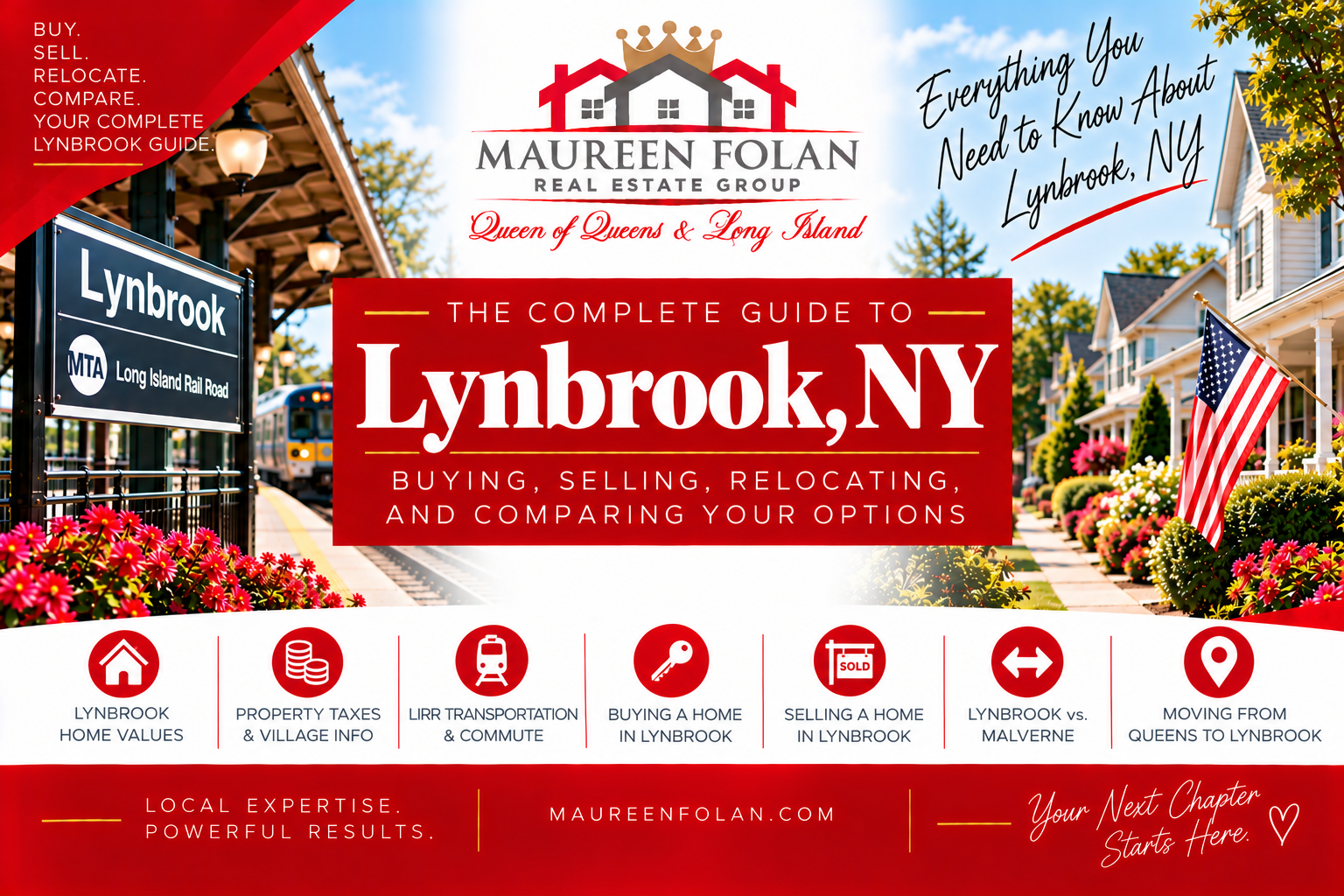
 The Complete Guide to Buying and Selling Real Estate in Lynbrook, NY
What should you know about Lynbrook, NY real estate before buying, selling, or relocating?
Whether you're buying or selling in Lynbrook, NY, understanding property values, village taxes, home condition, transportation, and ownership costs can help you make more informed decisions. If you're moving from Queens, you'll also want to coordinate your current-home sale with your next purchase so your equity, budget, and timing work together.
Understanding Lynbrook, NY Real Estate
If you're researching Lynbrook NY real estate, you'll find an incorporated village in Nassau County with residential properties, Long Island Rail Road service, and access to nearby Long Island communities.
Individual homes can differ significantly in architecture, condition, layout, lot characteristics, renovation history, and transportation access.
For buyers, those differences influence the complete ownership experience.
For sellers, they determine how a property should be priced and positioned against competing listings.
The most useful approach is to evaluate Lynbrook real estate property by property rather than relying on broad market assumptions.
Where Is Lynbrook, NY?
Lynbrook is an incorporated village within the Town of Hempstead in Nassau County.
The village has its own municipal government and certain local administrative responsibilities.
Official information is available through the Village of Lynbrook and the Town of Hempstead.
Its location places it near East Rockaway, Malverne, Rockville Centre, and Valley Stream.
For buyers, that creates opportunities to compare individual properties across neighboring communities.
For sellers, it means your competition may extend beyond Lynbrook's municipal boundaries.
What Makes Lynbrook Different From Nearby Communities?
One distinction is Lynbrook's incorporated village status.
Depending on the property, village administration may be relevant to local services, permits, regulations, and taxes.
Lynbrook also has Long Island Rail Road service, which may matter to buyers traveling toward Queens or Manhattan.
However, these characteristics don't automatically make every Lynbrook home suitable for every buyer.
Your decision should focus on the individual property's features, expenses, and location.
Buying a Home in Lynbrook, NY: Where Should You Start?
Before touring properties, define what you're trying to accomplish.
Do you need more interior space?
A dedicated workspace?
Additional storage?
Outdoor property?
A different floor plan?
A shorter or more manageable transportation routine?
Would you prefer a move-in-ready home, or are you comfortable making improvements?
These questions help you distinguish between attractive listings and properties that genuinely support your goals.
Related article: What Buyers Should Know Before Buying a Home in Lynbrook, NY.
Establish Your Complete Homebuying Budget
There's a difference between the maximum purchase price you may qualify for and the amount you actually want to spend.
For every serious Lynbrook property, consider:
Purchase price + financing costs + property-specific taxes + insurance + utilities + maintenance + landscaping + expected repairs and improvements.
A lower-priced property may require substantial renovations.
A larger lot may involve additional maintenance.
Older components may need attention sooner.
The objective isn't simply to complete the purchase.
It's to remain financially comfortable afterward.
Understanding Lynbrook Property Taxes
Property taxes are an important part of buying or owning a home in Nassau County.
Official assessment information is available through the Nassau County Department of Assessment.
Because Lynbrook is an incorporated village, buyers should also investigate applicable village-related tax components and services.
Current tax amounts may reflect exemptions or circumstances associated with the existing owner.
Your attorney and appropriate professionals can help clarify transaction-specific questions.
Don't assume two homes with similar asking prices have identical tax obligations.
Why Village Requirements Matter
Lynbrook's incorporated village status can influence which local authority administers certain property-related matters.
Depending on the home, you may need to investigate:
- Building permits
- Renovation approvals
- Certificates and property records
- Zoning requirements
- Applicable village taxes
- Local services
Before purchasing, verify the actual property's jurisdiction and documentation.
If you're selling, organizing available records before listing can help you respond to buyer questions.
Home Condition Matters More Than Cosmetic Finishes
A newly renovated kitchen can create an excellent first impression.
But it doesn't tell you the condition of the entire property.
Likewise, an older-looking home may have been carefully maintained.
Separate:
Appearance: How the home looks.
Age: How old individual features and components are.
Condition: How those components function and have been maintained.
Appropriate professional inspections and due diligence can help buyers better understand a property's physical condition.
Understand Renovations and Additions
Individual homes can change substantially over time.
Some Lynbrook properties may have undergone additions, conversions, or major renovations.
Before purchasing, investigate what work was completed and what documentation exists.
Your attorney and other appropriate professionals can help evaluate relevant permits, certificates, surveys, title information, and transaction-specific records.
For sellers, organizing this information early can make the transaction process more manageable.
Decide How Much Renovation You're Willing to Undertake
Before making an offer, determine whether you're primarily a:
Move-in-ready buyer: You prefer relatively little immediate work.
Cosmetic-update buyer: You're comfortable changing finishes gradually.
Renovation buyer: You're willing to undertake substantial improvements.
All three approaches can work.
The mistake is purchasing a property requiring major construction when you don't actually want to manage it.
If significant improvements are necessary, investigate realistic costs and timelines before committing.
Layout Can Matter More Than Square Footage
Two Lynbrook homes with similar reported square footage can function very differently.
During showings, imagine your actual routine.
Where do you enter?
How does the kitchen connect with the living areas?
Where would you work?
How much storage exists?
Which rooms would you regularly use?
How do you access the outdoor areas?
A functional layout may provide more practical value than additional square footage you won't use.
Evaluate Storage and Outdoor Space
Storage deserves its own evaluation.
Look at closets, pantries, garages, utility areas, and other available storage.
Then evaluate the lot.
Consider usability, landscaping, driveways, outdoor entertaining areas, and maintenance responsibilities.
A larger lot isn't automatically more useful.
The right property provides outdoor space you actually want to use and maintain.
Lynbrook Long Island Rail Road Transportation
Lynbrook has an LIRR station with service associated with the Long Beach and Babylon branches.
For buyers traveling regularly toward Queens or Manhattan, transportation may be an important consideration.
Current schedules and station information are available through the Long Island Rail Road.
However, the complete commute depends on the individual property, schedule, and destination.
Evaluate transportation door to door.
Consider how you'll reach the station, which train you'll use, whether transfers are necessary, and the return trip.
If transportation is important, test your likely route under realistic conditions.
Explore Lynbrook Beyond the Listings
A showing tells you about the house.
It doesn't fully explain your everyday routine.
Spend time in Lynbrook outside of appointments.
Run errands.
Test transportation.
Visit shopping areas, restaurants, public parks, and other destinations relevant to your interests.
Return at another time.
You're determining whether the individual property and its location support your daily activities.
Selling a Home in Lynbrook, NY: Start With Your Competition
If you're selling a home in Lynbrook, begin with one important question:
"What else can my likely buyer purchase for approximately the same amount?"
Buyers may compare your property with other Lynbrook listings and homes in nearby communities.
They'll evaluate:
- Price
- Condition
- Layout
- Usable space
- Documented improvements
- Lot characteristics
- Property taxes
- Transportation
- Maintenance responsibilities
Your selling strategy should identify what genuinely differentiates your home.
Related article: Selling a Home in Lynbrook, NY: How to Prepare, Price, and Position Your Property.
How Much Is Your Lynbrook Home Worth?
Automated valuations may provide a starting point.
However, a property-specific market analysis should consider relevant recent comparable sales, current listings, pending activity where useful, condition, layout, improvements, lot characteristics, location, and buyer activity.
The objective isn't to identify the highest nearby sale.
It's to understand how your property compares with homes buyers can realistically purchase instead.
Closed Sales and Active Listings Serve Different Purposes
Closed transactions show what buyers previously paid.
Active listings show what buyers can purchase today.
Both matter.
Suppose recent sales support your intended asking price.
Then several competing homes enter the market with updated interiors or other appealing features.
Your potential buyers will see those homes too.
Your pricing strategy should reflect the competition available when your property launches.
Should You Renovate Before Selling?
Not necessarily.
Some sellers assume they need a new kitchen, updated bathrooms, or major exterior improvements before listing.
But substantial construction can introduce costs and delays.
Before beginning, ask:
What might the property sell for in its current condition?
What do competing homes offer?
Which improvements could meaningfully affect buyer perception?
What would the project cost?
How long would it take?
Would the expected benefit justify the investment?
Analyze your market position before committing to major work.
Prepare Your Lynbrook Home Strategically
A practical preparation strategy involves three categories.
Repairs: Address damaged, malfunctioning, visibly deteriorated, or unfinished items.
Cosmetic refreshes: Consider deep cleaning, decluttering, lighting, paint, landscaping, and furniture arrangement.
Major renovations: Evaluate substantial projects individually based on cost, timing, and expected market benefit.
You don't need to make every part of your property new.
You need to make its genuine strengths easy to recognize.
Professional Photography and Marketing Matter
Many buyers will first encounter your home online.
Professional-quality photography should communicate the exterior, main living spaces, kitchen, bathrooms, natural light, layout, outdoor areas, and distinctive features.
Your listing description should reinforce accurate property details.
Rather than relying on generic adjectives, identify what makes the home worth considering.
Pricing Your Lynbrook Home Strategically
Pricing is competitive positioning.
Your asking price determines which properties buyers compare with yours.
Increase the asking price substantially, and buyers may expect more renovations, additional usable space, different amenities, or another property type.
Your home hasn't changed.
Its competition has.
An effective pricing strategy should be grounded in relevant comparable sales, current listings, and the property's individual characteristics.
Monitor Buyer Feedback After Listing
Once your home enters the market, pay attention to showing requests, second visits, buyer questions, feedback, offers, new competing listings, and price adjustments.
These signals can help you evaluate whether the property is positioned effectively.
If activity is weaker than anticipated, investigate whether pricing, presentation, condition, showing access, or competition may be contributing.
Market feedback should inform your strategy.
Evaluate Offers Beyond Purchase Price
The highest offer isn't automatically the strongest complete offer.
Depending on the transaction, relevant considerations may include financing, contingencies, closing timing, contractual terms, and transaction certainty.
Your attorney and appropriate professionals can help evaluate transaction-specific details.
The strongest offer should support both your sale and your plans afterward.
Moving From Queens to Lynbrook, NY
For Queens homeowners, purchasing in Lynbrook may be one part of a larger relocation.
If you already own in Queens, begin by understanding your current property's potential market value.
Estimate likely net proceeds after accounting for your remaining mortgage and applicable transaction expenses.
Then determine how much equity you actually want to use.
Available purchasing power doesn't automatically need to become a larger purchase price.
Related article: Moving From Queens to Lynbrook, NY: What Homeowners Should Know Before Relocating.
Coordinate Your Queens Sale and Lynbrook Purchase
If your current-home proceeds are needed for your Lynbrook purchase, establish your preferred transaction sequence early.
Ask:
Do I need to sell before buying?
Could I purchase first?
Can I comfortably own both properties temporarily?
How much equity will I use?
How much liquidity do I want afterward?
What happens if my Queens home sells first?
What happens if the right Lynbrook property appears first?
Planning these scenarios before negotiations can provide greater flexibility.
Comparing Lynbrook With Malverne
Malverne may naturally appear in the same property search.
Both Lynbrook and Malverne are incorporated villages within the Town of Hempstead.
Both have Long Island Rail Road service, although station service patterns differ.
When comparing properties, evaluate purchase price, property taxes, condition, layout, lot, transportation, renovation requirements, and maintenance.
The strongest individual property may resolve the geographic decision.
Related article: Lynbrook vs. Malverne, NY: What Homebuyers Should Compare Before Choosing.
Comparing Lynbrook With East Rockaway
East Rockaway is another neighboring incorporated village.
Buyers may consider properties in both locations.
Compare actual homes based on condition, layout, usable space, taxes, village requirements, transportation, insurance, and total ownership costs.
Avoid assuming one village is universally preferable.
Related article: East Rockaway vs. Lynbrook, NY: What Homebuyers Should Compare Before Choosing.
A Lynbrook Homebuyer's Checklist
Before making an offer, ask:
- Does the property accomplish the reasons I'm moving?
- What are the verified property-specific taxes?
- What village-related requirements apply?
- Can I comfortably afford the total ownership costs?
- What renovations or modifications have been made?
- What documentation is available?
- What is the property's physical condition?
- Does the layout and lot work for my routine?
- Does transportation work from this exact address?
- Would I still want this property if I weren't worried about losing it?
These questions help you approach the purchase with a clearer strategy.
A Lynbrook Home Seller's Checklist
Before listing, ask:
- What is my home's realistic market value?
- Which properties will buyers compare with mine?
- What genuinely differentiates my home?
- What improvement documentation should I organize?
- Which repairs should I complete?
- Which cosmetic refreshes could improve presentation?
- Should I reconsider major renovations?
- Does my asking price create a competitive position?
- How will I respond to market feedback?
- How will this sale support my next move?
These answers create the foundation for a strategic launch.
Final Takeaway: Lynbrook, NY Real Estate
When evaluating Lynbrook NY real estate, focus on the individual property.
If you're buying, compare purchase price, property-specific taxes, village requirements, condition, documented improvements, layout, lot, transportation, insurance, maintenance, and total ownership costs.
If you're selling, focus on competitive pricing, thoughtful preparation, professional presentation, accurate documentation, and current market feedback.
And if you're relocating between Queens and Lynbrook, coordinate your current-home sale and next purchase through one connected strategy.
As Maureen Folan, Queens & Long Island Real Estate Expert, I help buyers and sellers evaluate these decisions property by property.
Because the goal isn't simply to buy or sell in Lynbrook.
It's to make sure the property, price, ownership costs, transportation, timing, and strategy all support whatever comes next. 
Ready to Make Your Lynbrook Move?
Whether you're buying, selling, or relocating, Maureen Folan Real Estate Group can help you develop a property-specific strategy.
If you're selling: Request a Personalized Home Value Estimate based on your property's condition, layout, improvements, lot, relevant recent sales, and current competition.
If you're buying: Schedule a Buyer Consultation to compare Lynbrook properties based on your budget, transportation requirements, condition preferences, and total ownership costs.
If you're relocating from Queens: Schedule a Queens & Long Island Relocation Consultation to coordinate your current-home sale with your Lynbrook purchase.
Maureen Folan
Queens & Long Island Real Estate Expert
Maureen Folan Real Estate Group
MaureenFolan.com