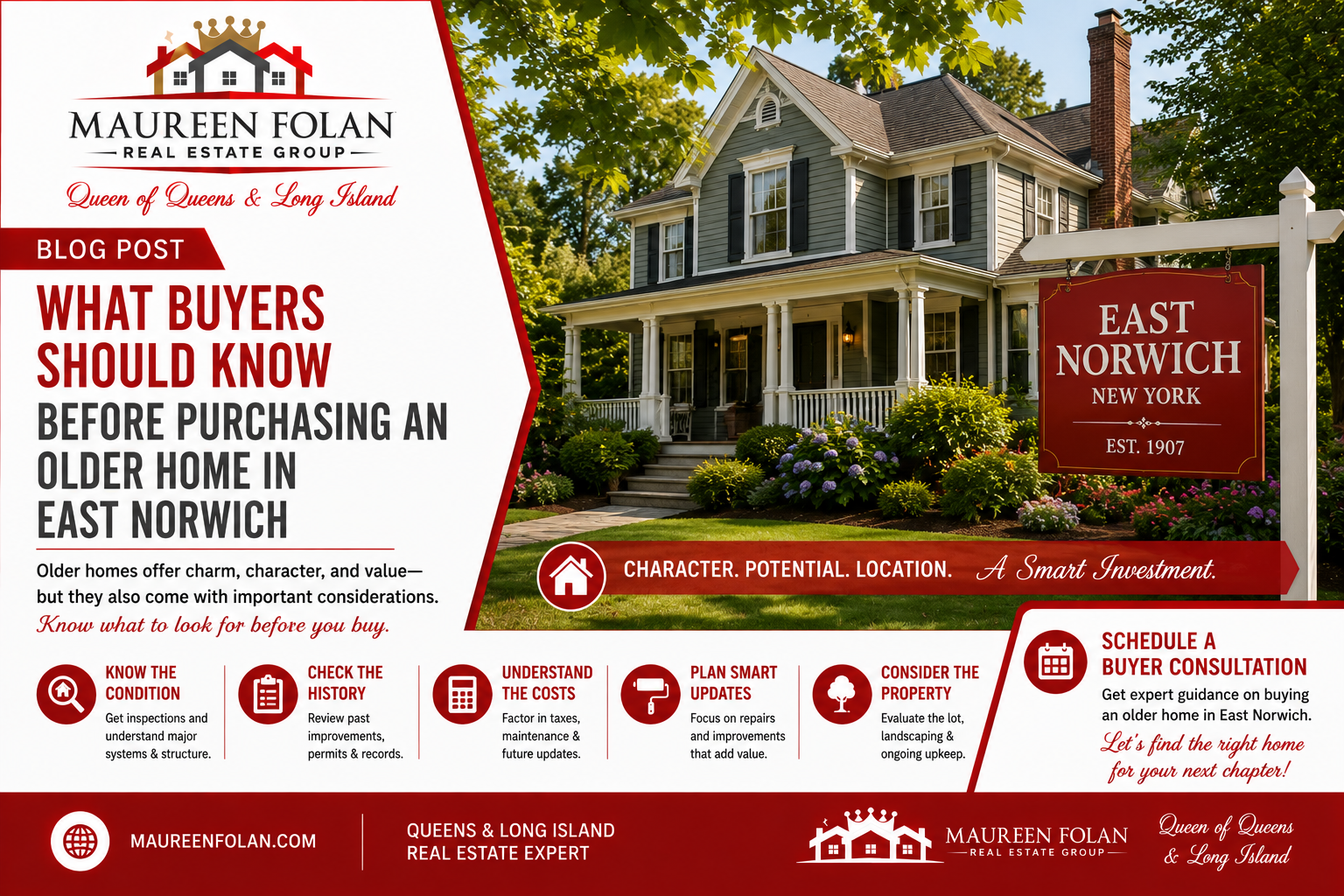
 What Buyers Should Know Before Purchasing an Older Home in East Norwich
What should you know before buying an older home in East Norwich, NY?
An older East Norwich home can offer distinctive architecture, established property features, and renovation potential, but age makes careful evaluation especially important. Before buying, you should understand the home's current condition, major systems, previous improvements, property-specific taxes, maintenance requirements, renovation budget, and total cost of ownership rather than focusing only on cosmetic appearance.
Buying a Home in East Norwich, NY Requires Looking Beyond the Finishes
If you're considering buying a home in East Norwich, NY, you may encounter properties that have been standing for decades.
Some may have been extensively renovated.
Others may retain many original characteristics.
And many will fall somewhere in between, with improvements completed by different owners at different times.
That can make an older home interesting—but it also means you should understand exactly what you're purchasing.
A new kitchen doesn't necessarily mean the entire house has been modernized.
Likewise, an older bathroom or dated flooring doesn't automatically mean the underlying property is in poor condition.
The goal is to separate three things:
Age. Condition. Appearance.
They're related, but they're not the same.
An Older Home Isn't Automatically a Problem
One of the biggest mistakes buyers can make is treating the age of a home as a verdict on its quality.
A well-maintained older property may have been cared for thoughtfully over many years.
A newer-looking property can still have components requiring attention.
Instead of asking whether the house is “too old,” ask more useful questions:
What has been maintained?
What has been replaced or improved?
What appears to remain original?
What might require attention during my expected ownership period?
That approach gives you much more useful information than the year the home was built alone.
Start With the Structure and Major Systems
When touring an older East Norwich property, beautiful finishes can easily capture your attention.
But countertops aren't usually the most consequential part of the house.
If you become serious about the property, you'll want appropriate professional due diligence concerning the home's major components and systems.
Depending on the property, those may include areas such as:
- Roofing
- Foundation and structural components
- Electrical system
- Plumbing
- Heating and cooling
- Windows and doors
- Drainage and moisture conditions
- Chimneys or fireplaces where applicable
- Exterior materials
- Insulation and ventilation
A showing isn't a substitute for a professional inspection.
Your job during the showing is primarily to decide whether the home deserves further investigation.
If it does, qualified professionals can help you understand its condition more thoroughly.
Don't Let a Renovated Kitchen Distract You
Renovated kitchens and bathrooms can make older homes feel significantly newer.
That's appealing.
But cosmetic renovation and whole-home modernization aren't the same thing.
Suppose the kitchen was remodeled recently.
Ask what else has been updated.
Was the electrical system changed as part of the project?
Was plumbing modified?
Were permits required and, where relevant, properly handled?
What other improvements have been made over time?
You don't need to assume there's a problem.
You simply want to understand the scope of what “renovated” actually means.
A home can have a brand-new kitchen while other major components remain much older.
That's not necessarily bad.
It's information you should have when deciding what you're willing to pay.
Understand the Difference Between Cosmetic and Capital Improvements
When you walk through a home, start separating potential future projects into categories.
Cosmetic improvements might include paint, flooring, light fixtures, hardware, or other finishes.
These can still cost money, but they're generally different from replacing major systems or completing significant construction.
Capital improvements can involve larger, more expensive components of the property.
If you're comfortable with cosmetic work but don't want to undertake major projects soon after closing, that distinction matters.
A home with dated finishes and well-maintained underlying systems may be more attractive to you than a beautifully decorated property with larger future projects.
Evaluate the house from the inside out—not simply from the photographs inward.
Ask About the History of Improvements
Older homes often evolve.
One owner adds something.
Another renovates a kitchen.
Someone replaces windows.
A bathroom is updated years later.
That history can help you understand the property.
Where available, ask about known improvements and documentation.
Relevant records may help clarify what work was completed and when.
Depending on the project and circumstances, permits, certificates, warranties, receipts, or other documentation may also be relevant.
Your attorney, inspector, and other appropriate professionals can help you determine which records or issues require further investigation for a particular transaction.
The important thing is not to assume.
If an addition looks newer than the rest of the home, ask about it.
If the listing mentions substantial improvements, understand what those improvements actually involved.
Budget for Ownership, Not Just Purchase
An older home can fit comfortably within your purchase budget and still create an ownership budget you haven't anticipated.
Before making an offer, think beyond the mortgage.
Your broader calculation may include:
Purchase price + property-specific taxes + insurance + utilities + routine maintenance + expected repairs + planned improvements.
Then consider your time horizon.
If you expect to own the home for many years, which components might reasonably require attention during that period?
You don't need to predict every future repair.
You do need enough financial flexibility that normal homeownership doesn't become a crisis every time something needs attention.
Keep Cash Reserves After Closing
This is especially important if you're buying an older property.
Don't spend every available dollar on the purchase simply because you've been approved to do so.
After closing, you may want to make cosmetic changes.
You may need furniture.
You may discover routine maintenance items once you've lived in the home for a while.
And eventually, every house requires repairs.
A financial reserve gives you flexibility.
That can be more valuable than stretching to your absolute maximum purchase price and having no room left for the property itself.
Property Taxes Should Be Verified for the Specific Home
East Norwich is within the Town of Oyster Bay, but you shouldn't use a generic town or community estimate when evaluating taxes.
Verify the property-specific information for the home you're considering.
The Town of Oyster Bay provides online access to property-related information and municipal resources, which can be useful starting points when researching a property. Town of Oyster Bay official website
Your real housing cost should incorporate those property-specific obligations rather than purchase price alone.
This becomes especially important when comparing an East Norwich home with one in Syosset, Oyster Bay, or another nearby community.
Two similarly priced homes aren't necessarily equally affordable.
Pay Attention to the Lot Too
When evaluating an older home, buyers sometimes become so focused on the structure that they forget about the land surrounding it.
The lot is part of what you're purchasing.
Look at how usable the outdoor space is.
Consider landscaping and maintenance.
Observe drainage characteristics.
Look at driveways, patios, retaining features, mature trees, and other exterior elements.
If the property is larger than what you've owned before, consider what maintaining it will realistically involve.
Mature landscaping can create a distinctive setting.
It can also require care.
Neither is inherently good or bad.
You simply need to understand what comes with the property.
Older Homes Can Offer Characteristics That Are Difficult to Reproduce
One reason buyers consider older homes is that they may offer details or property characteristics that aren't easily replicated.
That could include architecture, room proportions, established landscaping, materials, or other features.
This is where your personal priorities matter.
If you appreciate those characteristics, you may be comfortable accepting some updates over time.
Another buyer may prefer newer construction and fewer immediate projects.
Neither buyer is making the wrong choice.
The purpose of your search is to identify which tradeoffs make sense for you.
Don't Overestimate the Cost of Every Cosmetic Issue
There's another mistake to avoid.
Some buyers walk into an older home, see dated finishes, and mentally turn every room into a major renovation.
Not every change needs to happen immediately.
Paint can wait.
Flooring may be changed later.
A functional kitchen doesn't necessarily need to be replaced on move-in day just because it isn't your preferred style.
Ask yourself:
Can I comfortably live with this?
If the answer is yes, you may be able to improve the property gradually instead of treating every cosmetic preference as an immediate expense.
That can materially change how you evaluate value.
But Don't Underestimate Major Renovations Either
The opposite mistake can be equally problematic.
It's easy to say:
“We'll just redo the kitchen.”
Or:
“We can always change the layout.”
Those statements can represent very different levels of cost and complexity.
Before paying a premium for a home based on what you believe it could become, get realistic about the projects required to get there.
If your purchase depends on a substantial renovation being financially feasible, appropriate professional estimates and due diligence can become particularly important.
Potential is valuable only when you can realistically execute the plan.
Understand New York Seller Disclosures
New York's Property Condition Disclosure Act generally requires sellers of covered residential real property to provide a Property Condition Disclosure Statement before the buyer signs a binding contract of sale.
The disclosure is based on the seller's actual knowledge and is not a warranty or substitute for your own inspections and investigations.
That's particularly important with older properties.
A disclosure can provide useful information.
It shouldn't become the entirety of your due diligence.
Questions concerning your legal rights, contracts, title, disclosures, or transaction-specific requirements should be discussed with your attorney.
Professional Inspection Matters
If you decide to pursue an older East Norwich home, a qualified home inspector can help you better understand the property's visible condition.
Depending on the home and what is discovered, additional specialized evaluation may sometimes be appropriate.
The purpose isn't to find a “perfect” house.
Every property has maintenance requirements.
The purpose is to reduce uncertainty and understand what you're taking on before completing a major purchase.
You can then evaluate findings in context.
Is something routine maintenance?
Is it a future project?
Does it require more immediate attention?
Does it materially change how you view the property?
Information allows you to make that distinction.
Don't Expect the Seller to Make an Older Home New
An inspection isn't a renovation wish list.
If you're purchasing an older home, you should expect some components to reflect the home's age.
Your due diligence helps identify condition and potential concerns; it doesn't automatically mean every older element should be replaced by the seller.
This is another reason to decide your condition tolerance before you make an offer.
If you want virtually every component to be new, an older property may not be the right target for your search.
If you're comfortable owning a home that evolves over time, you may view the same property very differently.
Compare East Norwich With Your Other Options
If you're considering buying a home in East Norwich, NY, you may also be looking at Syosset, Oyster Bay, or other nearby markets.
Compare actual properties.
Suppose your budget buys a renovated Syosset home with one set of characteristics and an older East Norwich home with a larger lot or a different layout.
Which better fits your goals?
Don't decide based solely on which community name you prefer.
Compare:
- Purchase price
- Property-specific taxes
- Condition
- Renovation requirements
- Lot
- Layout
- Transportation
- Ongoing maintenance
- Distance to your regular destinations
That's the comparison that can help you make a confident decision.
If You're Moving From Queens, Expect Your Maintenance Routine to Change
Queens buyers should pay particular attention to property responsibilities.
Depending on what you currently own, an East Norwich house may introduce more exterior maintenance, landscaping, or other homeownership tasks.
Think about whether you want those responsibilities.
More property may be one reason you're moving.
If so, that's a benefit you're intentionally choosing.
But you should still budget for the time and money required to maintain it.
The goal isn't simply to purchase more house or more land.
It's to purchase a property that supports the lifestyle and financial plan you want next.
Final Takeaway: Buying an Older Home in East Norwich, NY
If you're buying a home in East Norwich, NY, don't judge an older property solely by its age—or by how recently its kitchen was renovated.
Look at the complete home.
Understand the condition of major systems and components. Investigate the history of improvements. Verify property-specific taxes. Consider maintenance requirements. Establish realistic renovation expectations. And maintain enough financial flexibility to own the home comfortably after closing.
An older East Norwich property may offer distinctive characteristics and significant potential.
But potential should be evaluated alongside condition, cost, documentation, and your willingness to take on future projects.
As Maureen Folan, Queens & Long Island Real Estate Expert, I help buyers compare those factors so you're not simply deciding whether you love the house.
You're determining whether the property makes sense as a long-term ownership decision. 
Schedule a Buyer Consultation
Considering an older home in East Norwich or comparing East Norwich with Syosset and other nearby Long Island communities?
Schedule a Buyer Consultation with Maureen Folan Real Estate Group.
We'll discuss your budget, condition preferences, renovation tolerance, location priorities, and current options so you can approach your search with a clearer strategy.
If you're moving from Queens, we can also look at how your current property and expected sale proceeds fit into the purchase.
And ask for the Property Tax Guide to help organize the property-specific ownership costs you'll want to investigate as you compare homes.
Maureen Folan
Queens & Long Island Real Estate Expert
Maureen Folan Real Estate Group
MaureenFolan.com
:format(webp):quality(80)/u.realgeeks.media/maureenfolan/001.jpg)
:format(webp):quality(80)/u.realgeeks.media/maureenfolan/HVREPORT.png)