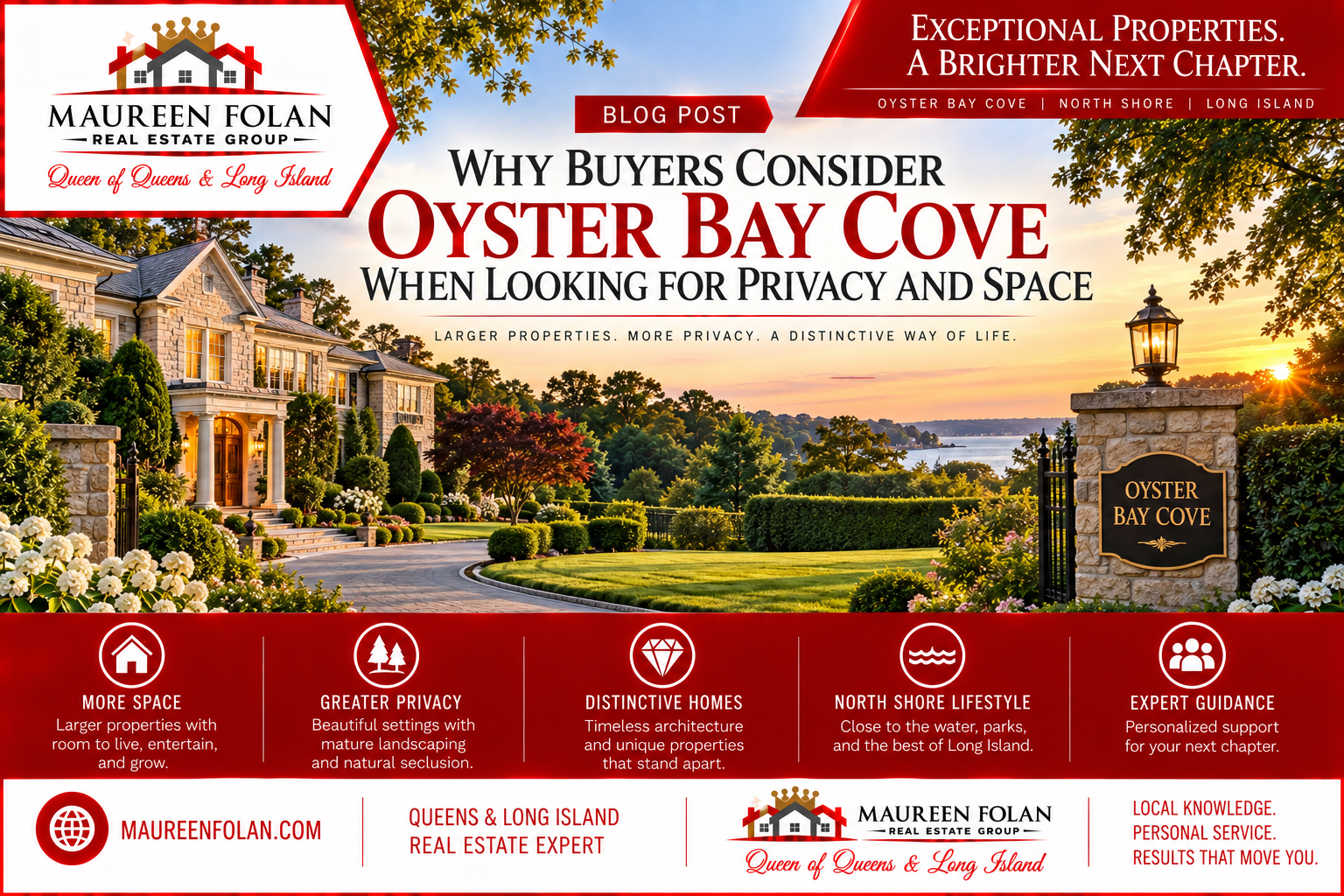
 Why Buyers Consider Oyster Bay Cove When Looking for Privacy and Space
Why do luxury homebuyers consider Oyster Bay Cove when looking for more privacy and space on Long Island’s North Shore?
Oyster Bay Cove can offer buyers a residential setting where larger properties, substantial setbacks, mature landscaping, distinctive architecture, and lower-density surroundings may create the sense of space and privacy they want. But luxury buyers should evaluate each property individually—because acreage, usable land, condition, taxes, maintenance, and the actual source of a home's privacy can vary considerably.
What Makes Oyster Bay Cove Luxury Homes Different?
If you're exploring Oyster Bay Cove luxury homes, you may be looking for something that's difficult to find in a more densely developed market.
Space.
Privacy.
Land.
Distinctive architecture.
A property that feels separate from its surroundings.
Those characteristics can be compelling, especially if you're moving from Queens or another location where your current home sits much closer to neighboring properties.
But there's an important distinction to make:
More land doesn't automatically create a better luxury property.
The value comes from what that land, setting, and home actually allow you to experience.
Oyster Bay Cove Is an Incorporated North Shore Village
Oyster Bay Cove is an incorporated village within the Town of Oyster Bay in Nassau County.
The Village maintains its own municipal government and provides information and resources for residents and property owners through its official site. Village of Oyster Bay Cove
For buyers, the municipal boundary is useful context.
But your purchase should ultimately be driven by the individual property.
Two Oyster Bay Cove homes can offer dramatically different combinations of acreage, privacy, architecture, condition, outdoor amenities, and maintenance.
You're not simply buying the village name.
You're buying one particular property within it.
Privacy Is One of the Hardest Luxury Features to Quantify
Luxury listings use the word private constantly.
But what does it actually mean?
One property may feel private because the house sits far back from the road.
Another may use mature landscaping to create screening.
A third may have enough acreage to provide significant separation from neighboring homes.
Topography can create privacy too.
So can the orientation of the home.
Before paying a premium for privacy, identify exactly what creates it.
Stand in the primary living areas.
Look outside.
Walk the grounds where appropriate.
Notice neighboring properties.
Ask yourself:
Does this property provide the degree and type of privacy I'm actually looking for?
That's much more useful than accepting an adjective in a listing description.
Acreage Is Only the Beginning
If additional land is one of your priorities, you'll naturally look at lot size.
Don't stop there.
Two properties can contain similar acreage and function completely differently.
One may offer broad, level outdoor areas.
Another could contain extensive wooded or sloped portions.
One property may place the house in the center of the land.
Another may sit closer to a boundary.
One could provide expansive lawns and outdoor amenities.
Another may emphasize natural landscaping.
Evaluate usable land, not acreage alone.
Ask What You Want the Land to Do
This is one of the best ways to prevent yourself from paying for property you don't actually need.
Why do you want more land?
Privacy?
Outdoor entertaining?
Gardening?
A pool?
Recreation?
A larger sense of separation?
Simply more scenery around the house?
Once you know the purpose, you can judge whether the individual property accomplishes it.
A smaller lot that creates exceptional privacy may be more valuable to you than substantially more acreage without the same functional benefits.
More Property Means More Maintenance
The same land that gives you privacy also needs care.
Depending on the property, ownership responsibilities may include:
- Lawn maintenance
- Mature trees
- Landscaping
- Irrigation
- Driveways
- Walkways
- Exterior lighting
- Fences or gates
- Drainage
- Patios and terraces
- Pools or other outdoor amenities
You may choose to handle some of that yourself or hire professionals.
Either way, it becomes part of the ownership cost.
Luxury buyers should think beyond:
“Can I afford to buy this?”
and ask:
“Am I comfortable operating and maintaining this property?”
The Approach to the Home Can Be Part of the Experience
On a larger property, the experience often begins well before the front door.
The entrance.
Driveway.
Landscaping.
Setback.
First view of the house.
These features can create a sense of arrival that is difficult to reproduce on a smaller lot.
That's part of why buyers seeking privacy and space may respond strongly to certain Oyster Bay Cove properties.
But pay attention to the practical side too.
A long driveway needs maintenance.
Extensive landscaping requires care.
Trees and exterior features create responsibilities.
The same characteristics creating the property's appeal also contribute to its ownership profile.
Architecture Can Matter as Much as Acreage
A beautiful setting doesn't automatically make the house itself work for you.
Look at the architecture carefully.
How does the home sit on the land?
Do major rooms take advantage of the setting?
Is there strong natural light?
How do indoor spaces connect with outdoor areas?
Does the layout support the way you live?
Is the architecture cohesive?
Have additions been integrated effectively?
A luxury property is strongest when the house and land feel like they belong together.
Bigger Isn't Automatically Better Inside Either
The same principle applies to interior square footage.
A larger home isn't necessarily a more functional home.
Think about how you'll actually use the rooms.
Do you entertain frequently?
Need dedicated workspace?
Host overnight guests?
Want hobby or fitness space?
Need significant storage?
Or are you paying for rooms you'll rarely enter?
More square footage means more to furnish, heat, cool, clean, and maintain.
The right luxury home should provide useful space, not simply impressive measurements.
Move-In-Ready Can Be Valuable
If you're making a significant purchase, you may prefer a property that requires little immediate work.
That can be especially appealing with a larger home because renovation projects can quickly become substantial in scale and cost.
But move-in-ready doesn't necessarily mean brand-new.
A home can feel move-in-ready when it is:
Well maintained.
Functionally sound.
Consistently presented.
Updated appropriately.
Ready for you to occupy without an immediate list of major projects.
That predictability can carry real value.
Renovation Opportunities Can Be Attractive Too
Another buyer may see things differently.
Perhaps you're willing to purchase an older or less updated Oyster Bay Cove home because it provides acreage, architecture, or privacy you couldn't easily reproduce.
That can be a legitimate strategy.
Just don't underestimate the work.
Before making a purchase dependent on significant renovations, investigate realistic costs and timelines with appropriate professionals.
Ask whether the home's underlying characteristics justify the investment.
A property with exceptional land and architecture may be worth improving.
But “potential” isn't free.
Distinguish Character From Condition
Older or distinctive properties can create another challenge.
You may encounter finishes that aren't current but still contribute to the home's architectural identity.
Don't automatically assume every older feature needs to disappear.
At the same time, don't confuse architectural character with deferred maintenance.
A preserved original detail can be valuable.
A component that no longer functions properly is a different issue.
Appropriate inspections and due diligence can help you understand the condition of the property if you decide to pursue it.
Outdoor Amenities Can Change the Value Equation
Luxury buyers may encounter properties with:
Pools.
Terraces.
Outdoor kitchens.
Gardens.
Sport-related areas.
Extensive landscaping.
Guest or accessory structures where legally applicable.
These features can make a property significantly more compelling to the buyer who wants them.
They also create maintenance.
Before paying a premium for an amenity, ask:
Will I actually use this?
There's a difference between being impressed by a feature during a showing and valuing it enough to maintain it for years.
Mature Landscaping Can Be an Asset
One reason established luxury properties can feel especially private is mature landscaping.
Large trees and established plantings can take decades to reproduce.
That can make them a meaningful component of the property.
But landscaping should still be evaluated practically.
What maintenance does it require?
Which elements provide screening?
Are there areas that need attention?
How does vegetation affect natural light?
Does the landscaping complement the architecture?
Maturity can create value.
It can also create responsibility.
Property Taxes Belong in the Early Analysis
When considering a higher-value Oyster Bay Cove property, verify the property-specific taxes early.
Don't rely on a generic estimate for the community.
Two homes with similar asking prices can carry different tax obligations.
That difference affects your total annual ownership expense.
When comparing properties, consider:
Purchase price + financing + property-specific taxes + insurance + utilities + landscaping + maintenance + expected improvements.
That is a more meaningful affordability calculation than asking price alone.
Insurance Should Be Property-Specific Too
Larger and more distinctive properties may contain features that affect insurance considerations.
Pools.
Outbuildings where applicable.
Specialized systems.
High-value finishes.
Other property-specific characteristics.
Don't assume the insurance profile of one Oyster Bay Cove home applies to another.
Investigate the individual property with an appropriate insurance professional before making assumptions about ongoing costs.
Privacy Can Affect Security and Property Management
Greater privacy can be appealing.
It may also influence how you think about the property operationally.
Exterior lighting.
Gates where applicable.
Landscaping.
Driveway visibility.
Alarm and monitoring systems.
Property access.
These are practical ownership considerations.
Again, privacy isn't inherently better or worse.
It's a feature with both benefits and responsibilities.
Transportation Should Still Be Tested
A private North Shore setting may be one of your priorities, but you still need to get places.
If you commute regularly to Queens, Manhattan, or elsewhere on Long Island, map your route from the actual property.
If rail travel matters, review the stations and services you'd realistically use through the Long Island Rail Road.
Don't settle for a generic commute estimate.
Test the trip at realistic times when possible.
A property can be extraordinary and still create a routine you don't want.
Visit the Area Without a Showing Appointment
When evaluating Oyster Bay Cove, spend time in the broader area when you're not touring houses.
Drive the routes you'd use.
Visit nearby Oyster Bay.
Run an ordinary errand.
Explore public destinations relevant to you.
Test your transportation.
Visit at another time of day.
You're not trying to determine whether the area is “good.”
You're determining whether the location supports your routine.
Oyster Bay Cove vs. Other North Shore Luxury Markets
If you're looking at Oyster Bay Cove, you may also be considering Laurel Hollow, Cold Spring Harbor, Huntington Bay, or other North Shore communities.
That's useful.
Luxury buyers often have wider geographic flexibility because the property itself can matter more than a particular ZIP code.
Compare actual homes.
Perhaps Oyster Bay Cove provides the acreage and privacy you want.
Maybe Laurel Hollow presents another compelling estate property.
Cold Spring Harbor might offer a setting or architecture you prefer.
The right home may resolve the town question for you.
Scarcity Can Influence the Search
The more requirements you combine, the smaller your inventory becomes.
Suppose you want:
A particular amount of acreage.
Substantial privacy.
Move-in-ready condition.
A pool.
A specific architectural style.
A certain price range.
A convenient location.
You may not see many properties meeting every criterion.
That scarcity matters.
But don't let it eliminate discipline.
Rare doesn't automatically mean appropriately priced.
Your job is to distinguish between difficult to replace and worth the premium.
Buyers Should Be Prepared Before the Right Property Appears
If you're shopping for a specific type of luxury home, establish your strategy early.
Know:
Your comfortable purchase range.
Your financing approach where applicable.
Your desired cash reserves.
Your condition tolerance.
Your renovation budget.
Your property-tax expectations.
Your maintenance tolerance.
Your timing.
Your walk-away point.
Then when the right home appears, you can evaluate it efficiently without inventing your financial strategy during negotiations.
If You're Moving From Queens, Start With Your Current Home
Oyster Bay Cove may appeal particularly to Queens homeowners looking for more property and privacy.
If you already own in Queens, your current home may play a major role in your next purchase.
Start by understanding its potential market value and your estimated net proceeds.
Then decide how much equity you want to apply to the Oyster Bay Cove purchase.
Don't automatically put every available dollar into the next home.
A larger property may require greater reserves for maintenance, landscaping, improvements, and other ownership expenses.
Your Queens sale and Long Island purchase should work as one coordinated financial strategy.
Don't Buy Privacy for the Idea of Privacy
This is worth emphasizing.
A large, private property can look extraordinary during a showing.
But ask how you expect to use it.
If you value separation, land, outdoor living, and the setting enough to maintain them, the property may be exactly what you're looking for.
If you're rarely outdoors and don't particularly care about acreage, you may be paying a substantial premium for features that don't materially improve your life.
Luxury should be personal.
What Should You Look for During an Oyster Bay Cove Showing?
Don't focus only on finishes.
Evaluate the complete property.
Look at:
- How the home sits on the land
- What creates the privacy
- How much of the acreage is usable
- Condition of the house
- Architecture and layout
- Natural light
- Outdoor amenities
- Landscaping and maintenance
- Property-specific taxes
- Improvements you would want to make
- Total ownership costs
- Transportation from the actual property
This gives you a much stronger basis for comparison.
Final Takeaway: Why Buyers Consider Oyster Bay Cove Luxury Homes
Buyers considering Oyster Bay Cove luxury homes may be drawn to the opportunity to find more land, privacy, architectural distinction, and a different type of North Shore residential setting.
But acreage and privacy should never be evaluated as abstract luxury features.
Ask what creates them.
Determine how usable the land is.
Understand the maintenance.
Evaluate the home itself.
Calculate total ownership costs.
Test your transportation.
And compare the property with the best alternatives available across the North Shore.
As Maureen Folan, Queens & Long Island Real Estate Expert, I help luxury buyers evaluate Oyster Bay Cove and neighboring markets property by property—because the strongest purchase isn't necessarily the biggest house or the largest lot.
It's the home where the space, privacy, architecture, costs, and ownership responsibilities all make sense for the life you want next. 
Schedule a Buyer Consultation
Considering a luxury home in Oyster Bay Cove or comparing properties across Long Island's North Shore?
Schedule a Buyer Consultation with Maureen Folan Real Estate Group.
We'll discuss your budget, acreage and privacy priorities, preferred architecture, condition expectations, transportation needs, and current opportunities so your search is built around the property characteristics that genuinely matter to you.
If you're moving from Queens, we can also connect the sale of your current home with your North Shore purchase through one coordinated strategy.
Maureen Folan
Queens & Long Island Real Estate Expert
Maureen Folan Real Estate Group
MaureenFolan.com
:format(webp):quality(80)/u.realgeeks.media/maureenfolan/001.jpg)
:format(webp):quality(80)/u.realgeeks.media/maureenfolan/HVREPORT.png)