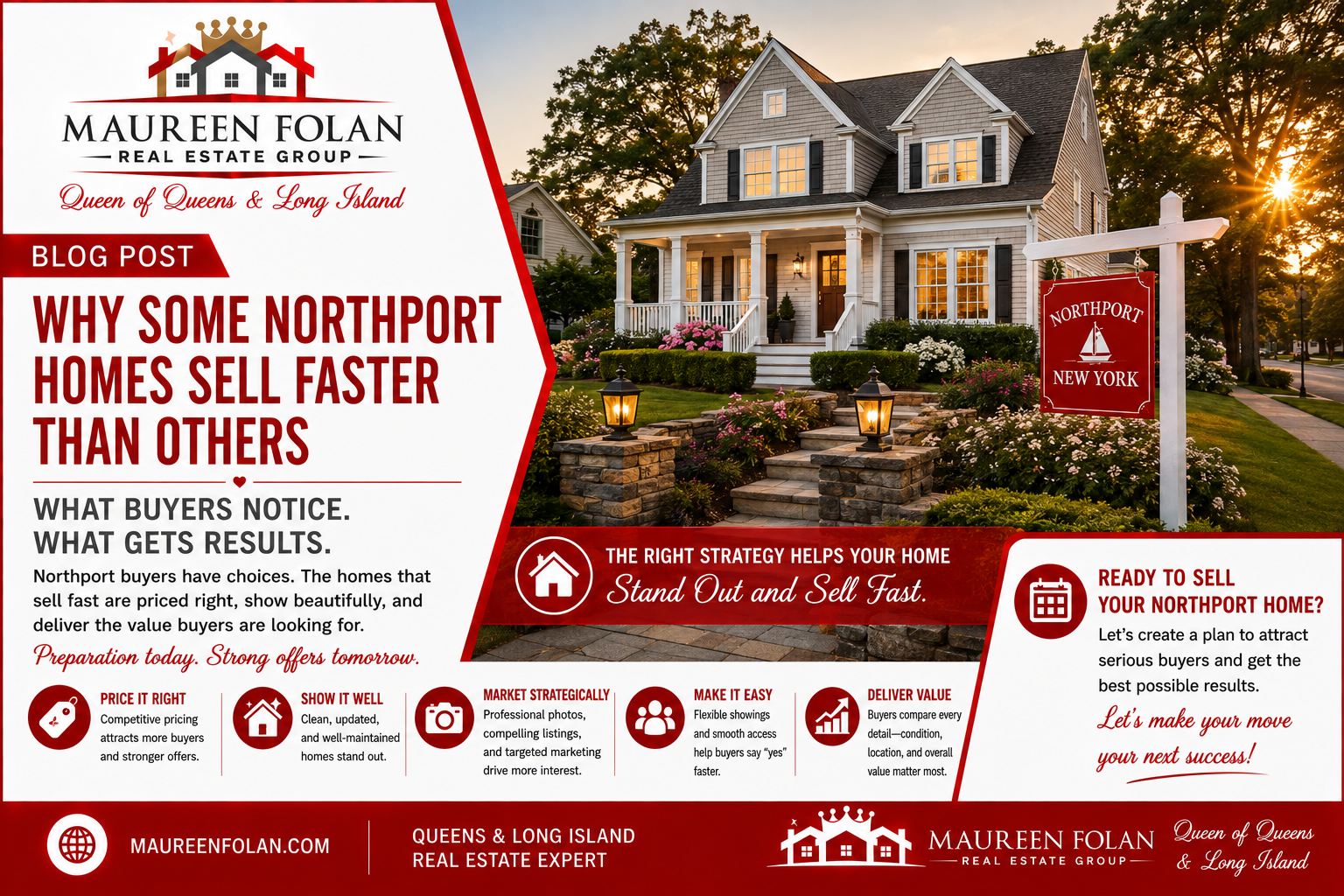
 Why Some Northport Homes Sell Faster Than Others
Why do some Northport homes sell faster than others?
Homes that attract buyers quickly usually create a strong combination of competitive pricing, appealing condition, effective presentation, compelling photography, clear marketing, and perceived value from the moment they hit the market. Northport's competitive 2026 market can create opportunities for sellers, but strong demand doesn't make every property equally attractive.
Selling a Home Fast in Northport, NY Isn't Just About Market Conditions
If you're preparing to sell, you've probably seen Northport homes appear online and disappear into contract seemingly overnight.
Then you'll see another property remain available much longer.
Why?
It can be tempting to assume the faster-selling home was simply “better.”
Sometimes it was.
But often, the difference comes down to how effectively the property was positioned when buyers first encountered it.
If your goal is selling a home fast in Northport, NY, focus on the factors you can control:
Price. Preparation. Presentation. Marketing. Access. Response to the market.
You can't control which buyers are looking during the week you list.
You can control what they see when your property appears.
Northport Is Currently a Competitive Market
The broader market provides an encouraging backdrop.
Redfin's current Northport housing-market reporting tracks prices, days on market, sale-to-list relationships, and competitive conditions. In recent 2026 reporting, Northport has been characterized as a highly competitive market. Current Northport housing-market data
That matters—but it doesn't guarantee a fast sale.
Townwide statistics combine different types of properties, price ranges, conditions, and locations.
A beautifully prepared home at one price point may face a completely different buyer pool from an older property requiring substantial renovation at another.
Your property competes within its specific market segment.
That's the market you need to understand.
1. Fast-Selling Homes Often Get the Price Right From the Beginning
Pricing is one of the strongest factors influencing early buyer response.
When your home first reaches the market, buyers compare it with the alternatives available immediately.
If the price feels aligned with the property's condition, location, size, and features, buyers have a reason to investigate further.
If the asking price feels disconnected from those characteristics, they may move on.
This is why the strategy of:
“Let's start high and reduce it later”
can create problems.
You can lower the price later.
You cannot recreate the first time active buyers see the listing.
The First Week Matters
New listings naturally attract attention from buyers and real estate professionals monitoring the market.
That's your launch window.
Ideally, the property enters the market with everything aligned:
Photography is ready.
The home is prepared.
The asking price has been researched.
Showing logistics have been established.
Marketing communicates the property's strongest characteristics.
You don't want to spend the first week correcting issues that could have been addressed beforehand.
A strong launch doesn't guarantee a quick sale.
It gives the property the best opportunity to generate serious early consideration.
2. Buyers Compare Price With Condition
A property's asking price doesn't exist in isolation.
Buyers compare it with what they'll need to do after closing.
Suppose two Northport homes are similarly priced.
One feels maintained and ready to occupy.
The other needs paint, flooring, exterior repairs, and significant updating.
The second property can still sell quickly.
But buyers will evaluate whether the price sufficiently reflects the additional work.
This is why condition and pricing have to work together.
An older or less updated home isn't automatically disadvantaged.
It simply needs to make sense relative to its competition.
3. Move-In-Ready Condition Can Reduce Buyer Uncertainty
Some buyers are comfortable taking on renovation projects.
Others aren't.
A home that feels move-in-ready can appeal to buyers who want to reduce the number of projects they face immediately after closing.
But move-in-ready doesn't have to mean completely renovated.
A property can feel ready to occupy when it is:
- Clean
- Well maintained
- Functionally sound
- Bright
- Decluttered
- Consistently presented
- Free of obvious unfinished projects
For many sellers, this is good news.
You may not need a major renovation to improve buyer perception.
4. Small Maintenance Problems Can Add Up
One loose doorknob probably isn't going to derail your sale.
But buyers don't always evaluate small problems individually.
They may experience them cumulatively.
A damaged piece of trim.
A dripping faucet.
A nonfunctioning light.
Peeling paint.
A sticking door.
An exterior item needing attention.
After enough small issues, the buyer may start wondering:
“What else hasn't been maintained?”
Before listing, walk through your home and identify the inexpensive, visible problems that create unnecessary doubt.
Addressing those items can be one of the most practical parts of preparation.
5. The Exterior Sets the Tone
Buyers begin evaluating your property before they walk through the door.
They notice the street.
Then the yard.
Then the driveway.
Then the exterior.
Then the entrance.
You don't need elaborate landscaping to make a strong impression.
You need the property to look cared for.
Trim where appropriate.
Clean walkways.
Remove unnecessary exterior clutter.
Address obvious maintenance.
Make the entrance easy to find and inviting.
The objective isn't to impress buyers with landscaping.
It's to avoid giving them reasons for concern before the showing begins.
6. Photography Can Determine Whether the Showing Happens
Your first showing may happen on a screen.
That's why photography isn't merely a record of the property.
It's part of the marketing strategy.
Strong listing photography should help buyers understand:
- The layout
- Room proportions
- Natural light
- Condition
- Outdoor areas
- Distinctive features
- The relationship between important spaces
Photographs should represent the home accurately while showing it at its best.
If buyers can't understand the property online, some may never schedule the in-person showing.
7. Decluttering Helps Buyers See the House
Decluttering isn't about removing every sign of your personality.
It's about reducing visual competition.
When countertops are covered, buyers see the objects before they see the workspace.
When closets are packed, they may perceive insufficient storage.
When furniture overwhelms a room, they may underestimate its size.
Your belongings aren't the product being sold.
The space is.
Preparation should help buyers understand that space quickly.
8. Natural Light Can Change the Showing Experience
Buyers often respond positively to bright rooms.
If your home has good natural light, make sure they can experience it.
Clean windows.
Open appropriate window treatments.
Replace failed bulbs.
Make sure rooms are consistently illuminated.
If furniture or other items unnecessarily block windows, consider whether rearranging them would improve presentation.
Again, you're not manufacturing something the home doesn't have.
You're making sure existing strengths aren't hidden.
9. Northport's Location Can Be Part of the Marketing
Northport has characteristics that distinguish it within the broader Long Island market.
The incorporated Village describes itself as a North Shore waterfront community known for its deep-water harbor, parks and beaches, historic architecture, and pedestrian-oriented downtown. Village of Northport
For a property where those amenities are relevant, location can become an important part of the marketing story.
If the home offers convenient access to Main Street, waterfront recreation, or another meaningful local feature, communicate that accurately.
Don't rely on generic phrases such as “amazing location.”
Explain what actually makes the location useful.
10. Buyers Need to Understand What Makes Your Home Different
Every property has competition.
Your marketing should answer:
Why should a buyer seriously consider this home instead of the alternatives?
Maybe it's the lot.
Maybe it's condition.
Perhaps the home has distinctive architecture.
Maybe the layout works especially well.
Perhaps there's outdoor space that's difficult to reproduce.
Maybe the location is the differentiator.
Your listing doesn't need ten selling points.
It needs the right ones.
Strong marketing prioritizes the characteristics buyers are most likely to value.
11. Easy Showing Access Can Matter
A beautifully marketed home can't sell to a buyer who never gets inside.
Showing logistics matter.
Of course, you need reasonable boundaries around your schedule and property.
But unnecessary barriers can reduce opportunities.
If serious buyers repeatedly struggle to schedule appointments, some may simply move on to another home.
Before listing, decide how showings will work.
What notice do you need?
Are there particular unavailable times?
How quickly can requests be confirmed?
A clear plan can make the process easier for everyone involved.
12. Sellers Should Monitor Early Feedback
Once the home launches, start listening to the market.
How many showing requests are you receiving?
Are buyers returning for second visits?
What objections appear repeatedly?
Are competing properties going under contract?
Has new inventory appeared?
You shouldn't react emotionally to every individual comment.
One buyer may dislike something the next buyer loves.
Look for patterns.
Repeated feedback can provide useful information about price, presentation, or how the property compares with alternatives.
13. A Quiet Market Response Is Information
Suppose you expected substantial activity and received very little.
That's useful information too.
It doesn't automatically mean the price must change.
First investigate.
Is the listing presentation strong?
Are the photographs effective?
Is the property easy to show?
Did new competition enter at the same time?
How does the home's condition compare?
Does the asking price put it against properties with substantially stronger features?
Then determine what adjustment, if any, makes sense.
The worst response is pretending the market isn't telling you anything.
14. Don't Renovate Simply to Sell Faster
When sellers hear that updated homes attract attention, they sometimes conclude that a major renovation is necessary.
Not necessarily.
A renovation could improve marketability.
It could also cost significant money, delay your listing, and introduce construction risk without producing an equivalent increase in sale price.
Before beginning a large project, compare:
Current potential value vs. prepared value vs. renovated potential value.
Then consider project cost and timing.
Often, targeted preparation makes more sense than comprehensive remodeling.
15. Older Northport Homes Can Still Compete Strongly
Northport's architectural character is part of its identity, and the Village specifically recognizes its 19th-century architecture. Village of Northport
That means “older” doesn't automatically mean “less desirable.”
Buyers may value character, established settings, or distinctive architectural details.
The key is maintenance.
A preserved original feature and visible deferred maintenance communicate two very different things.
If your home has character, let it be an advantage.
Don't automatically renovate it away.
16. Your Property Needs to Tell One Consistent Story
The strongest listings often feel coherent.
The price matches the condition.
The photographs match the actual experience.
The description emphasizes the right features.
The preparation supports the price.
The marketing reflects the location.
Buyers understand what they're being offered.
When those elements contradict one another, friction appears.
For example, a premium asking price combined with obvious deferred maintenance may create a disconnect.
A beautifully renovated property with poor photography may fail to communicate its advantage.
Consistency matters.
17. Fast Isn't Always the Only Goal
There's another important point.
Selling quickly is not necessarily the only measure of a successful sale.
Your goals may involve:
Price.
Timing.
Certainty.
Closing terms.
Coordination with another purchase.
Flexibility.
A property that sells in three days isn't automatically a better outcome than one that sells in three weeks.
The objective should be a successful sale aligned with your priorities, not simply the shortest possible market time.
Know Your Next Move Before You List
This becomes especially important if you're selling Northport and buying elsewhere.
If you need specific timing, that should be incorporated into the strategy.
If you're moving out of state, your priorities may be different.
If you're downsizing locally, another set of considerations may matter.
Knowing your next move helps you evaluate offers based on the complete package instead of price alone.
What Should You Do Before Listing a Northport Home?
A practical pre-listing process looks like this:
- Understand your home's likely competitive range.
- Review recent relevant sales and current listings.
- Identify repairs and strategic cosmetic improvements.
- Decide whether any major renovation is actually justified.
- Declutter and prepare the property for photography.
- Establish the pricing and launch strategy.
- Identify the home's strongest differentiators.
- Create a manageable showing plan.
- Know how you'll evaluate early market feedback.
- Connect the sale strategy with your next move.
This turns “putting your home on the market” into an actual plan.
Final Takeaway: Why Some Northport Homes Sell Faster
If your goal is selling a home fast in Northport, NY, don't assume speed comes down to luck.
Market conditions matter, but the homes that attract serious attention quickly often have several things working together:
Strategic pricing.
Appropriate preparation.
Strong presentation.
Effective photography.
Clear property positioning.
Easy buyer access.
Responsive market strategy.
Northport's competitive 2026 market can provide sellers with meaningful opportunity, while its waterfront Village, harbor, historic architecture, parks, and downtown give properties relevant local context when marketed accurately. Village of Northport
But demand alone doesn't determine your outcome.
As Maureen Folan, Queens & Long Island Real Estate Expert, I help Northport homeowners understand how their individual property competes before choosing a price or spending heavily on preparation.
Because the goal isn't merely to sell quickly.
It's to launch strategically, attract serious buyers, and create the strongest possible path to your next move. 
Get a Personalized Home Value Estimate
Thinking about selling your Northport home?
Get a Personalized Home Value Estimate from Maureen Folan Real Estate Group.
We'll evaluate your property's condition, features, location, relevant recent sales, and current competition to help determine how your home could be positioned in today's Northport market.
You can also request the Home Seller Preparation Checklist before spending money on repairs, improvements, or renovations.
Maureen Folan
Queens & Long Island Real Estate Expert
Maureen Folan Real Estate Group
MaureenFolan.com
:format(webp):quality(80)/u.realgeeks.media/maureenfolan/001.jpg)
:format(webp):quality(80)/u.realgeeks.media/maureenfolan/HVREPORT.png)