QUEENS & LONG ISLAND REAL ESTATE BLOGS

Categories:

Selling - Queens | Selling - Long Island


Sept. 3, 2026

Selling a Home in Northport, NY: What Sellers Should Know About Today’s Buyers

Selling a Home in Northport, NY: What Sellers Should Know About Today’s Buyers

What should you know about today’s buyers before selling a home in Northport, NY?

Northport buyers are making decisions in a highly competitive 2026 market, but strong demand doesn’t mean every home will perform the same way. If you’re selling, your best opportunity comes from understanding how buyers evaluate price, condition, presentation, renovation needs, property characteristics, and Northport’s distinctive village and waterfront setting before your listing goes live.

Selling a Home in Northport, NY Starts With Understanding Your Buyer

If you're thinking about selling a home in Northport, NY, it's easy to focus on your side of the transaction.

What is your home worth?

When should you list?

What should you repair?

How much do you want to net?

Those questions matter.

But there's another question that can influence nearly every one of those decisions:

What will buyers see when they compare your property with their other options?

Northport is not a market where every home is interchangeable. Property condition, lot, architecture, location, proximity to the Village, renovation level, and overall presentation can create meaningful differences between listings.

Understanding those differences is the foundation of a strong selling strategy. 

Northport's 2026 Housing Market Is Highly Competitive

Current market data provides important context.

For the three months ending July 2026, Redfin reported a Northport median sale price of approximately $1.05 million, up 20.2% from the comparable period a year earlier. Homes averaged 17 days on the market in July, and Redfin currently classifies Northport as a “most competitive” market.

Those figures are encouraging for homeowners considering a sale.

But they need to be interpreted carefully.

Northport's transaction volume is relatively limited, and a townwide median can shift depending on the particular mix of homes sold during a period. A median sale price is therefore market context—not an automatic valuation for your property.

Your home still needs to be evaluated against the properties buyers would realistically consider alongside it.

Today's Buyers Can See the Competition Immediately

Buyers don't shop for homes one at a time.

When your listing appears, prospective buyers can quickly compare it with other properties based on asking price, photographs, condition, size, lot, location, and features.

That makes your competitive position extremely visible.

Suppose your home is listed at a similar price to a substantially renovated property.

What does yours offer that makes the comparison compelling?

Perhaps it's a better lot.

Maybe it offers distinctive architecture.

Perhaps the layout is more functional, or the property occupies a location the buyer prefers.

Those advantages matter—but only if your pricing and marketing allow buyers to recognize them.

Buyers Expect Price and Condition to Make Sense Together

Not every Northport buyer wants a completely renovated house.

That's important.

A home can be older, need cosmetic updating, and still attract serious interest.

But buyers tend to evaluate the amount of work required relative to the price.

A dated kitchen isn't simply a design preference. Some buyers will mentally assign a future renovation cost to it.

The same can happen with bathrooms, flooring, exterior maintenance, or other visible projects.

That doesn't mean you should renovate everything.

It means you should understand how condition affects perceived value.

If your home requires work, the pricing strategy should acknowledge the competitive environment it enters.

Move-In-Ready Homes Can Reduce Buyer Uncertainty

Why can well-prepared homes generate strong attention?

Because condition can provide certainty.

Buyers already need to budget for the purchase, closing expenses, moving, insurance, taxes, maintenance, and everything else associated with homeownership.

A property that feels clean, maintained, functional, and ready to occupy reduces the number of immediate projects they need to consider.

Move-in-ready doesn't necessarily mean brand-new.

A Northport home can retain its character while still feeling cared for.

That distinction can be especially relevant in a community the Village itself describes as having a significant collection of 19th-century architecture.

The objective isn't to strip an older home of what makes it distinctive.

It's to present its character confidently while addressing unnecessary buyer objections.

Northport's Setting Is Part of What You're Selling

A Northport listing is more than its bedroom count.

The incorporated Village of Northport sits on Long Island's North Shore within the Town of Huntington. The Village describes itself as known for its deep-water harbor, parks and beaches, historic architecture, and pedestrian-oriented downtown.

Northport's 2026 comprehensive planning materials also describe approximately two miles of waterfront and identify parks, a beach, marinas, and other coastal amenities as important elements of the Village's character.

For sellers, this creates an important marketing lesson.

Don't market only the house when location is part of the property's value proposition.

If your home has convenient access to Main Street, the harbor, parks, or another location-specific amenity, that context may deserve to be communicated accurately.

The property and its setting should tell one coherent story.

Village Life Can Be Part of the Buyer Experience

Northport's Village environment is another characteristic that can distinguish it from other Long Island searches.

The official Village website specifically identifies Northport's downtown as pedestrian-friendly, while Village Park and Cow Harbor Park sit at the west end of Main Street.

That doesn't mean every buyer wants to live near downtown.

Some may prefer a different residential setting.

The point is that Northport provides several different location experiences, and your marketing should accurately reflect the one your property actually offers.

Don't use generic lifestyle language.

Be specific about the home and its location.

First Impressions Start Before Buyers Reach the Door

Before buyers appreciate your kitchen or floor plan, they encounter the exterior.

They notice landscaping.

The driveway.

Exterior maintenance.

The walkway.

The front entrance.

These elements don't have to be elaborate.

They should make the property feel intentionally prepared.

A neglected first impression can create questions before the showing even begins.

Conversely, a clean and maintained exterior can establish confidence before buyers enter.

Walk across the street and look back at your property.

What catches your eye first?

That's useful information.

Your First Showing May Actually Happen Online

Before a buyer visits your home, they may see it on a phone.

Photography therefore plays an important role in your launch.

Buyers should be able to understand the property from the listing presentation.

Rooms should look functional.

Natural light should be visible.

Distinctive features should be obvious.

Outdoor areas should be represented accurately.

And the images should make buyers want to investigate further without creating unrealistic expectations.

The goal isn't to make the home look like something it isn't.

It's to make sure its strongest qualities aren't overlooked.

Buyers Notice Layout More Than Sellers Sometimes Expect

You've had years to adapt to your home's layout.

A buyer has minutes.

Make it easy for them to understand how rooms function.

Overcrowded furniture can make a useful room appear smaller.

Excessive belongings can hide storage.

An undefined room can leave buyers wondering what they would do with the space.

Preparation can help communicate function without requiring renovation.

If a room has an obvious practical purpose, let buyers see it.

If it offers flexibility, present it cleanly enough that buyers can imagine their own use.

Natural Light Matters

Natural light is another factor buyers often respond to before they consciously analyze it.

Prepare accordingly.

Open appropriate window coverings.

Clean windows.

Replace failed bulbs.

Make sure rooms are consistently illuminated for photography and showings.

You don't need to manufacture light that isn't there.

You simply don't want preventable presentation issues making the property feel darker than it really is.

Don't Renovate Just Because You're Selling

A competitive Northport market can tempt sellers in two opposite directions.

One seller assumes:

“The market is strong, so I don't need to do anything.”

Another assumes:

“Buyers expect perfection, so I need to renovate everything.”

Neither is a good universal strategy.

Instead, divide your preparation into three categories:

Repair: What is broken or visibly needs attention?

Refresh: What relatively modest work could strengthen presentation?

Renovate: Which major projects, if any, are supported by the property's competitive position?

The objective is to spend strategically—not maximally.

Historic Character Should Be Treated Thoughtfully

Northport's architectural character can be an asset, but older homes also require buyers to evaluate condition carefully.

If your property contains distinctive original or period features, don't automatically assume they need to be modernized before listing.

Some buyers may appreciate them.

At the same time, character shouldn't become an excuse for deferred maintenance.

A preserved feature and a neglected feature aren't the same thing.

Understanding what should be maintained, refreshed, repaired, or left alone can be especially important when preparing an older Northport home.

Outdoor Space Should Be Easy to Understand

Northport's coastal identity can make outdoor living and recreation part of the broader buyer conversation, but your private property still needs to stand on its own.

If you have a patio, deck, yard, garden, or other usable outdoor area, make its function clear.

Remove unnecessary clutter.

Address obvious maintenance.

Trim vegetation where appropriate.

Let buyers understand how the outdoor space relates to the home.

The Village itself maintains waterfront recreation including Village Park, Cow Harbor Park, Scudder Park, Steers Beach, and the Village Dock, though access rules differ by facility and residency.

Accurate local context can strengthen marketing without exaggerating what a particular property offers.

Pricing Correctly Is Still Essential in a Competitive Market

A competitive market does not eliminate pricing risk.

In fact, buyers with easy access to listing information can identify an aggressively priced home quickly.

Starting too high can place your property against stronger competition.

It can also reduce urgency among buyers who otherwise might have considered it.

The right pricing strategy should examine:

  • Recent relevant sales
  • Current active competition
  • Pending activity when useful information is available
  • Property condition
  • Lot and layout
  • Renovation level
  • Location
  • Current buyer response within your price segment

Your objective isn't simply to choose the highest possible asking price.

It's to position the home so buyers see a compelling relationship between price and value.

Watch the Market After You Launch

Your strategy shouldn't become static the moment the listing goes live.

The market will start giving you information.

How many showing requests are you receiving?

What feedback appears repeatedly?

Has new competition entered?

Have comparable properties gone under contract?

Have competing sellers changed their prices?

You shouldn't overreact to every comment.

But you should remain attentive to patterns.

A strong seller strategy is responsive to evidence.

Think About Your Next Move Before Offers Arrive

Where are you going after your Northport home sells?

Your answer can affect how you evaluate offers.

Perhaps you're purchasing elsewhere on Long Island.

Maybe you're relocating out of state.

You may be downsizing or selling a property you've owned for many years.

If timing matters, establish your ideal scenario early.

The highest-priced offer isn't automatically the strongest offer for your circumstances.

Financing, contingencies, timing, and other terms can influence the overall package.

Knowing your priorities beforehand makes negotiation more deliberate.

What Should Northport Sellers Do Before Listing?

Start with a property-specific market analysis.

Then walk through the home objectively.

Identify repairs.

Determine whether cosmetic refreshes would strengthen presentation.

Evaluate major renovations carefully before committing money.

Review your competition.

Establish your pricing strategy.

Prepare for photography.

Organize relevant property information.

And determine how the sale connects with whatever you're doing next.

Those steps create a launch plan rather than simply a listing date.

Final Takeaway: Selling a Home in Northport, NY

If you're considering selling a home in Northport, NY, current 2026 market conditions provide encouraging evidence of buyer competition. Recent Redfin data showed a median sale price of approximately $1.05 million, a 20.2% year-over-year increase, and a median 17 days on market for July.

But those statistics don't guarantee the outcome for your property.

Today's buyers are still comparing price, condition, renovation needs, layout, outdoor space, location, presentation, and overall value.

Northport's harbor, parks, historic architecture, and pedestrian-oriented downtown can also contribute meaningful location context for a listing when those characteristics are relevant to the property.

As Maureen Folan, Queens & Long Island Real Estate Expert, I help Northport homeowners determine how their individual property fits within that market before making major pricing or preparation decisions.

Because a strong market can create opportunity.

A strong selling strategy is what helps you take advantage of it. 

Get a Personalized Home Value Estimate

Thinking about selling your Northport home?

Get a Personalized Home Value Estimate from Maureen Folan Real Estate Group.

We'll look at your property's features, condition, location, relevant recent sales, and current competition to help determine where your home may fit within today's Northport market.

You can also request the Home Seller Preparation Checklist before making renovation or pre-listing spending decisions.


Maureen Folan
Queens & Long Island Real Estate Expert
Maureen Folan Real Estate Group
MaureenFolan.com
Sept. 1, 2026

The Complete Guide to Living in Syosset, NY Before You Buy a Home

The Complete Guide to Living in Syosset, NY Before You Buy a Home

What should you know about living in Syosset, NY before buying a home?

Before buying in Syosset, you should look beyond the house itself and understand how the property's price, taxes, condition, transportation options, maintenance requirements, nearby amenities, and location fit your everyday routine. Syosset offers direct LIRR access and an established residential market, but the right decision depends on the individual property and what you want from your next move.

What Should You Know About Living in Syosset, NY?

If you're researching living in Syosset, NY, you've probably already spent some time looking at listings.

That's useful—but don't make the house your only focus.

When you purchase a home, you're also choosing the routine surrounding it.

Where will you commute?

How much property do you want to maintain?

What will your total monthly housing costs look like?

Which places do you expect to visit regularly?

Would you rather buy something extensively renovated or improve a home gradually?

Those questions help turn a broad Syosset search into a personalized real estate strategy.

The goal isn't to determine whether Syosset is universally the “best” place to live.

It's to determine whether a particular Syosset home works for you. 

Understanding the Syosset Real Estate Market

Syosset represents a significant housing investment for many buyers.

Current market reporting from Redfin tracks median sale prices, days on market, sale-to-list relationships, and competitive conditions in Syosset. Current Syosset housing-market data

Those numbers are useful for understanding the broader market.

They aren't a substitute for evaluating individual properties.

Within Syosset, price can vary according to factors including:

  • Property size
  • Lot characteristics
  • Condition
  • Renovation level
  • Layout
  • Location
  • Amenities
  • Current competition

Instead of asking, “What does a house in Syosset cost?” define the type of home you actually want and examine what that segment of the market currently costs.

That's a much more useful budget.

Decide What You Can Comfortably Own

Your mortgage approval doesn't necessarily tell you what you should spend.

Before touring seriously, calculate the broader financial picture.

For each property, consider:

Purchase price + financing + property-specific taxes + insurance + utilities + maintenance + expected improvements.

This matters because two similarly priced Syosset homes may create very different ownership costs.

One could be extensively renovated but carry one set of ongoing expenses.

Another may cost less initially but require significant improvements.

The question isn't simply which home you can purchase.

It's which one you can comfortably own.

Property Taxes Deserve Property-Specific Research

If you're moving to Long Island from Queens or elsewhere, property taxes may be one of the costs you're investigating carefully.

Avoid relying on a generic statement about “Syosset taxes.”

Research the specific property.

Taxes can differ between homes, and those differences can materially affect your monthly and annual housing expenses.

Make tax information part of your early comparison rather than something you investigate only after falling in love with a house.

The same principle applies when comparing Syosset with East Norwich, Huntington, or another Long Island market.

Two homes with the same asking price aren't necessarily equally affordable.

Syosset's LIRR Station Can Be an Important Consideration

Transportation is one practical reason some buyers include Syosset in their search.

Syosset has a Long Island Rail Road station, and the MTA provides current station and schedule information for buyers who expect to use rail transportation. Long Island Rail Road information

If you plan to commute by train, however, don't stop at the timetable.

Test the entire trip.

How long does it take to get from the home to the station?

How will you get there?

What parking or drop-off arrangements would apply?

Which train would you realistically take?

What does the return trip look like?

Where do you go after leaving the train?

Transportation should be evaluated from the front door of the house, not from the center of a map.

Driving Matters Too

Many Long Island buyers don't commute exclusively by train.

You may work elsewhere on Long Island, travel throughout the region, work remotely part of the week, or have several regular destinations.

If that's you, test your driving routes.

Don't simply look at the number of miles.

Traffic patterns and travel times can change the practical experience considerably.

Drive from the property to your workplace at a realistic time if possible.

Do the same for other destinations you expect to visit frequently.

A house may check every box and still create a transportation routine you don't want.

It's better to discover that before you make an offer.

What Kind of Syosset Home Do You Want?

The next step is deciding which property characteristics actually matter to you.

Start with the basics:

How many bedrooms do you realistically need?

How much storage?

Do you need dedicated workspace?

How important is outdoor space?

Do you want a garage?

How much property are you willing to maintain?

Do you prefer a completely updated home or an opportunity to renovate?

Then separate your list into three categories:

Must have.

Would like.

Can compromise.

That distinction becomes extremely valuable once you're comparing actual homes.

Without it, nearly every showing can create a new version of your wish list.

Move-In-Ready vs. Renovation Opportunity

This is one of the biggest decisions many Syosset buyers face.

A move-in-ready home can reduce immediate uncertainty.

You may be able to move in without managing significant construction or budgeting for major cosmetic changes right away.

That convenience can be valuable.

But you may also pay more for renovations completed by someone else.

A less updated property can create a different opportunity.

Perhaps you obtain a layout, lot, or location you prefer and make improvements over time.

The tradeoff is that you need an appropriate renovation budget and tolerance for the work involved.

Neither option is universally better.

The important thing is knowing which buyer you are before competition for a particular property influences you.

Should You Renovate Your Syosset Home Before Selling?

Although that article is written for sellers, it can also help buyers understand how renovation and market value don't necessarily move dollar for dollar.

What Should You Look for During a Showing?

When touring a Syosset home, don't let staging become the entire experience.

Look at how the property functions.

Pay attention to:

  • Overall visible condition
  • Layout and room relationships
  • Natural light
  • Storage
  • Kitchen functionality
  • Bathroom condition
  • Exterior maintenance
  • Lot usability
  • Parking configuration
  • Improvements you would want to make

Ask yourself whether you like the underlying home.

Paint can change.

Furniture disappears when the seller moves.

Decor isn't part of your purchase.

Location, lot, fundamental layout, and many structural characteristics are much harder to change.

Keep those differences in perspective.

Today's Buyers Are Looking at More Than Finishes

Current buyer expectations also provide useful context.

Many buyers are evaluating the relationship between condition and price.

A completely renovated property can be compelling because it reduces the number of immediate projects after closing.

But buyers may also see value in a less updated home when its price and underlying characteristics make sense.

That's why you shouldn't automatically reject a property because it doesn't photograph like a design magazine.

Ask what would actually need to change for you to enjoy living there.

Sometimes the answer is much less than you initially imagine.

What Today's Buyers Expect From Homes in Syosset

How Much Outdoor Space Do You Actually Want?

Outdoor space can be one reason buyers look beyond denser housing environments.

But don't automatically equate more land with a better purchase.

Think about how you intend to use it.

Do you want space for entertaining?

Gardening?

Recreation?

Privacy?

Or would you prefer a manageable yard that doesn't require extensive upkeep?

Then consider the maintenance.

Lawns, landscaping, trees, driveways, patios, fencing, and exterior features all require attention over time.

Buy the property you want to live with, not merely the one that looks most impressive during a showing.

Older Homes Require a Different Evaluation

Some properties may have been improved repeatedly over many years.

Others may retain older systems or finishes.

Age itself isn't the problem.

The question is condition.

If you're seriously considering an older home, appropriate professional inspections and due diligence can help you understand major components and potential future maintenance.

Don't assume a renovated kitchen means the entire property has been modernized.

And don't assume older cosmetic finishes mean the underlying home is poorly maintained.

Separate appearance, age, and condition.

What Buyers Should Know Before Purchasing an Older Home in East Norwich

The same evaluation principles can be useful when you're considering older properties elsewhere in the surrounding market.

Everyday Convenience Should Be Tested

You don't truly understand a home's location until you've tried living around it.

Before buying, consider doing ordinary things.

Drive to a grocery store.

Try your commute.

Visit nearby shopping or dining you expect to use.

See how long it takes to reach your regular destinations.

Visit at different times if practical.

This exercise is particularly useful if you're relocating from Queens.

Your definition of convenience may change when your daily transportation pattern changes.

The objective isn't to determine whether one routine is better.

It's to decide whether the new routine works for you.

Syosset vs. East Norwich

East Norwich may also appear in your search.

Because the communities are relatively close, buyers can easily assume the decision is mostly about town preference.

Actual inventory can tell a different story.

Your budget may produce one combination of house, condition, lot, and location in Syosset and another in East Norwich.

Compare the real options.

Syosset's direct LIRR station may be particularly relevant if rail transportation plays a major role in your routine.

An East Norwich property might offer a different housing or location equation that appeals more to you.

Neither community needs to win.

Syosset vs. East Norwich: How Do the Two Communities Compare for Homebuyers?

What If You're Moving From Queens to Syosset?

If you already own a Queens property, your buying strategy begins before you tour your first Syosset home.

Start by understanding what your existing home could realistically sell for.

Then estimate the potential net proceeds after your remaining mortgage and transaction-related costs.

That number may affect your down payment, comfortable purchase range, cash reserves, and renovation budget.

Then think about timing.

Do you need to sell first?

Can you buy first?

How much overlap could you comfortably manage?

What happens if the Queens sale closes before you've found your Syosset property?

What happens if the right Syosset home appears first?

The best time to answer those questions is before either transaction forces you to.

Moving From Queens to Syosset: The Lifestyle and Real Estate Changes Buyers Should Expect

Don't Use Rankings to Choose Where You Live

If you're researching living in Syosset, NY, you'll inevitably encounter websites ranking communities.

I recommend treating those rankings cautiously.

A home-buying decision should be based on your individual requirements—not assumptions about the people who live in a particular place.

Focus instead on measurable factors:

Price.

Property characteristics.

Taxes.

Transportation.

Condition.

Maintenance.

Amenities you personally expect to use.

Distance to your regular destinations.

Those factors tell you whether the property works for your life without relying on stereotypes or steering-oriented descriptions.

Prepare Before You Find the House You Love

Syosset can be a competitive housing market.

That makes preparation important.

Before the right property appears, establish your:

Comfortable budget.

Financing position.

Condition tolerance.

Non-negotiable property features.

Preferred timing.

Maximum renovation exposure.

Walk-away point.

This doesn't mean you should make decisions hastily.

It means you don't have to invent your strategy while you're emotionally invested in a specific home.

Preparation gives you the ability to act efficiently without abandoning discipline.

If You're Selling a Home to Buy in Syosset

Your current property can become an important part of your buying power.

This is especially relevant for homeowners relocating from Queens.

A coordinated strategy can help you understand how the expected sale proceeds affect your next purchase and how the two timelines interact.

Instead of treating one agent's job as “sell this house” and another decision as “find that house,” think about the complete transition.

Your current property is funding or influencing your next chapter.

The strategy should reflect that connection.

Five Questions to Ask Before Making an Offer

Before making an offer on a Syosset property, ask yourself:

  1. Does this home meet the needs that actually matter to me?
  2. Can I comfortably afford the complete ownership cost?
  3. Am I realistic about the repairs or improvements I want to make?
  4. Does this location work for my actual transportation and everyday routine?
  5. If I don't get this house, am I comfortable continuing the search rather than exceeding my limits?

That fifth question is especially useful in a competitive market.

The fear of losing a property shouldn't automatically determine what you're willing to pay.

Final Takeaway: Living in Syosset, NY Before You Buy

If you're considering living in Syosset, NY, your research should go beyond browsing beautiful homes.

Understand the market.

Calculate total ownership costs.

Verify property-specific taxes.

Test your transportation routine.

Decide how much property you want to maintain.

Know whether you prefer move-in-ready condition or renovation potential.

And spend enough time around the location to understand how a particular property would fit your everyday life.

If you're relocating from Queens, connect that research with your current-home strategy from the beginning.

As Maureen Folan, Queens & Long Island Real Estate Expert, I help buyers evaluate both sides of that decision: the property you're considering and the home or community you're moving from.

Because buying in Syosset isn't simply about finding an available house.

It's about finding a property whose price, location, condition, costs, and everyday practicality work together for your next move. 

Schedule a Buyer Consultation

Thinking about buying a home in Syosset?

Schedule a Buyer Consultation with Maureen Folan Real Estate Group to discuss your budget, timing, preferred type of property, transportation needs, and current Syosset opportunities.

If you're moving from Queens to Syosset, we can also look at your current property's potential value and build a coordinated plan for selling and buying.

And ask for the Property Tax Guide to help organize the ownership-cost questions you'll want to investigate when comparing Long Island homes.


Maureen Folan
Queens & Long Island Real Estate Expert
Maureen Folan Real Estate Group
MaureenFolan.com

Sept. 1, 2026

What Today’s Buyers Expect From Homes in Syosset
What Today’s Buyers Expect From Homes in Syosset

What are today’s buyers looking for when they shop for homes in Syosset, NY?

Buyers aren’t all looking for the same house, but many are evaluating a similar combination of factors: condition, functional space, renovation requirements, natural light, outdoor usability, storage, total ownership costs, and value compared with competing properties. For Syosset sellers, understanding those expectations can help you decide what to improve, what to leave alone, and how to position your home before it reaches the market.

Understanding Syosset, NY Real Estate Trends Starts With the Buyer

When homeowners hear the phrase Syosset, NY real estate trends, they may immediately think about prices, inventory, and days on market.

Those numbers matter.

But another trend deserves just as much attention:

What are buyers actually responding to when they see a home?

That question matters because buyers don't purchase market statistics.

They purchase individual properties.

A competitive market can create urgency, but buyers still compare homes based on condition, layout, location, price, and the amount of work they believe they'll need to take on after closing.

If you're preparing to sell in Syosset, understanding that decision-making process can be just as important as knowing the latest median sale price. 

Buyers Want the Price and Condition to Make Sense Together

One of the biggest misconceptions about buyer expectations is that everyone wants a completely renovated home.

Some do.

Others would happily purchase a property requiring improvements if the price appropriately reflects its condition.

What buyers tend to notice is the relationship between price and what they're getting.

Imagine two Syosset homes offered in a similar range.

One has been extensively updated.

The other has an older kitchen, dated bathrooms, and several cosmetic projects.

The second home doesn't automatically lose.

It might offer a better lot, a more useful layout, more space, or another characteristic the buyer values.

But buyers will evaluate whether the asking price appropriately accounts for the work they expect to complete.

For sellers, that's the key.

You don't necessarily have to make your property look like the most renovated listing.

You need to make its value proposition clear.

Move-In-Ready Still Gets Attention

For many buyers, move-in-ready condition has a straightforward advantage: convenience.

Buying a home already requires significant planning and expense.

If buyers can move in without immediately managing contractors or a long project list, that can be attractive.

But move-in-ready doesn't have to mean brand-new.

A property can feel ready to occupy when it is:

Clean. Maintained. Functional. Bright. Well presented.

This is important if you're considering selling.

You may not need to renovate your kitchen to create a stronger impression.

Fixing visible maintenance issues, refreshing selected paint, improving lighting, decluttering, and deep cleaning may substantially change how buyers experience the home.

Strategic preparation and major renovation are not the same thing.

Buyers Are Paying Attention to Renovation Costs

When buyers see a project, they don't only see its appearance.

They may see a future expense.

A dated bathroom becomes a renovation budget.

Worn flooring becomes another project.

Visible deferred maintenance can create questions about what else might require attention.

That doesn't mean buyers will reject the property.

It means they may mentally add those costs to the purchase price.

If you're selling, consider the cumulative effect.

One small cosmetic issue probably won't define a showing.

A dozen visible unfinished items can create a broader impression that the home requires significant work.

Addressing the right smaller items before listing can sometimes be more valuable than pouring the entire preparation budget into one dramatic renovation.

Functional Layouts Matter

Square footage is important, but buyers experience a home through its layout.

Two properties can contain roughly the same amount of space and function very differently.

Today's buyer may ask:

Where would I work from home?

Where does everyday clutter go?

Is there useful storage?

How does the kitchen connect to the living areas?

Can rooms serve more than one purpose?

Does the floor plan support the way I expect to use the house?

This is why sellers should think carefully about furniture placement and room presentation.

An overcrowded room can make useful space difficult to understand.

A largely empty or ambiguously arranged space can create the opposite problem: buyers may struggle to imagine what the room is for.

Good presentation helps communicate function, not simply decoration.

Flexible Space Can Be Valuable

How people use their homes continues to evolve.

A room doesn't always need one rigid purpose.

A spare bedroom might function as an office.

A finished area could provide space for hobbies, exercise, guests, or other activities depending on the property and buyer.

If your Syosset home has flexible areas, your marketing should help buyers recognize that versatility without making assumptions about who will live there.

Show what the space can do.

Let buyers decide how it fits their lives.

Natural Light Makes an Immediate Impression

Natural light rarely appears as the largest line item on a buyer's spreadsheet.

Yet it can influence the emotional response to a home immediately.

Bright rooms often feel more open and inviting.

If you're selling, make sure buyers can experience the light your home already has.

Clean the windows.

Open appropriate window treatments before photography and showings.

Make sure artificial lighting is functioning consistently.

Consider whether large furniture or heavy coverings unnecessarily block windows.

You don't need to create something the property doesn't have.

You want buyers to see it at its best.

Kitchens Still Receive Close Attention

The kitchen remains one of the spaces buyers tend to examine carefully.

That doesn't mean every Syosset seller needs a new one.

Buyers may evaluate:

  • Overall condition
  • Storage
  • Counter space
  • Appliance condition
  • Lighting
  • Layout and functionality
  • How the kitchen connects with adjacent spaces

If your kitchen is older but clean and functional, there may be opportunities to improve presentation without replacing it.

If it's extensively renovated, make sure the photography and marketing communicate that strength clearly.

And if you're considering a major renovation immediately before selling, first compare the cost and timeline with what the market appears to reward.

Renovate because the strategy supports it—not because you assume every buyer requires it.

Bathrooms Can Influence the Perception of Condition

Bathrooms receive similar scrutiny.

Buyers often notice cleanliness and maintenance before they notice expensive finishes.

Grout, caulk, lighting, fixtures, paint, ventilation, and overall presentation can affect whether a bathroom feels maintained.

Again, a refresh and a remodel are different things.

A seller may be able to improve a bathroom's presentation without rebuilding it.

That's why preparation decisions should begin with an objective walkthrough of the property.

Storage Is Quietly Important

Storage isn't glamorous, but buyers notice when a home appears to lack it.

Closets packed to capacity can unintentionally suggest that there isn't enough storage.

Crowded garages or other storage areas can have the same effect.

Before listing, consider reducing what is stored in the spaces buyers will examine.

You're not simply decluttering for prettier photographs.

You're helping buyers understand the home's usable capacity.

If you're buying, look beyond staging and ask where your belongings would realistically go.

A beautiful room is less useful if the house doesn't function for your everyday needs.

Outdoor Space Should Be Usable, Not Merely Large

Buyers may be attracted to outdoor space, but size alone doesn't tell the whole story.

They may consider how a yard can actually be used, how much maintenance it requires, and how it relates to the house.

A smaller, thoughtfully maintained outdoor area may work better for one buyer than a much larger property requiring substantial upkeep.

If you're selling, you don't need elaborate landscaping.

You do want the outdoor areas to be understandable.

Trim where appropriate.

Remove unnecessary clutter.

Address obvious maintenance.

Make entrances and usable spaces easy to see.

The objective is to help buyers recognize the property's potential without forcing them to mentally clear away distractions.

Buyers Are Looking at the Entire Cost of Ownership

Syosset buyers aren't only evaluating asking prices.

Many are also thinking about financing, property-specific taxes, insurance, maintenance, utilities, and expected improvements.

That's especially important in a market where purchasing a home can represent a substantial financial commitment.

For sellers, this is another reason pricing matters.

A buyer comparing two homes may decide that the property with the lower asking price isn't actually the less expensive option once renovation needs and ongoing costs are considered.

Likewise, a higher-priced home may still need to justify its premium.

Value is the complete package.

The Syosset Market Remains Competitive

Current market data reinforces why both buyers and sellers should prepare carefully.

Redfin's Syosset housing-market reporting provides regularly updated information on prices, days on market, sale-to-list relationships, and competitive conditions. Current Syosset housing-market data

Competitive conditions don't mean buyers stop evaluating value.

They mean desirable, appropriately positioned properties can require buyers to make decisions efficiently.

For buyers, preparation means understanding your financing, comfortable budget, preferred condition, and non-negotiables before the right home appears.

For sellers, it means getting the pricing, preparation, photography, and marketing strategy aligned before the listing goes live.

Buyers Expect Good Digital Presentation

Your property's first showing may happen on a phone.

That makes listing presentation part of the buyer experience.

Professional-quality photography should make the home's layout and strongest features easy to understand.

The property description should communicate useful distinctions rather than rely on generic adjectives.

And the overall marketing should give a buyer enough information to decide whether the home deserves an in-person visit.

A strong online presentation cannot rescue a property that is fundamentally overpriced.

But weak presentation can make a strong property easier to overlook.

Buyers Also Notice Maintenance

One of the fastest ways to weaken buyer confidence is a pattern of visible deferred maintenance.

A loose handle.

A damaged piece of trim.

A nonfunctioning light.

Peeling paint.

An obviously neglected exterior item.

Individually, these may be minor.

Together, they can create a question:

“What else hasn't been maintained?”

That is why a pre-listing repair review can be useful.

You don't need to eliminate every imperfection.

You should identify the issues that create unnecessary doubts.

Sellers Should Avoid Chasing Every Trend

If you're preparing a Syosset home for sale, don't redesign it around every style you see online.

Design trends change.

Your objective is broad marketability.

A clean, cohesive, well-maintained property usually gives buyers more room to imagine their own preferences than a highly personalized last-minute renovation.

This is particularly important when you're spending money specifically for resale.

You aren't renovating for your own enjoyment over the next decade.

You're making an investment intended to strengthen a near-term sale.

That requires a different decision-making standard.

Buyers Still Care About the Things You Can't Renovate

Sellers can change paint.

They can update fixtures.

They can improve landscaping.

They can't easily change the lot, general location, or fundamental structure of the property.

Buyers know that.

A home needing cosmetic work may still attract significant interest if it offers underlying characteristics buyers value.

That's why your marketing should identify the property's genuine strengths instead of focusing exclusively on finishes.

What is difficult to replicate about the home?

Make sure buyers understand it.

What Should Syosset Sellers Do Before Listing?

If you're planning to sell, start by evaluating your property in the context of current competition.

Then create a preparation list divided into:

Repair: What genuinely needs attention?

Refresh: What modest changes could strengthen presentation?

Renovate: Which larger projects, if any, have enough potential benefit to justify their cost and timing?

Next, establish your pricing strategy.

Prepare for photography.

Organize relevant property information.

And decide how the initial buyer response will be evaluated after launch.

This approach is more strategic than simply trying to make the house “look nicer.”

What Should Syosset Buyers Do?

If you're buying, create your own framework.

Determine what you can comfortably spend.

Decide how much renovation you're willing to take on.

Identify your most important property characteristics.

Review property-specific taxes and ownership expenses.

Then tour enough homes to understand what your budget actually buys.

You'll quickly learn which tradeoffs matter to you.

Maybe you'll choose a smaller renovated home.

Maybe you'll prefer a larger property requiring cosmetic work.

Maybe layout will matter more than either.

The market can provide options.

Your priorities determine which option makes sense.

Final Takeaway: What Today's Syosset Buyers Expect

The most useful Syosset, NY real estate trends aren't limited to price charts.

Buyer expectations matter too.

Today's buyers may respond strongly to homes that create the right balance of condition, functionality, presentation, outdoor usability, manageable improvement needs, and value relative to the competition.

That doesn't mean your Syosset home needs to be perfect.

It means buyers need to understand what they're getting for the price.

For sellers, the strongest strategy is often to fix what matters, improve what will meaningfully strengthen presentation, and avoid spending heavily on renovations without first understanding the market.

For buyers, the goal is to look beyond beautiful finishes and evaluate the entire ownership proposition.

As Maureen Folan, Queens & Long Island Real Estate Expert, I help both sides understand those tradeoffs—so sellers can prepare strategically and buyers can recognize value when they see it. 

Get a Personalized Home Value Estimate

Thinking about selling your Syosset home and wondering how today's buyers may respond to it?

Get a Personalized Home Value Estimate from Maureen Folan Real Estate Group.

We'll look at your property's condition, features, relevant recent sales, and current competition to help determine how your home may fit within today's Syosset market.

You can also request the Home Seller Preparation Checklist to help identify which repairs and improvements may deserve attention before your property goes live.

If you're buying instead, Schedule a Buyer Consultation to discuss your budget, priorities, and current Syosset opportunities.


Maureen Folan
Queens & Long Island Real Estate Expert
Maureen Folan Real Estate Group
MaureenFolan.com

Sept. 1, 2026

What Buyers Should Know Before Purchasing an Older Home in East Norwich

What Buyers Should Know Before Purchasing an Older Home in East Norwich

What should you know before buying an older home in East Norwich, NY?

An older East Norwich home can offer distinctive architecture, established property features, and renovation potential, but age makes careful evaluation especially important. Before buying, you should understand the home's current condition, major systems, previous improvements, property-specific taxes, maintenance requirements, renovation budget, and total cost of ownership rather than focusing only on cosmetic appearance.

Buying a Home in East Norwich, NY Requires Looking Beyond the Finishes

If you're considering buying a home in East Norwich, NY, you may encounter properties that have been standing for decades.

Some may have been extensively renovated.

Others may retain many original characteristics.

And many will fall somewhere in between, with improvements completed by different owners at different times.

That can make an older home interesting—but it also means you should understand exactly what you're purchasing.

A new kitchen doesn't necessarily mean the entire house has been modernized.

Likewise, an older bathroom or dated flooring doesn't automatically mean the underlying property is in poor condition.

The goal is to separate three things:

Age. Condition. Appearance.

They're related, but they're not the same. 

An Older Home Isn't Automatically a Problem

One of the biggest mistakes buyers can make is treating the age of a home as a verdict on its quality.

A well-maintained older property may have been cared for thoughtfully over many years.

A newer-looking property can still have components requiring attention.

Instead of asking whether the house is “too old,” ask more useful questions:

What has been maintained?

What has been replaced or improved?

What appears to remain original?

What might require attention during my expected ownership period?

That approach gives you much more useful information than the year the home was built alone.

Start With the Structure and Major Systems

When touring an older East Norwich property, beautiful finishes can easily capture your attention.

But countertops aren't usually the most consequential part of the house.

If you become serious about the property, you'll want appropriate professional due diligence concerning the home's major components and systems.

Depending on the property, those may include areas such as:

  • Roofing
  • Foundation and structural components
  • Electrical system
  • Plumbing
  • Heating and cooling
  • Windows and doors
  • Drainage and moisture conditions
  • Chimneys or fireplaces where applicable
  • Exterior materials
  • Insulation and ventilation

A showing isn't a substitute for a professional inspection.

Your job during the showing is primarily to decide whether the home deserves further investigation.

If it does, qualified professionals can help you understand its condition more thoroughly.

Don't Let a Renovated Kitchen Distract You

Renovated kitchens and bathrooms can make older homes feel significantly newer.

That's appealing.

But cosmetic renovation and whole-home modernization aren't the same thing.

Suppose the kitchen was remodeled recently.

Ask what else has been updated.

Was the electrical system changed as part of the project?

Was plumbing modified?

Were permits required and, where relevant, properly handled?

What other improvements have been made over time?

You don't need to assume there's a problem.

You simply want to understand the scope of what “renovated” actually means.

A home can have a brand-new kitchen while other major components remain much older.

That's not necessarily bad.

It's information you should have when deciding what you're willing to pay.

Understand the Difference Between Cosmetic and Capital Improvements

When you walk through a home, start separating potential future projects into categories.

Cosmetic improvements might include paint, flooring, light fixtures, hardware, or other finishes.

These can still cost money, but they're generally different from replacing major systems or completing significant construction.

Capital improvements can involve larger, more expensive components of the property.

If you're comfortable with cosmetic work but don't want to undertake major projects soon after closing, that distinction matters.

A home with dated finishes and well-maintained underlying systems may be more attractive to you than a beautifully decorated property with larger future projects.

Evaluate the house from the inside out—not simply from the photographs inward.

Ask About the History of Improvements

Older homes often evolve.

One owner adds something.

Another renovates a kitchen.

Someone replaces windows.

A bathroom is updated years later.

That history can help you understand the property.

Where available, ask about known improvements and documentation.

Relevant records may help clarify what work was completed and when.

Depending on the project and circumstances, permits, certificates, warranties, receipts, or other documentation may also be relevant.

Your attorney, inspector, and other appropriate professionals can help you determine which records or issues require further investigation for a particular transaction.

The important thing is not to assume.

If an addition looks newer than the rest of the home, ask about it.

If the listing mentions substantial improvements, understand what those improvements actually involved.

Budget for Ownership, Not Just Purchase

An older home can fit comfortably within your purchase budget and still create an ownership budget you haven't anticipated.

Before making an offer, think beyond the mortgage.

Your broader calculation may include:

Purchase price + property-specific taxes + insurance + utilities + routine maintenance + expected repairs + planned improvements.

Then consider your time horizon.

If you expect to own the home for many years, which components might reasonably require attention during that period?

You don't need to predict every future repair.

You do need enough financial flexibility that normal homeownership doesn't become a crisis every time something needs attention.

Keep Cash Reserves After Closing

This is especially important if you're buying an older property.

Don't spend every available dollar on the purchase simply because you've been approved to do so.

After closing, you may want to make cosmetic changes.

You may need furniture.

You may discover routine maintenance items once you've lived in the home for a while.

And eventually, every house requires repairs.

A financial reserve gives you flexibility.

That can be more valuable than stretching to your absolute maximum purchase price and having no room left for the property itself.

Property Taxes Should Be Verified for the Specific Home

East Norwich is within the Town of Oyster Bay, but you shouldn't use a generic town or community estimate when evaluating taxes.

Verify the property-specific information for the home you're considering.

The Town of Oyster Bay provides online access to property-related information and municipal resources, which can be useful starting points when researching a property. Town of Oyster Bay official website

Your real housing cost should incorporate those property-specific obligations rather than purchase price alone.

This becomes especially important when comparing an East Norwich home with one in Syosset, Oyster Bay, or another nearby community.

Two similarly priced homes aren't necessarily equally affordable.

Pay Attention to the Lot Too

When evaluating an older home, buyers sometimes become so focused on the structure that they forget about the land surrounding it.

The lot is part of what you're purchasing.

Look at how usable the outdoor space is.

Consider landscaping and maintenance.

Observe drainage characteristics.

Look at driveways, patios, retaining features, mature trees, and other exterior elements.

If the property is larger than what you've owned before, consider what maintaining it will realistically involve.

Mature landscaping can create a distinctive setting.

It can also require care.

Neither is inherently good or bad.

You simply need to understand what comes with the property.

Older Homes Can Offer Characteristics That Are Difficult to Reproduce

One reason buyers consider older homes is that they may offer details or property characteristics that aren't easily replicated.

That could include architecture, room proportions, established landscaping, materials, or other features.

This is where your personal priorities matter.

If you appreciate those characteristics, you may be comfortable accepting some updates over time.

Another buyer may prefer newer construction and fewer immediate projects.

Neither buyer is making the wrong choice.

The purpose of your search is to identify which tradeoffs make sense for you.

Don't Overestimate the Cost of Every Cosmetic Issue

There's another mistake to avoid.

Some buyers walk into an older home, see dated finishes, and mentally turn every room into a major renovation.

Not every change needs to happen immediately.

Paint can wait.

Flooring may be changed later.

A functional kitchen doesn't necessarily need to be replaced on move-in day just because it isn't your preferred style.

Ask yourself:

Can I comfortably live with this?

If the answer is yes, you may be able to improve the property gradually instead of treating every cosmetic preference as an immediate expense.

That can materially change how you evaluate value.

But Don't Underestimate Major Renovations Either

The opposite mistake can be equally problematic.

It's easy to say:

“We'll just redo the kitchen.”

Or:

“We can always change the layout.”

Those statements can represent very different levels of cost and complexity.

Before paying a premium for a home based on what you believe it could become, get realistic about the projects required to get there.

If your purchase depends on a substantial renovation being financially feasible, appropriate professional estimates and due diligence can become particularly important.

Potential is valuable only when you can realistically execute the plan.

Understand New York Seller Disclosures

New York's Property Condition Disclosure Act generally requires sellers of covered residential real property to provide a Property Condition Disclosure Statement before the buyer signs a binding contract of sale.

The disclosure is based on the seller's actual knowledge and is not a warranty or substitute for your own inspections and investigations.

That's particularly important with older properties.

A disclosure can provide useful information.

It shouldn't become the entirety of your due diligence.

Questions concerning your legal rights, contracts, title, disclosures, or transaction-specific requirements should be discussed with your attorney.

Professional Inspection Matters

If you decide to pursue an older East Norwich home, a qualified home inspector can help you better understand the property's visible condition.

Depending on the home and what is discovered, additional specialized evaluation may sometimes be appropriate.

The purpose isn't to find a “perfect” house.

Every property has maintenance requirements.

The purpose is to reduce uncertainty and understand what you're taking on before completing a major purchase.

You can then evaluate findings in context.

Is something routine maintenance?

Is it a future project?

Does it require more immediate attention?

Does it materially change how you view the property?

Information allows you to make that distinction.

Don't Expect the Seller to Make an Older Home New

An inspection isn't a renovation wish list.

If you're purchasing an older home, you should expect some components to reflect the home's age.

Your due diligence helps identify condition and potential concerns; it doesn't automatically mean every older element should be replaced by the seller.

This is another reason to decide your condition tolerance before you make an offer.

If you want virtually every component to be new, an older property may not be the right target for your search.

If you're comfortable owning a home that evolves over time, you may view the same property very differently.

Compare East Norwich With Your Other Options

If you're considering buying a home in East Norwich, NY, you may also be looking at Syosset, Oyster Bay, or other nearby markets.

Compare actual properties.

Suppose your budget buys a renovated Syosset home with one set of characteristics and an older East Norwich home with a larger lot or a different layout.

Which better fits your goals?

Don't decide based solely on which community name you prefer.

Compare:

  • Purchase price
  • Property-specific taxes
  • Condition
  • Renovation requirements
  • Lot
  • Layout
  • Transportation
  • Ongoing maintenance
  • Distance to your regular destinations

That's the comparison that can help you make a confident decision.

If You're Moving From Queens, Expect Your Maintenance Routine to Change

Queens buyers should pay particular attention to property responsibilities.

Depending on what you currently own, an East Norwich house may introduce more exterior maintenance, landscaping, or other homeownership tasks.

Think about whether you want those responsibilities.

More property may be one reason you're moving.

If so, that's a benefit you're intentionally choosing.

But you should still budget for the time and money required to maintain it.

The goal isn't simply to purchase more house or more land.

It's to purchase a property that supports the lifestyle and financial plan you want next.

Final Takeaway: Buying an Older Home in East Norwich, NY

If you're buying a home in East Norwich, NY, don't judge an older property solely by its age—or by how recently its kitchen was renovated.

Look at the complete home.

Understand the condition of major systems and components. Investigate the history of improvements. Verify property-specific taxes. Consider maintenance requirements. Establish realistic renovation expectations. And maintain enough financial flexibility to own the home comfortably after closing.

An older East Norwich property may offer distinctive characteristics and significant potential.

But potential should be evaluated alongside condition, cost, documentation, and your willingness to take on future projects.

As Maureen Folan, Queens & Long Island Real Estate Expert, I help buyers compare those factors so you're not simply deciding whether you love the house.

You're determining whether the property makes sense as a long-term ownership decision. 

Schedule a Buyer Consultation

Considering an older home in East Norwich or comparing East Norwich with Syosset and other nearby Long Island communities?

Schedule a Buyer Consultation with Maureen Folan Real Estate Group.

We'll discuss your budget, condition preferences, renovation tolerance, location priorities, and current options so you can approach your search with a clearer strategy.

If you're moving from Queens, we can also look at how your current property and expected sale proceeds fit into the purchase.

And ask for the Property Tax Guide to help organize the property-specific ownership costs you'll want to investigate as you compare homes.


Maureen Folan
Queens & Long Island Real Estate Expert
Maureen Folan Real Estate Group
MaureenFolan.com

Sept. 1, 2026

Should You Renovate Your Syosset Home Before Selling?

Should You Renovate Your Syosset Home Before Selling?
Should you renovate your Syosset home before selling it?

Not necessarily. Before investing in a major renovation, you should determine whether the project is likely to improve your home's competitive position enough to justify the cost, time, and disruption. For many Syosset sellers, targeted repairs, cosmetic updates, cleaning, decluttering, and strategic presentation may make more sense than completing an expensive remodel immediately before listing.

Renovating Before Selling a Home in Syosset Isn't Automatically the Right Move

If you're preparing to sell your Syosset home, you may look around and immediately start seeing projects.

The kitchen feels dated.

A bathroom could use an update.

The floors aren't perfect.

Some rooms need paint.

Maybe you've been thinking about replacing countertops or finally tackling a project that's been on your list for years.

Then comes the question:

Should you renovate before you sell?

The answer shouldn't be based on whether a renovation would make the house look better.

Most renovations can do that.

The more important question is whether the project is likely to meaningfully improve your selling position after accounting for what it costs you to complete it.

Those are two very different standards. 

Start With the Syosset Market, Not Your Renovation Wish List

Before calling contractors, understand the market your property would enter today.

Current Syosset housing data can help establish the broader competitive environment, including prices, market times, and recent activity. Current Syosset housing-market data

But broad market data alone doesn't tell you whether to renovate.

You need to examine the homes that would actually compete with yours.

Ask:

What condition are comparable active listings in?

Which recently sold homes were renovated?

What did updated properties sell for compared with homes needing work?

How different were those homes from yours in size, lot, location, and features?

Are buyers in your likely price range expecting move-in-ready condition?

That competitive analysis should come before the renovation decision.

The Biggest Mistake Is Renovating Without Knowing Your Current Value

Imagine spending $75,000 improving your property without first understanding what it might sell for in its existing condition.

You have no meaningful baseline.

Maybe the work substantially improves your marketability.

Maybe buyers would have accepted the existing condition at an appropriate price.

Maybe a smaller preparation budget would have accomplished most of what you needed.

You can't evaluate those possibilities if you don't know where you're starting.

Before renovating, establish three rough scenarios:

What could the home potentially sell for as-is?

What could it potentially sell for after strategic cosmetic preparation?

What might it potentially sell for after the proposed major renovation?

Then compare the expected difference with the actual cost and risk of the work.

No projection can guarantee a future sale price, but this framework is far more useful than renovating first and hoping the market rewards you later.

Renovation Cost and Added Market Value Are Not the Same Thing

This is one of the most important concepts for sellers to understand.

If you spend $50,000 on a renovation, your home does not automatically become worth $50,000 more.

The market doesn't reimburse you based on receipts.

Buyers determine value through their willingness to pay for the complete property relative to their alternatives.

Some improvements may significantly strengthen buyer perception.

Others may improve appearance without producing an equivalent financial return.

And highly personalized renovations may appeal strongly to you while being less important to your eventual buyer.

The correct question isn't:

“How much will this renovation cost?”

It's:

“How much could this renovation change the way my home competes?”

Think in Three Categories: Repair, Refresh, or Renovate

Before deciding what to do, divide your potential projects into three groups.

Repair

These are things that are broken, damaged, or visibly require attention.

Examples could include malfunctioning hardware, damaged trim, leaking fixtures, visibly deteriorated surfaces, or other maintenance issues.

A collection of small unresolved problems can make buyers wonder what else has been deferred.

Refresh

These are relatively modest improvements intended primarily to strengthen presentation.

Examples might include:

  • Interior painting where needed
  • Deep cleaning
  • Updating selected light fixtures
  • Improving lighting
  • Refinishing or professionally cleaning certain surfaces where appropriate
  • Decluttering
  • Simplifying furniture arrangements
  • Exterior cleanup
  • Landscaping improvements

These projects can sometimes produce a meaningful visual difference without the expense or delay of a full renovation.

Renovate

These are major projects involving substantial cost, construction, planning, and time.

Kitchen replacements, major bathroom remodels, or extensive structural changes fall into this category.

The farther you move from repair toward renovation, the stronger the financial justification should be.

Should You Renovate the Kitchen Before Selling?

The kitchen is often where sellers feel the most pressure.

You may compare your existing kitchen with beautifully renovated properties online and assume yours needs to look the same.

It may not.

Start by asking whether the kitchen is dated or dysfunctional.

Those are different problems.

A dated kitchen may still be clean, functional, and usable.

In that situation, smaller changes could potentially improve presentation without requiring a complete remodel.

A kitchen with damaged components or meaningful functional issues may require a different approach.

Then look at the competitive market.

If comparable homes at your expected price are consistently extensively renovated, condition could affect how buyers perceive your property's value.

But if your home has other significant advantages—or if its price appropriately reflects condition—a full kitchen renovation may not be necessary.

Don't renovate because kitchens matter.

Renovate only when the specific economics of your property support it.

What About Bathrooms?

Bathrooms deserve similar analysis.

A bathroom doesn't necessarily need to be brand-new to show well.

Cleanliness, lighting, grout and caulk condition, fixtures, paint, and presentation can influence how buyers perceive the space.

Before demolishing a functioning bathroom, determine whether targeted improvements could address the biggest visual concerns.

Sometimes they can.

Sometimes a more substantial renovation is justified.

The answer depends on your anticipated price range, competing inventory, and the bathroom's actual condition.

Paint Can Be Different From Renovation

Painting is one of the most common pre-listing projects because it can change the visual impression of a room without involving major construction.

But even painting should be strategic.

You don't necessarily need to repaint every surface simply because you're selling.

Focus on areas where condition, highly personalized choices, or inconsistent finishes distract from the property.

The objective isn't to erase every sign that someone lived there.

It's to help buyers see the space and features of the home rather than becoming distracted by easily correctable presentation issues.

Don't Overlook Lighting

Lighting can dramatically affect how a property feels during photography and showings.

Before committing to a large renovation, examine whether rooms are being presented effectively.

Are bulbs working?

Are some spaces unnecessarily dark?

Do fixtures distract from otherwise appealing rooms?

Can natural light enter easily?

A buyer may interpret a dark room as smaller or less inviting even when the underlying space is good.

Improving how the property is illuminated can sometimes strengthen presentation at a fraction of the cost of remodeling.

Curb Appeal Is Part of Your Renovation Decision

Sellers sometimes spend heavily inside while ignoring the first thing buyers see.

The exterior.

Before buyers evaluate your renovated kitchen, they encounter the driveway, landscaping, walkway, front entrance, and exterior condition.

Walk across the street and look back at your home.

Does anything appear neglected?

Are plants obscuring important features?

Does the entrance feel clear and inviting?

Are there small maintenance items drawing unnecessary attention?

Strategic exterior preparation can help establish buyer confidence before they ever walk inside.

Move-In-Ready Doesn't Have to Mean Brand-New

Buyers may respond positively to homes that feel ready to occupy.

But move-in-ready and fully renovated are not synonymous.

A property can feel move-in-ready when it is:

Clean. Maintained. Functional. Well presented. Appropriately priced.

This distinction could save you from undertaking improvements that aren't necessary to achieve your selling objective.

If buyers can comfortably imagine living in the home without immediately facing a long list of urgent projects, the property may already satisfy much of what they want from move-in-ready condition.

Consider the Time Cost of Renovating

Money isn't your only cost.

Time matters.

Suppose a major renovation delays your listing by three months.

You need to consider what that delay means for your plans.

Are you trying to purchase another property?

Are you relocating?

Do you have a preferred closing window?

Will you continue carrying the property during construction?

Could the competitive market look different by the time you're finished?

A renovation that makes sense purely on appearance may make less sense once timing enters the equation.

That's why your expected selling date should be part of the renovation conversation.

Consider the Stress and Execution Risk Too

Renovations don't always unfold exactly as planned.

Materials can be delayed.

Costs can change.

Unexpected issues can appear after work begins.

A project can expand beyond its original scope.

If you're renovating a home you intend to keep for another decade, you may decide those challenges are worth managing.

If you're planning to sell shortly afterward, your calculation may be different.

You're taking on construction risk primarily for the benefit of a future buyer.

That doesn't mean you should never do it.

It means the potential benefit should be compelling enough to justify the additional complexity.

Don't Renovate to Match Your Personal Taste

Another risk is improving the home according to your preferences rather than the market.

Suppose you choose expensive finishes that you love.

A buyer may like them too.

But the buyer may not value them enough to pay substantially more for the property.

If you're renovating specifically for resale, the goal should generally be broad marketability rather than creating your personal dream space immediately before leaving it.

This is another reason pre-listing guidance can be valuable before selections and contracts are finalized.

Could Selling As-Is Make More Sense?

For some Syosset properties, selling in current condition may be a legitimate strategy.

That doesn't mean ignoring maintenance or presenting the property poorly.

It means recognizing that the market may contain buyers willing to purchase a home that needs improvement if the price and underlying property make sense.

The tradeoff is straightforward.

A buyer taking on additional work may account for that condition when deciding what they're willing to pay.

Your job as a seller is to compare that potential outcome with the cost, time, and uncertainty involved in doing the work yourself.

Sometimes renovating is the better choice.

Sometimes preparing without renovating is.

Sometimes selling largely as-is makes sense.

There is no universal answer.

How Should You Decide?

Before spending significant money, work through this sequence:

  1. Establish your home's current competitive position.
  2. Identify the buyer objections most likely to matter.
  3. Separate repairs from cosmetic refreshes and major renovations.
  4. Estimate realistic project costs and timelines.
  5. Review comparable updated and non-updated properties.
  6. Consider how improvements might change marketability—not merely appearance.
  7. Factor in your preferred listing date and next move.
  8. Choose the smallest scope of work that reasonably supports your selling objective.

That last point matters.

Your goal isn't to complete the maximum number of projects.

It's to make the right improvements for the sale you're trying to achieve.

Get Advice Before You Hire Contractors

One of the best times to speak with a real estate professional is before you begin spending money.

Not after the renovation is finished.

A pre-listing walkthrough can help identify which elements may matter most to buyers and how your home compares with current alternatives.

You can then make decisions with market context.

That doesn't guarantee a particular return on any project.

It does give you a more informed basis for deciding whether the project belongs on your pre-sale list at all.

Final Takeaway: Should You Renovate Your Syosset Home Before Selling?

So, should you renovate your Syosset home before selling?

Maybe—but don't assume you need to.

Start by understanding what the property could potentially command in its current condition and how it compares with the homes buyers can choose today.

Then distinguish between necessary repairs, strategic refreshes, and expensive renovations.

Calculate more than project cost. Consider timing, inconvenience, execution risk, and whether buyers in your segment are likely to value the finished result.

In many cases, the smartest preparation strategy isn't “renovate everything.”

It's fix what matters, improve what buyers will notice, present the home effectively, and price it according to its actual condition.

As Maureen Folan, Queens & Long Island Real Estate Expert, I help Syosset homeowners make those decisions before they commit to expensive projects.

Because the best time to find out you didn't need a $75,000 renovation is before you spend $75,000. 

Get a Personalized Home Value Estimate

Thinking about selling your Syosset home but unsure whether you should renovate first?

Get a Personalized Home Value Estimate from Maureen Folan Real Estate Group before making major improvement decisions.

We'll look at your home's current condition, relevant comparable sales, competing properties, and the improvements you're considering so you can make a more informed decision about where your preparation budget may be best spent.

You can also request the Home Seller Preparation Checklist to help separate essential repairs, useful refreshes, and projects that may deserve a second look before you begin.


Maureen Folan
Queens & Long Island Real Estate Expert
Maureen Folan Real Estate Group
MaureenFolan.com

Sept. 1, 2026

Moving From Queens to Syosset: The Lifestyle and Real Estate Changes Buyers Should Expect

Moving From Queens to Syosset: The Lifestyle and Real Estate Changes Buyers Should Expect
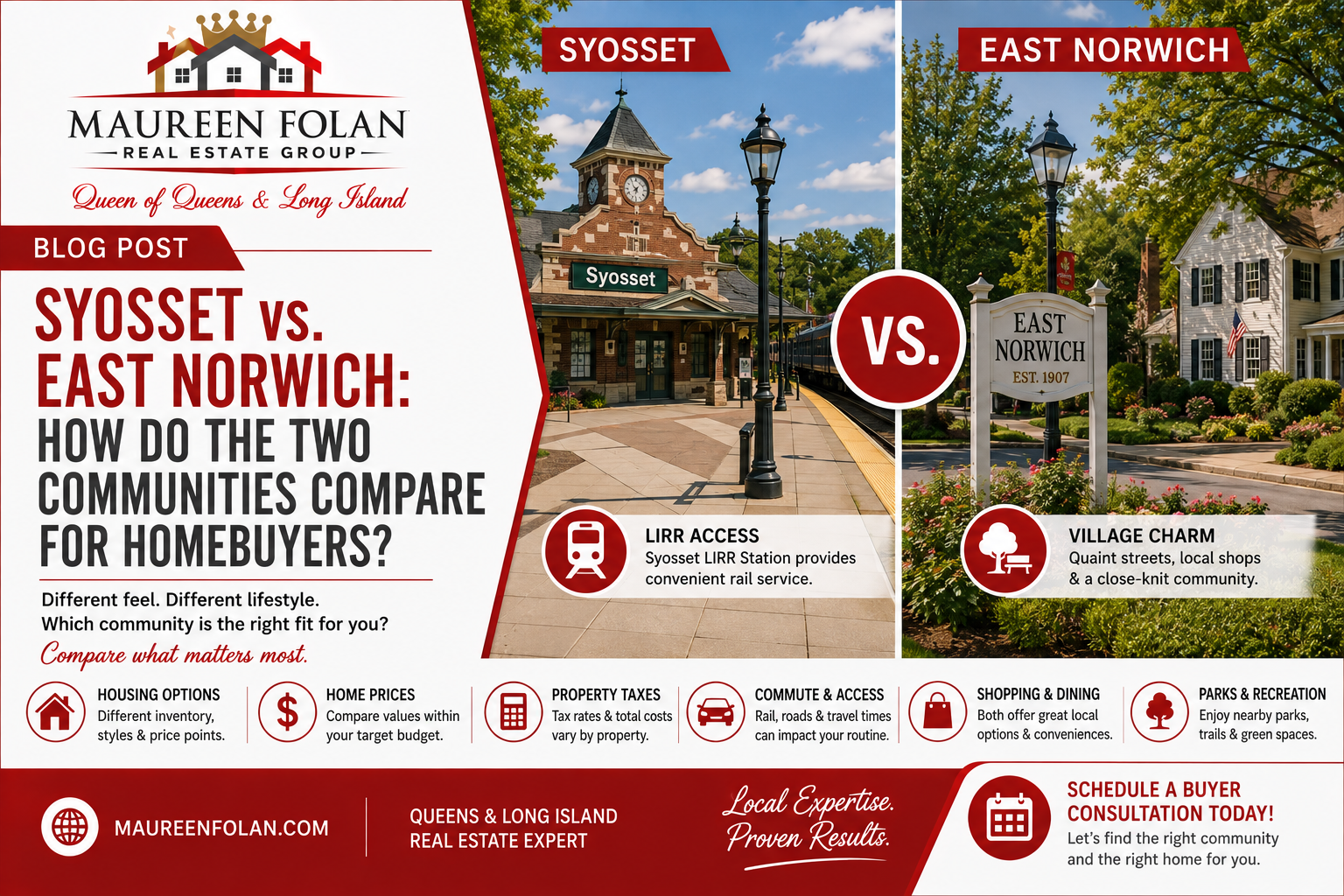
What changes should you expect when moving from Queens to Syosset, NY?

Moving from Queens to Syosset can change the type of home you own, your transportation routine, property expenses, maintenance responsibilities, and how you approach everyday errands. The smartest transition starts by understanding what your Queens home may contribute financially, then comparing Syosset properties based on total ownership cost and practical fit—not purchase price alone.

Moving From Queens to Syosset Is More Than a Change of Address

If you're considering moving from Queens to Syosset, you're probably thinking about the home you could buy next.

But the move involves more than square footage.

You may be changing from one housing environment to another, taking on different property-maintenance responsibilities, adjusting your commute, and reorganizing parts of your everyday routine.

If you already own a home in Queens, there's another layer:

You may need to sell one property while purchasing another.

That makes this both a lifestyle decision and a financial strategy.

The best place to start isn't with a Syosset listing.

It's with a clear understanding of what you want your move to accomplish. 

Start With the Home You Already Own in Queens

Before determining what you should spend in Syosset, understand what your Queens property may realistically be worth.

Your available equity could influence:

  • Your down payment
  • Comfortable Syosset purchase range
  • Financing needs
  • Cash reserves after closing
  • Renovation budget
  • Transaction timing

Don't automatically use an online estimate as your expected sale price.

Your Queens home's actual competitive position depends on its location, property type, condition, improvements, recent comparable sales, and the listings competing for buyers when you're ready to sell.

Once you have a realistic estimate of your potential proceeds, you can build your Syosset search around actual numbers rather than assumptions.

Expect a Significant Real Estate Investment in Syosset

One misconception you should avoid is assuming that leaving Queens automatically means dramatically cheaper housing.

Syosset is a substantial real estate market.

For the three months ending June 2026, Redfin reported a median Syosset sale price of approximately $1.314 million. Homes sold at a median of 99.6% of list price, and Redfin classified the market as very competitive.

That doesn't mean you need $1.314 million to buy in Syosset.

A median describes the midpoint of transactions during a particular period—not the price of the home that's right for you.

Recent sales demonstrate meaningful variation among individual Syosset properties.

The practical takeaway is that you need to define your desired property first and then determine what that type of home currently costs.

Your Purchase Price Isn't Your Real Housing Budget

When comparing your Queens home with a potential Syosset property, don't stop at sale price.

Instead, calculate the broader ownership picture:

Purchase price + financing + property-specific taxes + insurance + utilities + maintenance + anticipated improvements.

This is particularly important when comparing houses with different lot sizes, ages, and conditions.

A property with a lower purchase price could require significant improvements.

Another may cost more initially but require less immediate work.

The better choice depends on your finances and priorities.

Your goal shouldn't be to buy the most expensive home you're approved to purchase.

It should be to buy a property you can comfortably own after closing.

Property Taxes Should Be Investigated Early

Property-specific taxes can materially affect the affordability of a Syosset home.

Don't wait until you've become emotionally attached to a property to investigate them.

And avoid relying on a generic estimate for “Syosset taxes.”

Taxes can differ from property to property.

Make them part of your comparison from the beginning.

If two homes have similar asking prices but materially different ongoing costs, they aren't equivalent financial choices.

This is one reason a Property Tax Guide can be helpful when you begin moving from Queens to Long Island: it gives you a framework for identifying questions to investigate for each property rather than assuming purchase price tells the whole story.

You May Be Buying More Property—and More Responsibility

One reason you may be considering Syosset is the possibility of a different type of home or outdoor environment.

But additional property comes with additional responsibility.

A larger yard may require landscaping.

More exterior surfaces mean more maintenance.

Trees, driveways, patios, fences, drainage, and other property features can require attention over time.

That isn't necessarily a drawback.

It simply needs to be part of your decision.

Ask yourself what you actually want outdoor space to do for you.

If you genuinely want more usable property, maintaining it may be completely worthwhile.

If your main priority is interior space, you may prefer a property that gives you the house you want without significantly increasing exterior upkeep.

Buy the amount of property you want to maintain—not simply the largest lot available within your budget.

Your Definition of “Move-In-Ready” May Change

When moving from Queens to Syosset, you'll probably encounter homes in different conditions.

Some may be extensively updated.

Others may require cosmetic work.

Some may present larger renovation opportunities.

Decide your tolerance before you start making offers.

You can think about homes in three categories:

Move-in-ready: You want little immediate work.

Cosmetic opportunity: You're comfortable changing paint, flooring, fixtures, and finishes over time.

Renovation project: You're prepared for more substantial construction in exchange for the right underlying property.

A less updated home can sometimes create an opportunity.

But don't underestimate renovation expenses simply because you like the location.

Likewise, don't automatically pay a large premium for renovations unless those improvements actually match your preferences.

Transportation May Feel Different

Transportation is one of the most practical changes to evaluate when moving from Queens to Syosset.

Syosset has a Long Island Rail Road station. The MTA's station information also notes that parking facilities at Syosset station are operated by the Town of Oyster Bay and require a Town resident permit.

If rail transportation is important to you, that can be a meaningful part of the move.

But don't reduce your analysis to “Syosset has an LIRR station.”

Test your complete trip.

How long does it take to get from the house to the station?

How will you reach it?

Which train fits your schedule?

What happens on the return trip?

Where is your final destination after the train?

Current schedules and service details should always be verified directly through the Long Island Rail Road before making a transportation-dependent housing decision.

Driving May Become a Bigger Part of Your Routine

Depending on where you currently live in Queens, you may be accustomed to having certain errands, services, restaurants, or transportation options close together.

Your Syosset routine could be different.

That doesn't make one environment better than the other.

It means you should understand how the specific property affects your everyday life.

When touring a home, don't only drive there from your current residence.

Test the routes you'll actually use.

Go from the property to the train station.

Drive to your regular work destination.

Check where you would handle routine errands.

Visit places you realistically expect to use.

The home may work beautifully.

Or you may discover that another Syosset location fits your routine better.

Don't Assume You Need the Biggest House You Can Buy

Moving from Queens can make additional space appealing.

But extra square footage should have a purpose.

Ask yourself what you need the additional space for.

A dedicated office?

Guest accommodations?

Storage?

Entertaining?

A larger kitchen?

A hobby area?

If you can't identify how you'll use the space, don't assume you should pay for it simply because it's available.

Larger homes generally require more furnishing, cleaning, heating, cooling, repair, and maintenance.

The strongest purchase is often the home that gives you enough of the right space, not the greatest possible amount.

Compare the Home's Layout, Not Just Its Square Footage

Two properties can contain similar square footage and function very differently.

Pay attention to the relationship between rooms.

Where would you enter the house every day?

How does the kitchen connect with the spaces you use most?

Where is the storage?

Could bedrooms or flex rooms serve the functions you need?

Does the floor plan create unused areas you're paying for but unlikely to use?

A functional layout can sometimes feel more spacious than a larger but less efficient home.

This is why touring actual properties teaches you more than comparing listing statistics.

Selling in Queens and Buying in Syosset Requires Timing

For homeowners, one of the most important questions is:

Do you need to sell before you buy?

If you need proceeds from your Queens home to complete the Syosset purchase, your transactions need to be coordinated carefully.

Consider several scenarios before listing:

What happens if your Queens home sells first?

Where will you live if you haven't found the right Syosset property?

What happens if the ideal Syosset home appears before your Queens sale?

Can you financially handle any overlap?

Which closing dates would work best?

What terms matter beyond price?

You don't want to develop your strategy after one transaction is already underway.

Your Queens Equity Can Change the Buying Conversation

If you've owned your Queens property for a significant period, accumulated equity may play an important role in your move.

But don't treat your gross sale price as the amount available for your next purchase.

Your planning should account for the remaining mortgage balance and transaction-related costs before determining expected net proceeds.

That number can then help inform your down payment and financing strategy.

This is where working across both markets can be especially useful.

Instead of one strategy for selling Queens and another for buying Syosset, you can evaluate the entire transition as a single financial plan.

Don't Let Competition Make the Decision for You

Syosset's recent market data shows meaningful buyer competition. Redfin reported that 41.1% of homes sold above list price in its June 2026 data, although individual transactions varied considerably.

That doesn't mean you should automatically bid above asking price.

It means you should know your limits before you're emotionally invested.

For every property you seriously consider, determine:

What is it worth to you?

How does it compare with recent relevant sales?

What alternatives are available?

How much work does it need?

What will your total ownership cost look like?

At what point does another property become the better choice?

Competition is easier to navigate when you've already established your boundaries.

Keep an Emergency and Improvement Reserve

Buying a house shouldn't leave you with no financial flexibility after closing.

Even a well-maintained property can eventually require repairs.

And after moving in, you may discover improvements you'd like to make once you've actually lived in the space.

Building reserves into your purchasing strategy can give you more flexibility after the transaction.

That's another reason the highest possible purchase price shouldn't automatically become your target budget.

Your financial life continues after you receive the keys.

Don't Compare Queens and Syosset as “Better” or “Worse”

A relocation article shouldn't tell you which community is supposedly superior.

Your move is personal.

Queens may offer aspects of daily life you value highly.

Syosset may offer a type of home, property, transportation arrangement, or location that better fits what you want next.

The purpose of researching the move is to understand those tradeoffs.

Ask:

What am I trying to gain?

What will change?

Which changes am I comfortable making?

Those questions are more useful than a generic “best place to live” ranking.

Visit Syosset Like You Already Live There

One of the simplest relocation exercises is also one of the most useful.

Spend time in Syosset when you aren't touring houses.

Drive around.

Try your commute.

Run a normal errand.

Visit at different times of day.

See how long it takes to reach the places that matter to you.

A showing tells you whether you like a house.

Spending time around the location helps you understand whether the property fits your routine.

You need both pieces before making a major purchase.

Final Takeaway: Moving From Queens to Syosset

If you're considering moving from Queens to Syosset, don't think of the process as simply selling one home and purchasing a larger or different one.

You're potentially changing your housing expenses, property responsibilities, transportation patterns, and daily routine.

Syosset's current real estate market also represents a substantial investment. Recent data showed a median sale price around $1.314 million, with Redfin characterizing the market as very competitive.

Start with your Queens property.

Understand its potential value and your expected proceeds.

Then build your Syosset budget around total ownership costs, not just purchase price.

Test your transportation routine.

Decide how much home and property you actually want.

And coordinate the timing of your sale and purchase before either transaction puts you under pressure.

As Maureen Folan, Queens & Long Island Real Estate Expert, I help homeowners connect both sides of this move so your Queens sale and Syosset purchase can work as one coordinated strategy.

Because the goal isn't simply to leave Queens and buy in Syosset.

It's to make sure your next home works for the life—and financial plan—you want next. 

Talk With a Queens & Long Island Real Estate Expert

Thinking about selling your Queens home and moving to Syosset?

Talk With a Queens & Long Island Real Estate Expert at Maureen Folan Real Estate Group.

We can start by evaluating your current Queens property, estimating how your sale could affect your purchasing budget, and comparing Syosset homes based on the factors that matter to your move.

You can also request the Property Tax Guide to help organize the ownership-cost questions you'll want to investigate as you compare Long Island properties.


Maureen Folan
Queens & Long Island Real Estate Expert
Maureen Folan Real Estate Group
MaureenFolan.com

Sept. 1, 2026

Syosset vs. East Norwich: How Do the Two Communities Compare for Homebuyers?

Syosset vs. East Norwich: How Do the Two Communities Compare for Homebuyers?
Syosset vs. East Norwich: what should you compare before deciding where to buy a home?

The most useful differences aren't about declaring one community “better.” You should compare available homes, price, property taxes and total ownership costs, lot and housing characteristics, transportation, proximity to the places you use, and the type of residential setting you prefer. Syosset and East Norwich are close geographically, but your home-buying experience can be quite different depending on the individual property.

Syosset vs. East Norwich: Start With the Home, Not the Town Name

If you're deciding between Syosset and East Norwich, you may be tempted to research both communities until you can declare a winner.

There's a better approach.

Start with your priorities.

How much do you want to spend?

What kind of property are you looking for?

How much outdoor space do you want?

Do you need rail transportation regularly?

Would you rather purchase something updated or take on renovations?

Which destinations do you need to reach most often?

Once you answer those questions, you can compare actual properties in both communities instead of comparing two labels.

That's particularly useful because Syosset and East Norwich sit relatively close to one another in Nassau County, yet the inventory available within your budget can produce very different choices. 

How Does the Syosset Real Estate Market Compare?

Syosset is an established and competitive residential market.

Current Redfin data tracks Syosset sale prices, market time, sale-to-list relationships, and other indicators. Those figures can help you understand the broad environment in which you're shopping. Current Syosset housing-market data

But don't use a townwide median as your purchasing budget.

The home you want may sit substantially above or below that figure depending on its size, condition, lot, location, and other characteristics.

The better exercise is to define a realistic range—perhaps the amount you are comfortable spending rather than the maximum you could theoretically borrow—and examine what is actually available in Syosset within it.

Then perform the same exercise in East Norwich.

That's when the comparison becomes meaningful.

East Norwich Gives Buyers Another North Shore-Area Option

East Norwich is a hamlet within the Town of Oyster Bay, placing it within a different local context from Syosset while keeping buyers near other North Shore communities.

The Town of Oyster Bay provides parks, recreation facilities, beaches, marinas, and other municipal resources throughout the town. Town of Oyster Bay parks and recreation

For a buyer, however, the important question isn't how many amenities appear on a municipal website.

It's which ones you expect to use and how conveniently a particular home allows you to reach them.

That property-specific approach keeps your comparison practical.

Housing Inventory May Make the Decision for You

Sometimes buyers spend weeks trying to decide between communities only to discover that the available homes make the answer much clearer.

Imagine you have a particular budget.

In Syosset, that budget might give you several homes with one combination of size, lot, condition, and location.

In East Norwich, it may produce a different combination.

Now you're making a real comparison.

Perhaps one property is extensively renovated but has less outdoor space.

Another may need cosmetic updates but offers a layout you prefer.

A third could have a larger lot but create a less convenient transportation routine.

Instead of asking:

“Is Syosset or East Norwich better?”

ask:

“Which of these actual homes gives me the best combination of the things I value?”

That question is far more useful.

Compare Condition as Well as Purchase Price

Purchase price alone can make two homes appear more similar than they really are.

Suppose a Syosset property and an East Norwich property are offered at roughly the same price.

One is move-in-ready.

The other needs a kitchen renovation, flooring, painting, and exterior work.

Those aren't financially equivalent choices simply because the asking prices match.

For the property requiring work, consider:

Purchase price + immediate repairs + planned renovations + time + disruption.

For the updated home, ask whether you're paying a premium for improvements you genuinely value.

Neither answer is automatically right.

Some buyers would rather avoid renovation entirely.

Others see an older home as an opportunity to customize a property over time.

Knowing which type of buyer you are can simplify your search considerably.

Property Taxes Should Be Evaluated Home by Home

Taxes can have a meaningful effect on your total housing expense.

But don't compare Syosset and East Norwich using a generalized statement about which community has “higher taxes.”

Verify the taxes for the actual properties you're considering.

Two homes with similar prices can have different tax obligations, which can affect your monthly cost and long-term budget.

For each property, consider:

Purchase price + financing + property-specific taxes + insurance + maintenance + anticipated improvements.

That produces a much clearer comparison of affordability.

If you're moving from Queens, this calculation becomes especially important because your next home's ownership costs may be structured differently from those of your current property.

Transportation Can Be a Major Difference

If you expect to use the Long Island Rail Road frequently, transportation deserves careful consideration.

Syosset has its own LIRR station on the Port Jefferson Branch. The MTA provides current schedules and service information, which you should check against your actual work or travel schedule. Long Island Rail Road information

If you're considering East Norwich, evaluate the transportation options from the specific property rather than assuming the same routine applies.

How would you reach the station you expect to use?

How long would that take?

What are the current train options?

Would you drive instead?

Where do you travel most frequently?

This can be one of the clearest examples of why nearby communities don't necessarily create identical lifestyles.

A few miles can matter when you make the trip every day.

Test Your Actual Commute

Online maps are useful.

A real-world test is better.

If commuting is important, visit a property at a realistic time and drive the route you expect to use.

If you plan to take the train, investigate the complete journey rather than only looking at scheduled rail time.

That includes getting from the home to the station, parking or drop-off logistics where applicable, the train itself, transfers, and the final portion of your trip.

The best transportation choice isn't the one that sounds most convenient.

It's the one that works for your routine.

How Much Property Do You Want?

Lot size can look exciting in listing photos.

Then you have to maintain it.

If one of your reasons for moving is to gain more outdoor space, decide what you actually want that space to accomplish.

Do you want room for entertaining?

Gardening?

Privacy?

Recreation?

Or do you simply want some outdoor space without a large maintenance commitment?

A larger property isn't automatically a better property.

It should serve a purpose that matters to you.

When comparing Syosset and East Norwich homes, look at lot usability, not simply the number attached to the acreage or square footage.

Look Closely at Older Homes

The approved East Norwich content plan specifically includes helping buyers understand older properties, and that's an important consideration when comparing homes.

Age by itself isn't a reason to reject a property.

Older homes can offer architecture, layouts, materials, or property characteristics that appeal to buyers.

But age makes due diligence important.

During your initial tour, pay attention to visible condition and the improvements that appear to have been made over time.

If you decide to pursue the property, appropriate professional inspections and other due diligence can help you better understand its condition.

Don't assume an older home is problematic.

And don't assume a beautifully updated interior means every component of the property is new.

Evaluate the complete home.

Think About Renovation Tolerance Before You Shop

Before touring either community, decide how much work you're willing to take on.

You can divide your tolerance into three categories:

Move-in-ready: You want minimal immediate work.

Cosmetic opportunity: You're comfortable with paint, flooring, fixtures, and other manageable improvements.

Renovation project: You're willing to undertake substantial improvements to get the location or underlying property you want.

Knowing where you fall can prevent you from wasting time touring homes that don't fit your real expectations.

It also helps you compare value more intelligently.

What About Shopping, Recreation, and Everyday Errands?

Buyers often focus so heavily on the house that they forget to test everyday life.

Where will you buy groceries?

Where will you go for dinner?

Where are the parks or recreational facilities you expect to use?

How long will routine errands take?

You don't need every amenity within walking distance.

You do need to understand whether the home's location works for the way you spend your time.

Visit both areas.

Drive around without a showing appointment.

Make a normal errand.

Have lunch nearby.

See what the routes actually feel like.

You'll learn more than you will from a generic online ranking.

If You're Moving From Queens, Compare What You're Gaining—and Changing

A Syosset vs. East Norwich decision can look different when you're coming from Queens.

You may be moving because you want a different type of home, more outdoor space, a different daily routine, or another Long Island location.

Be specific about that goal.

What are you trying to gain?

Then identify what changes come with it.

You may have more property to maintain.

Your commute may change.

Property-specific taxes may become a larger part of your housing budget.

Driving may play a different role in your daily routine.

The objective isn't to decide whether those changes are universally good or bad.

It's to determine whether they work for you.

Coordinate Your Queens Sale With Your Purchase

If you already own a home in Queens, don't evaluate your next purchase without understanding your current property's potential value.

Your expected net proceeds may influence your down payment, financing strategy, renovation budget, and comfortable purchase range.

Timing matters too.

Do you need to sell before buying?

Can you buy first?

What happens if you find an East Norwich or Syosset home before your Queens property sells?

What happens if the Queens sale happens first?

Working through these possibilities early can help you approach the buying process with more confidence.

Don't Use Community Rankings to Make the Decision

A comparison article should help you understand differences—not tell you which type of person belongs in which community.

That's why I recommend avoiding “best town” thinking.

Instead, use measurable and personal factors:

  • Current homes available within your budget
  • Property condition
  • Total ownership cost
  • Lot and layout
  • Transportation
  • Distance to your regular destinations
  • Renovation requirements
  • Maintenance expectations
  • Your anticipated length of ownership

Those considerations help you make an individualized decision without relying on stereotypes or assumptions.

Syosset May Be the Better Fit If...

Syosset may move higher on your list if the specific homes available there better match your budget and property requirements, or if access to the Syosset LIRR station works particularly well for your transportation needs.

You may also simply find a home there with the right combination of layout, condition, lot, and location.

That's enough reason to choose it.

You don't need a broader justification.

East Norwich May Be the Better Fit If...

East Norwich may move higher on your list if the properties you find there provide a combination of housing characteristics, lot, location, and access to the broader Oyster Bay area that better fits your priorities.

Again, the property should lead the decision.

If an East Norwich home works better for your finances and daily routine, that's more meaningful than a generic comparison between the two communities.

Final Takeaway: Syosset vs. East Norwich

So, Syosset vs. East Norwich—which should you choose?

Start with your budget and the actual homes available.

Then compare condition, property-specific taxes, renovation needs, lot characteristics, transportation, maintenance, and proximity to the places you use regularly.

Syosset's direct LIRR station may be particularly relevant for some buyers, while East Norwich's location within the broader Oyster Bay area can create a different property and location equation.

Neither community needs to “win.”

The right answer is the home that gives you the strongest combination of property, price, location, ownership costs, and everyday practicality.

As Maureen Folan, Queens & Long Island Real Estate Expert, I help buyers compare those factors at the property level—especially when you're considering multiple Long Island communities or coordinating a move from Queens.

Because the best comparison isn't Syosset versus East Norwich in the abstract.

It's your best Syosset option versus your best East Norwich option. 

Schedule a Buyer Consultation

Trying to decide between Syosset and East Norwich?

Schedule a Buyer Consultation with Maureen Folan Real Estate Group.

We can compare current properties in both markets, look at the practical differences in price, condition, taxes, transportation, and location, and help you determine which options best fit your next move.

If you're relocating from Queens, we can also connect your current-home strategy with your Long Island purchase.

And ask for the Property Tax Guide to help organize one of the important financial considerations when comparing Long Island homes.


Maureen Folan
Queens & Long Island Real Estate Expert
Maureen Folan Real Estate Group
MaureenFolan.com

Sept. 1, 2026

Why Buyers Continue to Consider Syosset When Moving to Long Island

Why Buyers Continue to Consider Syosset When Moving to Long Island

Why do buyers continue to consider Syosset, NY when moving to Long Island?

Syosset remains part of many Long Island home searches because it combines an established residential market with LIRR access, proximity to major roadways, nearby shopping and recreation, and a range of housing options. If you're moving to Syosset, NY, the key is determining whether the homes, ownership costs, transportation options, and everyday routine fit your priorities—not relying on rankings or assumptions about the community.

Why Is Syosset Part of So Many Long Island Home Searches?

When you're deciding where to buy on Long Island, it's easy to begin with a list of town names.

Syosset often appears on that list.

But a successful home search requires you to go deeper than reputation.

You're not purchasing the idea of a community. You're purchasing a specific property with a specific price, condition, tax obligation, location, maintenance profile, and relationship to the places you need to reach.

That's particularly important in Syosset, where buying a home can represent a substantial financial commitment.

So rather than asking whether Syosset is universally the “right” place to move, ask:

Does Syosset give me the combination of home, location, transportation, and ownership costs that works for my next move?

That's a question you can actually answer. 

Syosset Has a Competitive Real Estate Market

If you're moving to Syosset, NY, understanding the housing market is an important first step.

Current market information from Redfin tracks Syosset home prices, days on market, sale-to-list relationships, and competitive conditions. Current Syosset housing-market data

The larger lesson for buyers is that you shouldn't enter the Syosset market without a clear financial strategy.

Before seriously touring homes, determine:

  • Your comfortable purchase range
  • Your financing position
  • How much cash you want available after closing
  • The property-specific taxes you're prepared to carry
  • Your renovation budget, if applicable
  • Your expected maintenance costs
  • Which property features justify stretching your budget—and which don't

Your lender's maximum approval amount and your comfortable ownership budget aren't necessarily the same number.

Know the difference before competition for a particular property starts influencing your decisions.

Transportation Is One Practical Reason Buyers Consider Syosset

For buyers who need rail access, Syosset has its own Long Island Rail Road station on the Port Jefferson Branch.

The Metropolitan Transportation Authority provides current station, schedule, and service information for the LIRR, and buyers should use current schedules when evaluating their individual commute. Long Island Rail Road information

But having a train station in town doesn't automatically mean a property is convenient for your commute.

If transportation matters to your move, test the entire trip.

Start from the actual home you're considering.

How will you reach the station?

Will you drive, walk, get dropped off, or use another option?

What train would you realistically take?

Where do you need to transfer?

How does the return trip work?

If you're driving to work instead, map that route at the times you expect to travel.

A community's location can look excellent on a map and still produce a routine that doesn't work for you.

Syosset's Road Access Can Matter Too

Not every buyer is commuting into Manhattan.

You may work elsewhere on Long Island, travel throughout the region for business, work remotely most of the week, or have multiple destinations that matter.

Syosset's location near major Long Island transportation corridors can therefore become part of the decision.

But again, don't reduce your analysis to “good highway access.”

Your commute isn't a marketing phrase.

It's a route you may travel hundreds of times.

Drive it.

Test it.

Understand it before you commit to the house.

Buyers Can Find Different Types of Homes in Syosset

Another reason Syosset can remain on a buyer's shortlist is the range of homes that may appear within the market.

Depending on current inventory and budget, you may encounter properties with different ages, layouts, lot characteristics, renovation levels, and architectural styles.

Some buyers want a home that is completely updated.

Others are comfortable with cosmetic work.

Some actively look for renovation opportunities because they want greater control over the finished property.

This makes your condition tolerance one of the most important things to establish before you shop.

Ask yourself:

Do I want to pay more upfront for a home that requires less immediate work?

or

Would I rather purchase a property with improvement potential and complete projects over time?

Neither approach is inherently better.

The right answer depends on your finances, skills, schedule, and tolerance for disruption.

Move-In-Ready Can Carry a Different Kind of Value

When buyers compare homes, they aren't only comparing asking prices.

They're also estimating what happens after closing.

Suppose one Syosset home is updated and ready to occupy while another needs a kitchen, flooring, paint, and several repairs.

The second home may have the lower purchase price.

But now you have to consider the cost of improvements, how quickly you want them completed, and whether you want to manage those projects.

That's why move-in-ready properties can attract attention.

They can offer greater predictability.

That doesn't automatically make them the better purchase.

You still need to decide whether you're paying for improvements you actually value.

Property Taxes Need to Be Part of the Search From the Beginning

If you're moving from Queens or another part of the region, don't wait until you've fallen in love with a home to investigate its property-specific taxes.

They should be part of your initial financial comparison.

Two homes with similar purchase prices can produce different total monthly ownership costs.

When comparing properties, consider:

Purchase price + financing + property-specific taxes + insurance + maintenance + expected improvements.

That produces a much more useful picture than the asking price alone.

Also verify the actual tax information associated with a property rather than relying on a generalized statement about what homeowners “usually” pay in a community.

Real estate decisions happen at the property level.

Everyday Convenience Should Be Evaluated From the House

When you're researching moving to Syosset, NY, you may read descriptions of nearby shopping, dining, recreation, and transportation.

Those can be useful starting points.

But “nearby” means different things to different people.

If you expect to visit a particular shopping area regularly, map it from the property.

If you use certain recreation facilities, determine how easily you'll reach them.

If your work schedule requires frequent trips to another part of Long Island, test that route.

The house itself may be excellent, but your experience living there will be shaped by what happens once you leave the driveway.

What Should You Look for When Touring a Syosset Home?

A showing is your opportunity to evaluate much more than finishes.

Look at how the home actually functions.

Pay attention to:

  • Overall condition
  • Floor plan and room relationships
  • Natural light
  • Storage
  • Kitchen functionality
  • Bathroom condition
  • Visible maintenance
  • Lot usability
  • Exterior upkeep
  • Parking and driveway configuration
  • Improvements you would want to make

Try to separate cosmetic preferences from meaningful property considerations.

A paint color you dislike is relatively simple to change.

A floor plan that doesn't work for you may be much harder.

Likewise, don't allow beautiful staging to distract you from the home's underlying condition.

Ask yourself whether you like the property, not simply how it has been presented.

Think About How Much Property You Want to Maintain

If you're moving from a denser housing environment, additional outdoor space can initially seem like an automatic advantage.

It may be.

But property requires maintenance.

Lawns, landscaping, trees, exterior surfaces, driveways, patios, and other features all require attention over time.

The question isn't whether more outdoor space is good.

It's whether you want the amount of property that comes with the particular home.

A larger lot may be exactly what you've been looking for.

Another buyer may prefer something easier to maintain.

Both decisions are reasonable.

If You're Moving From Queens to Syosset, Start With Your Current Home

For Queens homeowners, the Syosset purchase may only be half of the transaction.

Your existing property could play an important role in determining your next-home budget.

Before becoming deeply involved in the Syosset search, understand what your Queens home may realistically sell for and approximately how much equity could be available after the transaction.

That lets you build your buying strategy on more concrete numbers.

Then consider the timing.

Do you need to sell before you buy?

Can you purchase first?

How much overlap can you comfortably manage?

What happens if your Queens property sells before you find the right Syosset home?

Planning these scenarios early can prevent your next move from becoming unnecessarily stressful.

Don't Choose Syosset Because Someone Says You “Should”

Online relocation content frequently reduces communities to rankings.

That isn't how I recommend choosing where to live.

Your decision should be based on objective property and location considerations that are relevant to you.

What can you comfortably afford?

What type of home can you purchase?

How does the location affect your transportation needs?

How much property do you want?

What ownership costs are associated with the specific home?

What amenities do you expect to use?

Those questions produce a personalized decision without relying on assumptions about who should live in a particular community.

Syosset vs. Huntington, Northport, or Other Long Island Options

You don't have to choose Syosset before you start touring homes.

In fact, comparing multiple markets can make you a better buyer.

Suppose your budget gives you one type of property in Syosset and another in Huntington.

Now you have a useful comparison.

Maybe the Syosset home better fits your transportation needs.

Maybe the Huntington property gives you a location or housing configuration you prefer.

Maybe another community produces a better balance.

The purpose of comparing towns isn't to declare a winner.

It's to understand the tradeoffs your budget creates.

That's much more valuable than reading a list of supposedly “best” Long Island communities.

Prepare Before the Right Syosset Home Appears

If current inventory produces a property that fits your priorities, you want to be able to evaluate it calmly and efficiently.

That preparation happens before the showing.

Know your financing.

Know your budget.

Know your preferred closing timeline.

Know which property characteristics are non-negotiable.

Know which improvements you're comfortable taking on.

And know when you're willing to walk away.

Preparation doesn't mean you should rush into an offer.

It means you have already established a framework for deciding whether the opportunity makes sense.

Final Takeaway: Moving to Syosset, NY

If you're considering moving to Syosset, NY, focus on the real estate decision in front of you rather than broad assumptions about the community.

Syosset can offer buyers an established residential market, direct LIRR access, regional transportation options, and varied housing opportunities. But the right purchase depends on the specific property, your budget, ownership costs, transportation needs, condition preferences, and long-term plans.

If you're relocating from Queens, add your current home to that equation.

Your Queens sale and Syosset purchase shouldn't be treated as two isolated transactions when one may directly influence the other.

As Maureen Folan, Queens & Long Island Real Estate Expert, I help you compare those pieces so you can understand what you're buying, what you're leaving, and how the entire move fits together.

Because the objective isn't simply to find a house in Syosset.

It's to find a home—and a financial strategy—that makes sense for your next move. 

Schedule a Buyer Consultation

Thinking about buying a home in Syosset or comparing Syosset with other Long Island communities?

Schedule a Buyer Consultation with Maureen Folan Real Estate Group.

We'll talk through your budget, preferred type of home, transportation needs, timing, and current options so you can approach your Syosset search with a clearer strategy.

If you're moving from Queens, you can also Talk With a Queens & Long Island Real Estate Expert about coordinating the potential sale of your current home with your Long Island purchase.

And ask for the Property Tax Guide if you'd like a starting point for understanding one of the important ownership costs to investigate when comparing Long Island properties.

Maureen Folan
Queens & Long Island Real Estate Expert
Maureen Folan Real Estate Group
MaureenFolan.com

Sept. 1, 2026

What Syosset Homeowners Should Do Before Selling Their Home in 2026

What Syosset Homeowners Should Do Before Selling Their Home in 2026

What should you do before selling your home in Syosset, NY in 2026?

Before listing, you should understand your home's current competitive position, establish a realistic pricing strategy, decide which repairs or improvements are actually worthwhile, prepare the property for photography and showings, and organize the practical details of your next move. The goal isn't to make your Syosset home perfect—it's to make deliberate decisions that help buyers understand its value.

Selling a Home in Syosset, NY Starts Before the Listing Goes Live

If you're thinking about selling a home in Syosset, NY, your first major decision isn't which photographs to use or when to hold an open house.

It's how you're going to position the property.

The work you do before your home reaches the market can influence its asking price, presentation, buyer response, and ultimately the options you have when offers arrive.

That makes the pre-listing period especially important.

Rather than immediately making improvements or choosing a price based on an online estimate, start by answering three questions:

What is my home competing against?

What will buyers notice about my property?

What do I need this sale to accomplish?

Those answers should shape nearly every decision that follows. 

1. Understand the Syosset Market You're Entering

A strong selling strategy starts with current information.

The Syosset housing market remains a significant financial market for buyers and sellers. Redfin's current market data provides regularly updated information on sale prices, market time, and competitive conditions in Syosset. Current Syosset housing-market data

But townwide statistics should only be your starting point.

Your home will compete within a much narrower market based on characteristics such as:

  • Price range
  • Property type and size
  • Lot characteristics
  • Condition and renovation level
  • Bedroom and bathroom configuration
  • Layout
  • Location
  • Amenities and distinctive features

A broad Syosset median cannot tell you precisely what your property is worth.

You need to know what buyers looking for a home like yours are seeing.

2. Get a Property-Specific Value Analysis

One of the easiest mistakes to make before selling is assuming that your home's value can be determined by one nearby sale.

Maybe a property around the corner sold for an impressive number.

That's relevant—but it doesn't automatically make it comparable.

Ask how that property differs from yours.

Was it larger?

More recently renovated?

On a different lot?

Did it offer a different layout?

Was its condition similar?

When did it sell?

The strongest pricing analysis considers multiple pieces of evidence rather than searching for the single sale that produces the highest possible number.

You should also consider active competition.

A closed sale tells you what a buyer paid in the past.

An active listing tells you what buyers can choose instead of your home today.

You need both perspectives.

3. Don't Automatically Renovate Before Selling

Once homeowners decide to sell, many immediately start thinking about renovations.

Should you replace the kitchen?

Update the bathrooms?

Install new flooring?

Redo the landscaping?

The answer isn't automatically yes.

Before spending substantial money, determine whether the improvement is likely to change how buyers perceive your property enough to justify its cost, time, and disruption.

Sometimes a larger project may make sense.

Other times, the more strategic preparation could include:

  • Addressing visible repairs
  • Painting selected areas
  • Improving lighting
  • Deep cleaning
  • Decluttering
  • Simplifying furniture arrangements
  • Improving exterior presentation
  • Taking care of obvious deferred maintenance

A $5,000 preparation plan can sometimes make more sense than a $50,000 renovation.

The correct strategy depends on your home and its competition.

4. Separate Repairs, Refreshes, and Renovations

One way to make preparation decisions easier is to divide potential projects into three categories.

Repairs are items that are damaged, broken, or visibly need attention.

A sticking door, leaking fixture, damaged trim, or broken hardware might fall into this category.

Refreshes are relatively modest changes intended to improve presentation.

Paint, lighting, cleaning, landscaping, and decluttering may fit here.

Renovations are larger projects involving substantial cost, construction, or time.

That might include replacing a kitchen or significantly remodeling a bathroom.

Make decisions in that order.

Addressing a collection of small maintenance problems may do more to improve buyer confidence than installing one expensive new feature while leaving obvious issues elsewhere.

5. Look at Your Home Through a Buyer's Eyes

You've lived with your home's quirks long enough that you may no longer notice them.

Buyers will.

Before listing, walk outside and approach your home as though you're seeing it for the first time.

Look at the exterior.

Walk through the front door.

Notice the entry.

Pay attention to natural light.

Open closets.

Look at countertops.

Walk through each room and ask:

What is the first thing my eye goes to?

Ideally, the answer is one of the property's strengths.

If your attention consistently lands on clutter, worn finishes, unfinished repairs, or oversized furniture, buyers may experience the same thing.

You don't need to remove your home's personality.

You need to make its space and features easy to understand.

6. Prepare for the Online Showing

Your first physical showing probably won't be the first time a buyer encounters your property.

That will often happen online.

Buyers may decide whether your Syosset home deserves an in-person visit based largely on its digital presentation.

That's why photography shouldn't be treated as an afterthought.

Before the photographer arrives:

Clear unnecessary items from counters.

Reduce visual clutter.

Make beds and organize rooms.

Clean windows and reflective surfaces.

Make sure lighting works.

Address obvious exterior distractions.

Consider how each room will appear within a photograph—not only how it feels when you're standing inside it.

Good photography doesn't replace a strong property.

It helps buyers recognize one.

7. Understand What Move-In-Ready Means to Your Buyer

Not every buyer expects a completely renovated home.

But many buyers appreciate certainty.

A property that feels maintained, clean, functional, and ready to occupy may reduce the number of immediate projects a buyer anticipates after closing.

That can be especially meaningful when buyers are already accounting for a substantial purchase price, closing expenses, moving costs, and ongoing ownership expenses.

If your home isn't fully renovated, don't assume you're at a disadvantage.

Instead, determine whether its condition is appropriately reflected in the pricing and marketing strategy.

An older home can still be highly compelling when buyers understand what makes it valuable.

8. Gather Important Property Information Early

Preparing to sell isn't only about appearance.

It's also about organization.

Before listing, begin gathering relevant information you already have about your property.

That might include records related to improvements, warranties, permits where applicable, surveys, certificates, or other documents relevant to the transaction.

You should also become familiar with New York's seller-disclosure requirements.

New York's Property Condition Disclosure Act generally requires sellers of covered residential real property to provide a Property Condition Disclosure Statement before the buyer signs a binding contract of sale. The official disclosure is based on the seller's actual knowledge and does not replace the buyer's inspections or testing.

Legal requirements can depend on the property and circumstances, so your attorney should advise you regarding your individual obligations.

The practical point is simple:

Don't wait until you have an accepted offer to start organizing.

9. Think About Your Next Move Before You List

Where are you going after your Syosset home sells?

This question can influence more of your selling strategy than you might expect.

Perhaps you're downsizing.

Maybe you're purchasing another Long Island property.

You could be relocating out of New York.

Or perhaps you're selling in Syosset as part of a larger financial or lifestyle transition.

Your next move affects timing.

It can also affect which offer terms matter most.

A seller who needs additional flexibility may evaluate an offer differently from someone whose next residence is already secured.

That's why you should establish your ideal timeline before buyers begin making offers.

The best offer isn't always determined solely by the highest price.

10. Decide How You'll Evaluate Offers

Before an offer arrives, determine what matters to you.

Price obviously matters.

But so can financing, contingencies, closing date, down payment, and other terms.

You want to evaluate the complete offer rather than becoming fixated on one headline number.

This is particularly important if several offers arrive close together.

You should understand what each buyer is proposing and how those terms align with your priorities.

A strong negotiating strategy starts before the negotiation.

11. Have a Launch Strategy

Putting a property into the MLS isn't the same thing as launching it strategically.

Before going live, you should know:

  • Your asking price
  • How the property will be positioned
  • Which features deserve emphasis
  • When photography and marketing will be ready
  • How showing requests will be handled
  • How initial buyer response will be evaluated
  • How competing listings will be monitored

The opening days of a listing can provide valuable information.

You don't want to spend them fixing preventable marketing or preparation problems.

12. Don't Assume a Strong Market Will Do All the Work

When homeowners hear about competitive buyer demand, it's tempting to assume preparation and pricing become less important.

The opposite can be true.

Buyers compare listings quickly.

If your home is priced appropriately and presented effectively, competition can work in your favor.

If buyers believe another property provides significantly better value, they have an alternative.

Your job isn't to convince every buyer that your home is perfect.

It's to position the property so the right buyers understand why it deserves serious consideration.

What Should You Do 30 Days Before Listing?

If your target listing date is approximately a month away, this is a useful time to become systematic.

Start with a market and property evaluation.

Then create your preparation plan.

Complete necessary repairs and selected refreshes.

Begin decluttering.

Organize documents.

Determine your pricing strategy.

Establish photography and marketing timing.

Discuss your expected selling timeline and next move.

By the time the property goes live, the major decisions should already have been made.

That allows you to focus on buyer activity and offers instead of scrambling to finish preparation.

Final Takeaway: Preparing to Sell a Home in Syosset, NY

If you're considering selling a home in Syosset, NY, don't begin by renovating everything or choosing an asking price based on the highest nearby sale.

Begin with strategy.

Understand the competition.

Evaluate your property honestly.

Determine which preparation work is actually worthwhile.

Organize the practical details.

Know what you want to accomplish after the sale.

Then build your pricing and marketing plan around those objectives.

As Maureen Folan, Queens & Long Island Real Estate Expert, I help Syosset homeowners make those decisions before the listing reaches the market—when there is still time to determine which improvements matter, which ones may not, and how the property should be positioned.

Because a successful sale doesn't begin when the first buyer walks through the door.

It begins with the decisions you make before the listing goes live. 

Get a Personalized Home Value Estimate

Thinking about selling your Syosset home in 2026?

Get a Personalized Home Value Estimate from Maureen Folan Real Estate Group.

We'll look at your property's features and condition alongside relevant recent sales and current competition to help you understand where your home may fit in today's Syosset market.

You can also request the Home Seller Preparation Checklist to organize the repairs, refreshes, documents, and decisions worth considering before you list.


Maureen Folan
Queens & Long Island Real Estate Expert
Maureen Folan Real Estate Group
MaureenFolan.com

Aug. 31, 2026

The Complete Guide to Huntington, NY Real Estate for Buyers and Sellers

The Complete Guide to Huntington, NY Real Estate for Buyers and Sellers

What should buyers and sellers know about Huntington, NY real estate in 2026?

Huntington offers a competitive North Shore housing market alongside a distinctive downtown, extensive parks and waterfront recreation, and a variety of residential settings. Whether you're buying, selling, or moving from Queens to Huntington, your strategy should account for the specific property, current competition, total ownership costs, location, condition, and your plans after the transaction—not simply townwide averages.

Understanding Huntington, NY Real Estate in 2026

If you're researching Huntington, NY real estate, you've probably already discovered that broad market statistics only tell part of the story.

For the three months ending June 2026, Redfin reported a median Huntington sale price of approximately $999,000, representing a 5.2% increase from the comparable period a year earlier. Homes averaged 21 days on the market during that period, and Redfin characterizes Huntington as a highly competitive housing market. Current Huntington housing-market data

Those figures provide useful context.

They do not tell you exactly what a particular Huntington home is worth—or what you should pay for one.

Individual properties can vary considerably based on location, condition, renovations, architecture, lot characteristics, layout, amenities, and price range.

That's why buyers and sellers need to understand both the market and the property. 

What Makes Huntington Different?

Huntington's appeal isn't limited to its housing inventory.

The broader Town of Huntington occupies a significant portion of Suffolk County's North Shore and includes approximately 60 miles of coastline through its harbors, bays, and inlets. The Town maintains waterfront resources including beaches, docks, marinas, boat ramps, and moorings. Town of Huntington waterfront resources

Residents also have access to nearly 100 parks, beaches, hiking trails, and other recreational facilities throughout the Town. Huntington parks and trails

Then there's Huntington Village.

The downtown area gives Huntington a recognizable commercial and cultural center, with restaurants, shops, entertainment, arts, and community activities.

For you as a buyer, these characteristics matter because choosing a home isn't simply about the structure.

You're choosing the environment around it.

Huntington Village and the Downtown Experience

Huntington Village can be one of the first things buyers associate with the area.

The Town describes Huntington Village as a cultural destination with restaurants, galleries, an independent cinema, a museum, and a major concert venue. Town financial reporting has also cited more than 50 restaurants and 200 retail stores in the Village. Town of Huntington downtown information

Nearby Heckscher Park encompasses approximately 18 acres and includes a pond and gardens. It also hosts events such as the Huntington Fall Festival and Summer Arts Festival. Heckscher Park information

That combination can be important if you want access to an established downtown while still considering homes in a broader suburban and North Shore environment.

But don't assume proximity to downtown is automatically the right choice.

Some buyers want to be close to activity.

Others prioritize a different residential setting, additional property, or another location within Huntington.

Your search should begin with your routine rather than somebody else's idea of the ideal location.

What Types of Homes Can Buyers Consider in Huntington?

One of the challenges—and advantages—of buying in Huntington is that properties can offer very different experiences.

Depending on your price range and location, you may encounter homes that vary in architecture, age, renovation level, lot characteristics, and proximity to amenities.

That makes Huntington difficult to summarize with a single “typical home.”

Instead, determine what you're actually looking for.

Consider questions such as:

  • How much space do you need?
  • How much property do you want to maintain?
  • Do you prefer a renovated home or a renovation opportunity?
  • How important is proximity to Huntington Village?
  • Do you want convenient access to parks or waterfront recreation?
  • What are your transportation requirements?
  • Which property features are truly non-negotiable?
  • What total monthly housing expense are you comfortable carrying?

Once you answer those questions, you can evaluate the inventory that actually fits your goals.

What Buyers Should Look for During a Huntington Home Tour

When you tour a Huntington home, don't let staging or cosmetic finishes become your entire evaluation.

Look at the complete property.

Pay attention to condition, layout, natural light, storage, outdoor space, visible maintenance, location, and how the asking price compares with competing homes.

Kitchens and bathrooms often receive extra attention because buyers know that substantial renovations can involve considerable expense and disruption.

But an older kitchen doesn't automatically make a property a poor choice.

You may discover that a home's layout, lot, location, or other characteristics are more valuable to you than brand-new finishes.

The objective is to distinguish between changes you can comfortably make and issues that could materially affect your purchasing decision.

What Buyers Look for When Touring Homes in Huntington, NY

Why Move-In-Ready Homes Can Stand Out

Condition is especially important in a competitive market.

A move-in-ready property can provide buyers with greater certainty about what happens after closing. Instead of immediately planning repairs or renovations, buyers may be able to focus on moving and settling into the home.

But “move-in-ready” doesn't necessarily mean completely remodeled.

A clean, functional, well-maintained property can feel move-in-ready even if every finish isn't new.

Sellers should pay attention to this distinction.

You don't necessarily need to remodel your entire home before listing.

Strategic repairs, paint, lighting, decluttering, cleaning, landscaping, and thoughtful presentation may sometimes do more for marketability than an expensive last-minute renovation.

Why Move-In-Ready Homes Are Attracting More Attention in Huntington

How Should Sellers Price a Huntington Home?

Pricing is one of the most important decisions you will make.

A strong pricing analysis should consider recent comparable sales, current competing listings, property condition, renovations, lot characteristics, layout, and buyer activity within your specific segment of the Huntington market.

One of the biggest mistakes sellers make is starting with the amount they want to receive and treating that number as market value.

Your financial goals matter.

But buyers don't determine what they'll pay based on what you need for your next move.

They compare your property with their alternatives.

That's why your asking price should establish a compelling relationship between price and perceived value.

The Biggest Pricing Mistakes Huntington Home Sellers Make

Why Starting Too High Can Be Risky

You may wonder why you shouldn't simply start high and reduce the price later.

Because you can't recreate your initial market launch.

When your home first appears, buyers and real estate professionals monitoring Huntington inventory have an opportunity to evaluate it as a new listing.

If the asking price places the home against stronger competition—or buyers don't see enough value to schedule a showing—you may lose some of that initial attention.

A later price reduction can change the equation.

It doesn't give you a brand-new first day.

Strategic pricing is therefore about more than estimating value. It's about deciding how you want the property positioned against the homes buyers can purchase right now.

How Should Huntington Sellers Prepare Before Listing?

Preparation should begin with an evaluation, not a shopping list.

Walk through the home and identify:

Repairs: Items that are broken, damaged, or visibly require attention.

Refreshes: Smaller improvements that may strengthen presentation.

Renovations: Larger projects involving greater cost, construction, or time.

Then evaluate which items are likely to matter in your competitive market.

Don't assume a renovated kitchen is necessary simply because another seller has one.

And don't assume buyers won't care about deferred maintenance because the Huntington market is competitive.

Your preparation should reflect the property, price range, competition, and likely buyer expectations.

Selling a Home in Huntington, NY in 2026: What Homeowners Need to Know Before Listing

Your Home's First Showing May Happen Online

Modern listing preparation extends beyond the physical showing.

Before buyers arrive at your door, they may encounter your property through photography and online marketing.

That makes presentation important.

Rooms should be easy to understand. Strong features should be visible. The property description should communicate useful distinctions rather than rely on generic language.

A successful listing tells buyers what they're looking at—and gives them a reason to investigate further.

For sellers, that means marketing should be considered before the listing goes live, not after the first week if activity is disappointing.

What If You're Moving From Queens to Huntington?

This is where Huntington real estate becomes part of a larger strategy.

If you own a home in Queens and want to purchase in Huntington, you may need to coordinate two transactions.

Start with your current property.

Understanding its potential market value and your estimated sale proceeds can help establish a realistic Long Island purchasing budget.

Then account for more than the purchase price of your next home.

Consider property-specific taxes, insurance, financing, maintenance, transportation, potential improvements, and the responsibilities associated with the particular property.

The goal is to understand what you can comfortably own, not simply what you can technically purchase.

Moving From Queens to Huntington, NY: What Homeowners Should Know Before Making the Move

Selling and Buying at the Same Time

Timing can become one of the biggest challenges for a relocating homeowner.

Do you need proceeds from your Queens sale before purchasing?

Can you carry both properties temporarily?

What happens if your Queens home sells before you find the right Huntington property?

What if the Huntington home appears first?

These aren't questions you want to answer under pressure.

A coordinated strategy should establish your preferred sequence, financial limitations, timing requirements, and acceptable contingencies before either transaction reaches a critical stage.

That's one advantage of approaching Queens and Huntington as one connected real estate move.

Huntington vs. Syosset and Other Long Island Communities

Huntington may not be the only location on your list.

You might also be considering Syosset, Northport, Cold Spring Harbor, Oyster Bay, or another Long Island community.

Instead of asking which one is universally “best,” compare them based on your requirements.

Huntington can stand out for buyers who value its prominent downtown and extensive North Shore recreational environment.

Syosset offers a different housing and location equation.

Northport, Cold Spring Harbor, and Oyster Bay each introduce additional property and lifestyle considerations.

Your decision should be based on fit, not rankings.

Huntington vs. Syosset: Which Long Island Community Is Right for Your Next Move?

What About Transportation?

If your move still requires regular access to Queens, Manhattan, or other parts of Long Island, transportation deserves a property-specific evaluation.

Huntington has Long Island Rail Road service, and the Town maintains parking resources around Huntington LIRR Station. Town of Huntington station parking information

The Town also operates Huntington Area Rapid Transit, known as HART, with fixed-route bus service. Huntington Area Rapid Transit information

But don't rely on someone else's description of a commute.

Map the trip from the actual house.

Check current schedules.

Consider station access and parking if relevant.

Test your driving route at the times you expect to travel.

A transportation plan is useful only when it reflects your actual routine.

What Do Buyers Really Value in Huntington?

There is no single Huntington buyer.

Different buyers value different things.

One may prioritize a renovated interior.

Another may accept significant cosmetic work to obtain a particular lot or location.

Someone else may care deeply about proximity to Huntington Village.

Another buyer may put outdoor recreation or transportation at the top of the list.

That's why sellers should avoid trying to make their property appeal equally to everyone.

Instead, identify the characteristics that make your home competitive and present those strengths clearly.

Why Buyers Are Choosing Huntington, NY Over Other Long Island Communities

Buyers and Sellers Both Need to Watch the Competition

Market statistics are useful, but real estate decisions happen at the property level.

If you're buying, look at what your budget currently buys.

After several showings, you'll begin understanding which tradeoffs accompany different prices.

If you're selling, monitor the homes competing with yours.

What happens when a new property enters the market?

What happens when another listing reduces its price?

Which homes move into contract?

Market conditions don't stand still simply because your listing strategy has been established.

Both buyers and sellers benefit from remaining responsive to new information.

Final Takeaway: Huntington, NY Real Estate in 2026

The Huntington, NY real estate market offers buyers and sellers a combination of competitive housing conditions, varied properties, a recognizable downtown, North Shore waterfront resources, and extensive parks and recreation.

Recent 2026 market data has shown a median sale price near $999,000 and relatively fast market times, but those broad figures are only a starting point. Huntington market overview

If you're buying, focus on the property, total ownership costs, condition, location, and how the home supports your routine.

If you're selling, focus on pricing, preparation, presentation, competition, and your objectives after the sale.

And if you're moving from Queens to Huntington, treat the two transactions as one coordinated plan.

As Maureen Folan, Queens & Long Island Real Estate Expert, I help buyers and sellers connect those pieces so they can make decisions based on the property and market in front of them—not generic real estate advice.

The goal isn't simply to complete a transaction.

It's to make sure your next move has a strategy behind it. 

Ready to Make Your Next Move in Huntington?

If you're selling, start with a Personalized Home Value Estimate to understand how your property may compete in today's Huntington market.

If you're buying, Schedule a Buyer Consultation to discuss your budget, priorities, timing, and current Huntington opportunities.

And if you're considering a move from Queens, Talk With a Queens & Long Island Real Estate Expert about coordinating your current home with your next purchase.


Maureen Folan
Queens & Long Island Real Estate Expert
Maureen Folan Real Estate Group
MaureenFolan.com