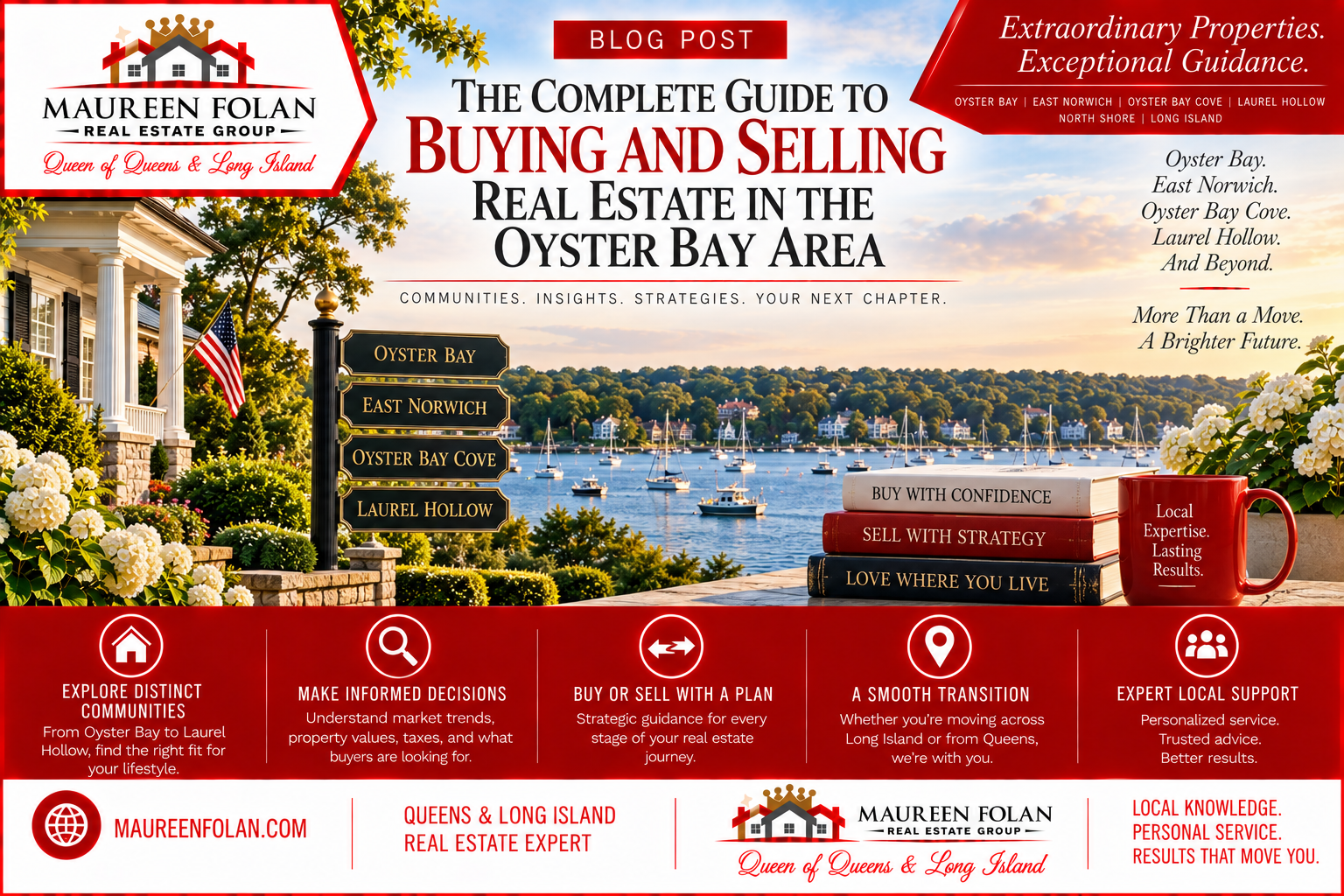
 The Complete Guide to Buying and Selling Real Estate in the Oyster Bay Area
What should you know about Oyster Bay, NY real estate before buying, selling, or relocating to the area?
The Oyster Bay area contains several distinct housing markets, from homes in Oyster Bay and East Norwich to larger luxury properties in Oyster Bay Cove and Laurel Hollow. Whether you're buying or selling, your strategy should account for the individual property's price, condition, taxes, land, architecture, maintenance, location, current competition, and total ownership costs rather than treating the entire area as one uniform market.
Understanding Oyster Bay, NY Real Estate Starts With Geography
If you're researching Oyster Bay, NY real estate, one of the first things to understand is what people mean when they say “Oyster Bay.”
The Town of Oyster Bay is a large Nassau County municipality containing numerous incorporated villages and unincorporated communities. Oyster Bay itself is also the name of a specific hamlet within the town. Town of Oyster Bay
Then there are nearby communities such as:
- East Norwich
- Oyster Bay Cove
- Laurel Hollow
These markets are geographically connected, but they shouldn't automatically be treated as interchangeable.
The homes, lot sizes, price points, architecture, taxes, condition, and ownership responsibilities can vary substantially.
That's why your search or selling strategy needs to begin at the property level.
Oyster Bay: Start With the Home and Your Everyday Routine
If you're buying in Oyster Bay itself, begin by defining what you need from the property.
How much interior space?
What type of lot?
How much maintenance are you comfortable taking on?
Do you prefer move-in-ready condition or renovation potential?
What transportation routine will you have?
Which nearby amenities do you realistically expect to use?
This is more useful than trying to decide whether Oyster Bay is broadly “right” for you.
You're not purchasing a community description.
You're purchasing a specific home and the routine surrounding it.
East Norwich Can Create a Different Housing Equation
East Norwich may naturally appear in the same home search.
A buyer comparing Oyster Bay and East Norwich should look at what the same budget actually produces in each market.
Perhaps one property is more extensively renovated.
Another may provide a different lot.
One could offer a more functional layout.
Another might have architectural characteristics you prefer.
Don't force yourself to choose the community first.
Let actual inventory reveal the tradeoffs.
Oyster Bay Cove Moves the Search Further Into Luxury Real Estate
Oyster Bay Cove can introduce a substantially different property type.
Buyers may encounter homes where acreage, privacy, architecture, mature landscaping, outdoor amenities, and estate-like settings become much more important parts of the purchase.
Oyster Bay Cove is an incorporated village within the Town of Oyster Bay and maintains its own municipal government. Village of Oyster Bay Cove
For a luxury buyer, that means simple comparisons based on bedroom count and square footage can become increasingly inadequate.
The land and setting may be just as important as the house.
Internal link: Why Buyers Consider Oyster Bay Cove When Looking for Privacy and Space
Laurel Hollow Gives Luxury Buyers Another North Shore Option
Laurel Hollow is another incorporated village within the Town of Oyster Bay and can naturally enter the same luxury-property search. Village of Laurel Hollow
Again, don't assume similar price points create similar properties.
Compare:
Architecture.
Usable acreage.
Privacy.
Condition.
Renovations.
Landscaping.
Outdoor amenities.
Taxes.
Maintenance.
Location.
Total ownership cost.
A property in Oyster Bay Cove may win one category.
A Laurel Hollow home may be stronger in another.
The correct answer depends on what you value.
Oyster Bay Cove vs. Laurel Hollow: What Luxury Buyers Should Compare
What Should Oyster Bay Area Buyers Focus On First?
Before you begin serious showings, establish a framework.
Know your:
Comfortable purchase range.
Total housing budget.
Property requirements.
Condition tolerance.
Renovation tolerance.
Transportation needs.
Maintenance tolerance.
Desired cash reserves.
Walk-away point.
This preparation becomes especially valuable when an attractive property receives significant interest.
You don't want to invent your financial strategy while emotionally invested in a particular house.
Purchase Price Is Only the Beginning
A home can fit within your purchase budget and still create an ownership budget you don't want.
For every serious property, think in terms of:
Purchase price + financing + property-specific taxes + insurance + utilities + landscaping + maintenance + expected repairs and improvements.
The importance of individual categories will vary.
A larger Oyster Bay Cove estate may require significant landscaping.
An older East Norwich home may have different future capital needs.
Another property may require substantial renovation.
Affordability is about ownership—not simply acquisition.
Property Taxes Deserve Early Attention
This is particularly important when comparing homes throughout Nassau County.
Don't rely on a generic statement about “Oyster Bay taxes.”
Verify the property-specific information.
Nassau County maintains official assessment resources that can help buyers investigate individual properties. Nassau County Department of Assessment
The Town of Oyster Bay also provides municipal information and resources for property owners. Town of Oyster Bay
Remember that current tax information may reflect circumstances or exemptions associated with the existing owner.
Your attorney and other appropriate professionals can help you understand information relevant to your specific transaction.
How Property Taxes Affect Homebuyers on Long Island's North Shore
Don't Compare Asking Prices Without Comparing Taxes
Suppose two homes are offered at exactly the same price.
That doesn't mean they're equally affordable.
Property-specific taxes may differ.
So may insurance.
Maintenance.
Utilities.
Renovation needs.
Landscaping.
The stronger comparison asks:
What will each property cost me to own—and what am I receiving for that cost?
That can materially change which home represents the better fit.
Condition Can Be More Important Than Age
The Oyster Bay area contains properties from different architectural periods.
Don't automatically assume newer is better.
A well-maintained older home may be an excellent property.
A newly decorated home can still contain older major components.
And a dated-looking house may have received significant maintenance over time.
Separate:
Age.
Appearance.
Condition.
If you decide to pursue a home, appropriate professional inspections and due diligence can help you understand what you're purchasing.
Move-In-Ready vs. Renovation Opportunity
This is one of the most important decisions buyers can make before shopping.
A move-in-ready home can provide predictability.
You may be able to settle in without immediately managing contractors or major projects.
A less updated property may offer another opportunity.
Perhaps you obtain a better lot, more architectural character, or another difficult-to-replicate feature and improve the interior gradually.
Neither strategy is inherently superior.
The question is whether your finances, schedule, and tolerance for construction support the choice.
Don't Underestimate Renovation
“We'll just redo the kitchen.”
That sentence can represent a very different project depending on the property.
Before making a purchase dependent on substantial renovation, investigate realistic costs and timing with appropriate professionals.
Consider whether the work may require permits or approvals.
Think about where you'll live during the project if necessary.
And maintain enough financial flexibility for scope changes.
Potential can create value.
But potential requires execution.
Buyers Should Pay Close Attention to Land
The lot becomes increasingly important as you move into larger North Shore properties.
Don't evaluate it only by acreage.
Ask:
How much is usable?
What is the topography?
How does the home sit on the land?
What creates privacy?
How much landscaping is involved?
Are there outdoor amenities?
How does the property drain?
How much exterior maintenance will ownership require?
More land is valuable when it supports something you actually want.
Privacy Is a Feature With a Cost
Privacy can be created by:
Acreage.
Setback.
Topography.
Mature landscaping.
Lot orientation.
A combination of these factors.
If privacy is important to you, identify what creates it.
Then consider what maintaining it involves.
Mature landscaping may require substantial care.
A long driveway requires maintenance.
A larger property may need more exterior attention.
The benefit and responsibility belong to the same asset.
Architecture Can Be Worth Paying For
Luxury buyers in Oyster Bay Cove or Laurel Hollow may encounter homes with distinctive architectural characteristics.
Don't evaluate them only through the lens of current design trends.
Consider:
Proportion.
Materials.
Craftsmanship.
Natural light.
Room relationships.
How the home sits on the property.
How renovations or additions relate to the original architecture.
A distinctive home can be difficult to reproduce.
That scarcity can matter.
What Should Sellers Understand About Today's Buyers?
If you're selling anywhere in the Oyster Bay area, remember that buyers compare price and condition together.
They don't necessarily expect every property to be completely renovated.
They do expect the asking price to make sense relative to the work required.
That creates an important seller lesson:
You don't have to solve every cosmetic issue.
You do need a strategy for how condition affects pricing and positioning.
What Sellers Should Know About Buyer Expectations in East Norwich
Sellers Should Start With Market Position, Not Renovation
Before spending heavily on pre-listing work, understand where your property may fit in its current condition.
Then divide potential projects into:
Repair: What is damaged or visibly needs attention?
Refresh: What modest work could strengthen presentation?
Renovate: Which major projects, if any, have a strong enough market rationale to justify their cost and delay?
This approach can prevent you from spending tens or hundreds of thousands of dollars solving problems the eventual buyer might have preferred to address differently.
How to Prepare a Luxury North Shore Home for the Market Without Over-Renovating
Luxury Sellers Need to Identify Scarcity
If you're selling an Oyster Bay Cove or Laurel Hollow property, ask:
What is difficult to reproduce about my home?
Acreage?
Privacy?
Architecture?
Mature landscaping?
A pool?
A distinctive setting?
Renovation quality?
A particular combination of features?
Those characteristics should help drive your marketing.
Luxury buyers may have broad geographic flexibility.
You need to give them a reason to choose your property over another exceptional option.
Pricing Determines Your Competition
An asking price doesn't simply communicate what you want.
It determines which homes buyers compare with yours.
If you price substantially above the property's likely competitive range, you may move it into a category where buyers expect more acreage, stronger renovation, different architecture, or additional amenities.
That can weaken your position.
Luxury pricing should be about strategic placement within the buyer's alternatives.
Selling a Home in Oyster Bay Cove, NY: How to Position a Luxury Property for Today's Market
Sellers Shouldn't Price From Renovation Receipts
You've invested in the home.
That may matter significantly.
But the market doesn't automatically reimburse improvements dollar for dollar.
Buyers evaluate the finished property against alternatives.
A renovation can add substantial value.
It can add less than it cost.
Or it can improve marketability without producing an equivalent price increase.
Cost and value are related.
They aren't identical.
Professional Presentation Matters
Your home's first showing may happen online.
Photography should help buyers understand:
Exterior architecture.
Important rooms.
Natural light.
Layout.
Land.
Outdoor spaces.
Distinctive property features.
For larger or luxury homes, video may help communicate scale and flow.
Where appropriate and legally permitted, aerial imagery can help explain acreage, property configuration, or setting.
The objective isn't to make the property look like something it isn't.
It's to make sure buyers understand why it deserves consideration.
Landscaping Is Part of the Product
This is particularly important for larger properties.
If land and privacy are major components of your home's value, landscaping can't be treated as background decoration.
Mature trees.
Hedges.
Gardens.
Lawns.
Outdoor entertaining areas.
Pools.
Paths.
The approach to the home.
All may contribute to the buyer experience.
Prepare them as deliberately as you prepare the interior.
Selling and Buying at the Same Time Requires Coordination
Many sellers are also buyers.
If you're selling in Queens and purchasing in Oyster Bay—or selling one Long Island property and buying another—the transactions may be financially connected.
Establish the sequence early.
Do you need to sell first?
Can you purchase first?
How much equity do you expect to use?
How much overlap can you comfortably manage?
What happens if one transaction moves faster than the other?
Planning these scenarios in advance can reduce pressure later.
Moving From Queens to Oyster Bay
For Queens homeowners, the Oyster Bay area can offer a very different property experience.
Depending on what you purchase, you may take on:
More interior space.
More land.
Different exterior maintenance.
Different property-specific taxes.
A new transportation routine.
Different insurance considerations.
A different relationship with outdoor space.
Before moving, define what you're trying to gain.
Then make sure the home you're purchasing actually delivers it.
Moving From Queens to Oyster Bay, NY: What Homeowners Should Know Before Making the Move
Transportation Needs to Be Tested From the Actual Home
If you need regular access to Queens, Manhattan, or elsewhere on Long Island, don't rely on a generic commute description.
The Long Island Rail Road's Oyster Bay Branch serves the area, but schedules and service should be verified through the Long Island Rail Road.
Then test the complete trip.
How do you reach the station?
How long does that take?
Which train fits your schedule?
Does your trip involve a transfer?
What happens at the other end?
If you're driving, test that route at a realistic time too.
Your commute begins at your driveway.
Spend Time in the Area Without Looking at Houses
This is one of the most useful things a buyer can do.
Stop shopping temporarily.
Drive around.
Visit the places you expect to use.
Run an ordinary errand.
Test your commute.
Experience the area at another time of day.
The purpose isn't to decide whether the community is attractive.
It's to understand whether your routine works there.
Buyers Should Compare Actual Properties Across Communities
If your search includes Oyster Bay, East Norwich, Oyster Bay Cove, and Laurel Hollow, don't choose the town first.
Choose your priorities.
Then compare the homes.
A useful framework includes:
| Factor | Property A | Property B |
|---|---|---|
| Purchase price | Compare | Compare |
| Property-specific taxes | Compare | Compare |
| Condition | Compare | Compare |
| Architecture | Compare | Compare |
| Usable land | Compare | Compare |
| Privacy | Compare | Compare |
| Outdoor amenities | Compare | Compare |
| Renovation needs | Compare | Compare |
| Transportation | Compare | Compare |
| Maintenance | Compare | Compare |
| Total ownership cost | Compare | Compare |
Then assign weight based on what matters to you.
Not every factor deserves equal importance.
Don't Use Rankings to Make a Real Estate Decision
Community rankings can oversimplify a highly personal decision.
Avoid choosing based on generalized claims about who lives in a particular place or who should move there.
Focus instead on objective factors:
Housing options.
Price.
Taxes.
Condition.
Land.
Architecture.
Maintenance.
Transportation.
Amenities you personally use.
Your long-term ownership goals.
That framework helps you make a property decision without relying on stereotypes or steering.
Five Questions Buyers Should Answer Before Making an Offer
Before pursuing an Oyster Bay-area property, ask:
- Does this home accomplish the things motivating my move?
- Can I comfortably afford the complete ownership cost?
- Am I realistic about the condition and improvements required?
- Does the location work for my actual transportation and routine?
- Would I still want this property if I weren't afraid of losing it?
That final question can be especially valuable when competition creates urgency.
Five Questions Sellers Should Answer Before Listing
If you're preparing to sell, ask:
- Which homes will buyers realistically compare with mine?
- What is genuinely difficult to reproduce about my property?
- Which repairs or improvements are actually worthwhile?
- Does my asking-price strategy fit the condition and competition?
- What does this sale need to accomplish for my next move?
Those answers create the foundation of your selling plan.
Final Takeaway: Oyster Bay, NY Real Estate
Oyster Bay, NY real estate isn't one uniform market.
Oyster Bay and East Norwich can provide one set of housing options, while Oyster Bay Cove and Laurel Hollow can introduce larger luxury properties where acreage, privacy, architecture, mature landscaping, and outdoor amenities become increasingly important.
If you're buying, evaluate the individual property's price, taxes, condition, land, architecture, maintenance, transportation, renovation needs, and total ownership costs.
If you're selling, focus on competitive positioning, preparation, pricing, presentation, and the characteristics that make your property difficult to reproduce.
And if you're moving from Queens, connect your current-home sale with your Long Island purchase through one coordinated plan.
As Maureen Folan, Queens & Long Island Real Estate Expert, I help buyers and sellers navigate those differences at the level where real estate decisions actually happen:
One property at a time.
Because the goal isn't simply to buy or sell in Oyster Bay.
It's to make sure the property, price, strategy, and next move all work together. 
Ready to Make Your Oyster Bay Area Move?
If you're selling, Get a Personalized Home Value Estimate based on your property's condition, land, architecture, improvements, relevant sales, and current competition.
If you're buying, Schedule a Buyer Consultation to compare Oyster Bay, East Norwich, Oyster Bay Cove, Laurel Hollow, and other Long Island opportunities based on your priorities and complete ownership budget.
And if you're relocating from Queens, Talk With a Queens & Long Island Real Estate Expert about coordinating your current-home sale with your next purchase.
You can also request the Property Tax Guide or Home Seller Preparation Checklist depending on where you are in the process.
Maureen Folan
Queens & Long Island Real Estate Expert
Maureen Folan Real Estate Group
MaureenFolan.com

